
What Is a Complex Fraction?
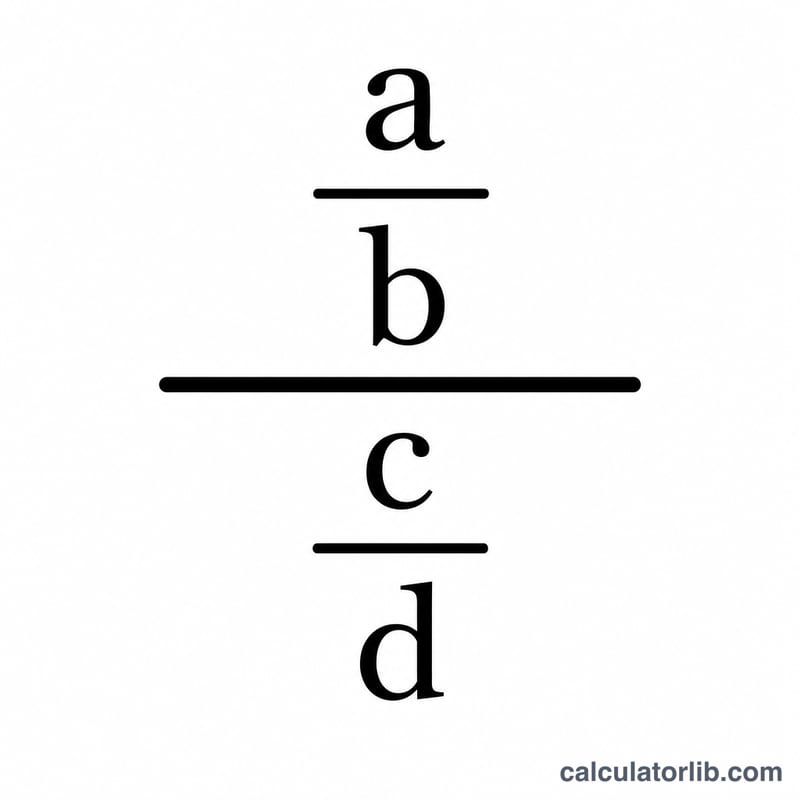
A complex fraction is a fraction whose numerator, denominator, or both are themselves fractions — for example \((a/b) / (c/d)\). Although they look intimidating, complex fractions simplify with one simple rule: dividing by a fraction is the same as multiplying by its reciprocal. This calculator does that for you and reduces the answer to lowest terms.
How to Use This Calculator
Enter the four whole-number parts of your complex fraction. The numerator of the whole expression is the fraction \(a/b\) and the denominator is the fraction \(c/d\). Press calculate to see the simplified fraction and its decimal equivalent. The tool also shows the unreduced product so you can follow the work.
The Formula Explained
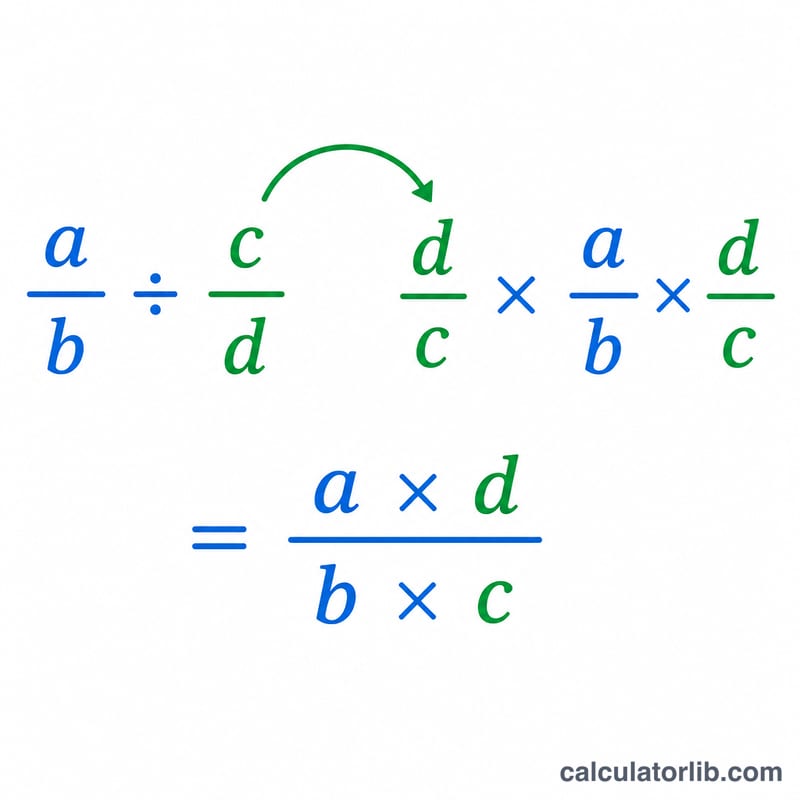
To divide \(a/b\) by \(c/d\), flip the bottom fraction and multiply:
The result \(ad/bc\) is then reduced by dividing the top and bottom by their greatest common divisor (GCD):
If the denominator comes out negative, the sign is moved to the numerator so the answer stays in standard form.
Worked Example
Simplify \((2/3) / (4/5)\). Multiply across by the reciprocal:
The GCD of 10 and 12 is 2, so dividing gives \(5/6\), which equals about \(0.8333\). That is exactly what this calculator returns.
FAQ
Can I use negative numbers? Yes — enter a negative sign on any part and the result is normalized so the denominator is positive.
What if a part is zero? If \(a\), the result is 0. If \(c\) or \(d\) makes the bottom fraction zero, division is undefined and the calculator returns 0 as a safeguard.
Does it accept decimals? Inputs are treated as whole numbers (rounded), since complex fractions are defined with integer parts. Convert any decimals to fractions first for an exact result.