
What is the Solve for Exponents Calculator?
This tool finds the unknown exponent x in an equation of the form \(a^x = b\), where a is the base and b is the result. Instead of guessing, it uses logarithms to give an exact answer in one step. It works for whole-number and fractional exponents alike.
How to use it
Enter the base (a) — the number being raised to a power — and the result (b) — the value the expression equals. Press calculate and the tool returns x, the exponent that satisfies the equation. The base must be positive and not equal to 1, and the result must be positive, since logarithms are undefined otherwise.
The formula explained
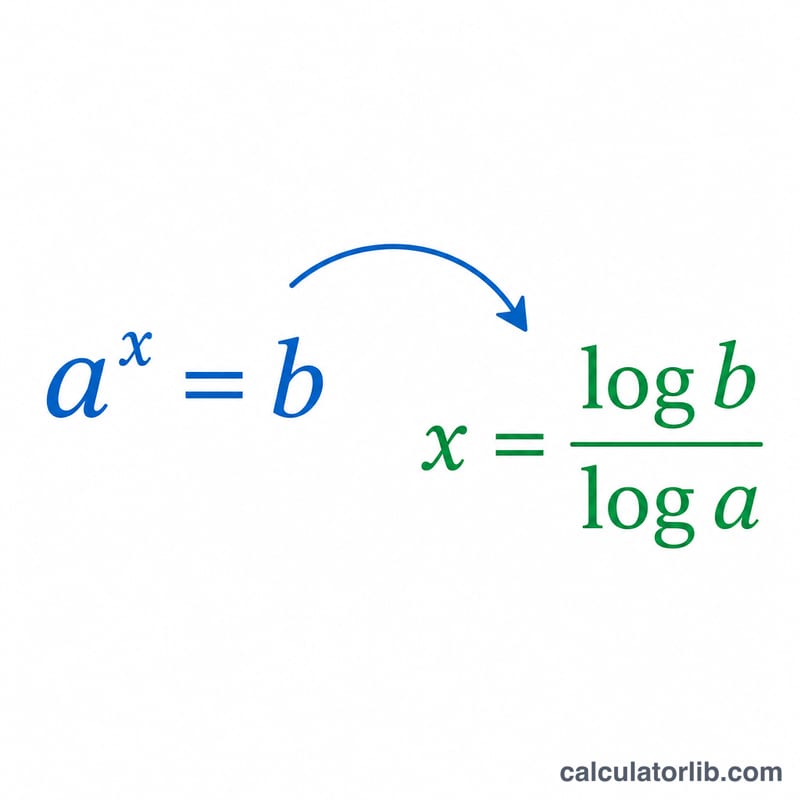
Starting from \(a^x = b\), take the logarithm of both sides: \(\log(a^x) = \log(b)\). The power rule of logarithms lets us pull the exponent out front: \(x \cdot \log(a) = \log(b)\). Dividing both sides by \(\log(a)\) gives the formula
$$x = \frac{\log(b)}{\log(a)}$$Any logarithm base works (natural log or log base 10) as long as you use the same base for numerator and denominator.
Worked example
Suppose \(2^x = 8\). Then
$$x = \frac{\log(8)}{\log(2)} = \frac{0.90309}{0.30103} = 3$$Indeed, \(2^3 = 8\). For a fractional case, \(9^x = 3\) gives
$$x = \frac{\log(3)}{\log(9)} = 0.5,$$since \(9^{0.5} = \sqrt{9} = 3\).
FAQ
Can the exponent be negative or a fraction? Yes. If b is between 0 and 1 (with \(a > 1\)) the exponent is negative; non-integer results are perfectly valid.
Why can't the base be 1? Because 1 raised to any power is always 1, so \(\log(1) = 0\) and the division is undefined.
Does the choice of log base matter? No — natural log, log base 10, or any base gives the same x, because the bases cancel in the ratio.