
What this calculator does
This exponents calculator raises a base x to a power n, written \(x^n\). It handles positive and negative bases, integer and decimal exponents, negative exponents (reciprocals), and the zero exponent. For small whole-number inputs it also shows a step-by-step multiplication expansion so you can see exactly how the answer is built.
How to use it
Enter the base in the x = field and the power in the n = field, then read the answer. Both can be positive or negative, whole numbers or decimals. A negative base such as -4 is treated literally as (-4)n — the whole value, sign included, is raised to the power.
The formula explained
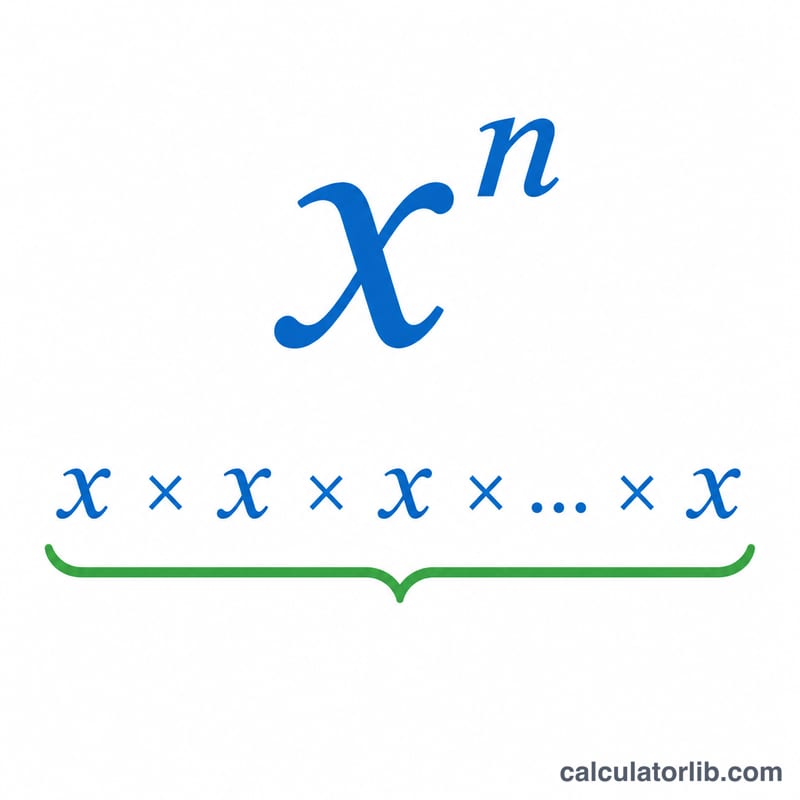
The core definition is
$$x^n = \underbrace{x \times x \times \cdots \times x}_{n\ \text{times}}$$with n factors. A few standard rules follow from this:
- Zero exponent: \(x^0 = 1\) for any x (this tool adopts the convention \(0^0 = 1\)).
- Negative exponent: \(x^{-n} = 1 / x^n\), which needs \(x \neq 0\).
- Negative base, even power: positive result; odd power: negative result.
- Decimal exponent: \(x^n = e^{n \cdot \ln(x)}\), valid only for \(x > 0\); a negative base with a non-integer power has no real value.
Worked example
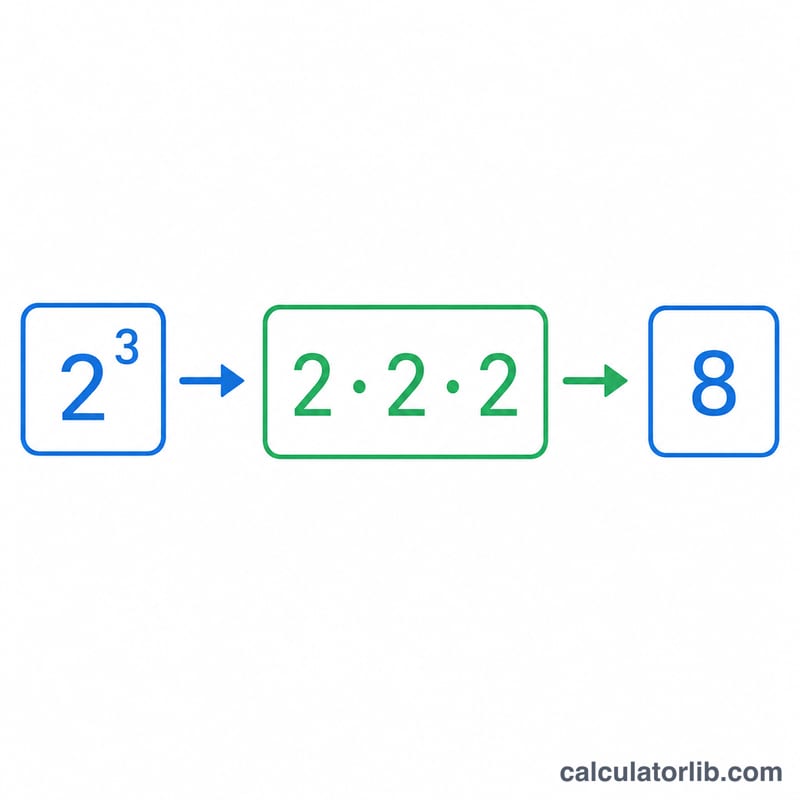
Take \(x = 3\) and \(n = 4\). Then
$$3^4 = 3 \cdot 3 \cdot 3 \cdot 3 = 81.$$For a negative exponent,
$$3^{-4} = \frac{1}{3^4} = \frac{1}{81} \approx 0.012346.$$For a negative base,
$$(-4)^2 = (-4) \cdot (-4) = 16,$$while \((-3)^3 = -27\).
FAQ
Why does \(-4^2\) sometimes equal -16? In strict math notation, \(-4^2\) means \(-(4^2) = -16\) because exponentiation binds tighter than the minus sign. This calculator instead treats an entered -4 as the full value \((-4)\), so it returns \((-4)^2 = 16\). Be mindful of that convention.
Can I use a fractional exponent? Yes. For example \(2^{0.5} = \sqrt{2} \approx 1.41421356\). But a negative base with a non-integer exponent gives a complex (non-real) result, so the calculator returns a message instead of a number.
What about very large exponents? Standard double precision overflows past roughly \(10^{308}\). Keep integer exponents under about 2000; for huge exact integer powers use a dedicated big-number tool.