
What is the Large Exponents Calculator?
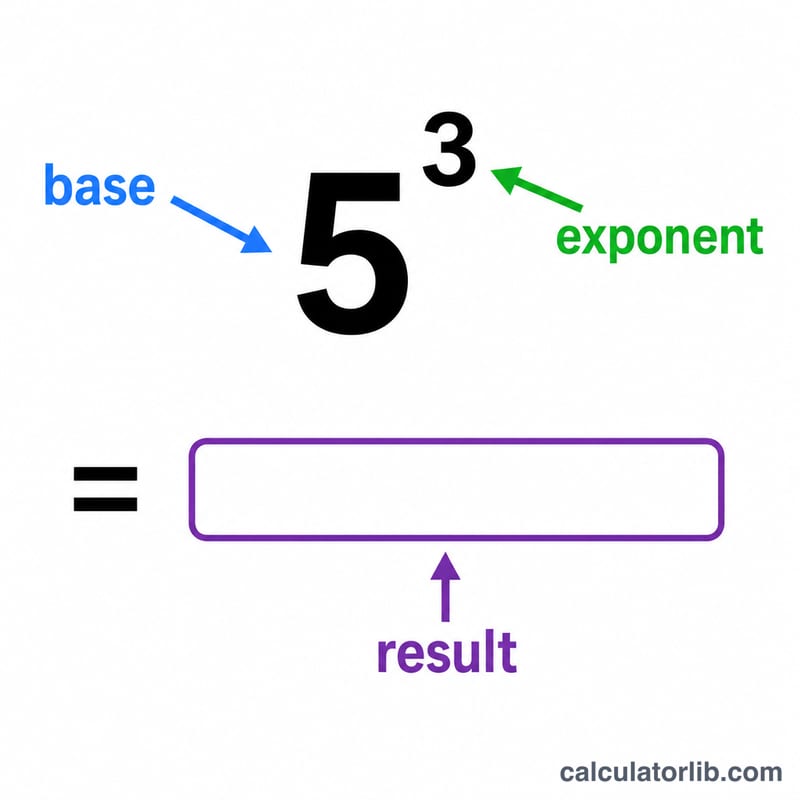
This tool computes base raised to an exponent (\(b^n\)) for any real base and exponent, including very large and negative powers. Alongside the exact value it reports the order of magnitude (the base-10 logarithm), which is the most practical way to understand huge results like \(2^{64}\) or \(10^{30}\).
How to use it
Enter a base and an exponent, then read the result. Negative exponents produce fractions (\(5^{-2} = 0.04\)), fractional exponents produce roots (\(9^{0.5} = 3\)), and an exponent of 0 always gives 1.
The formula explained
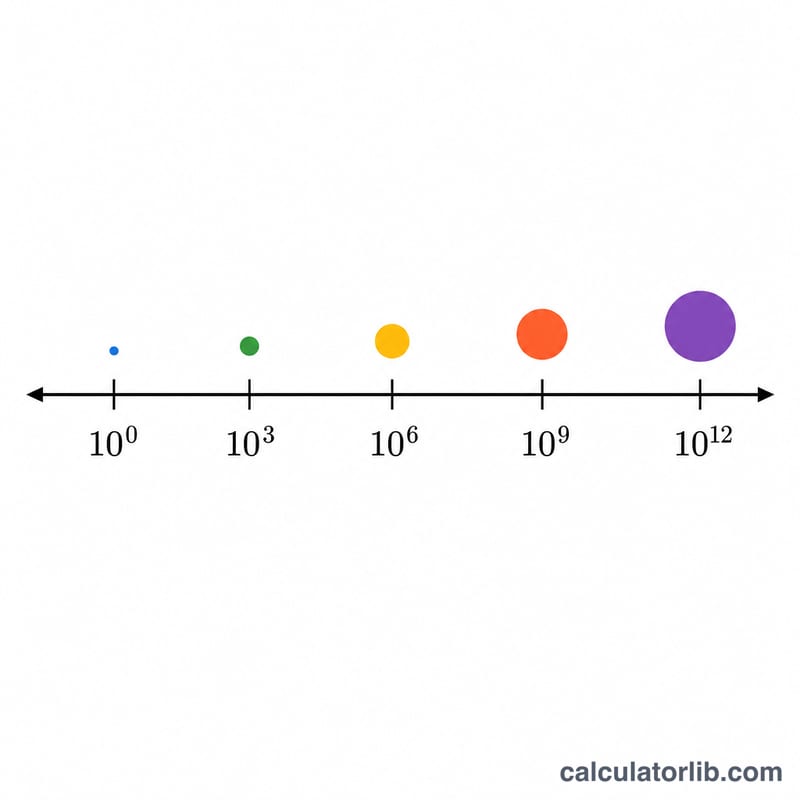
The core operation is repeated multiplication: $$y = b^n.$$ For large \(n\) the value grows extremely fast, so we also show $$\log_{10}\!\left(b^n\right) = n \cdot \log_{10}(b).$$ If this equals, say, 19.27, the answer is roughly \(10^{19.27} \approx 1.86 \times 10^{19}\). The order of magnitude is only defined for a positive base.
Worked example
For base 2 and exponent 10: $$2^{10} = 1024.$$ The order of magnitude is $$10 \cdot \log_{10}(2) = 10 \times 0.30103 = 3.0103,$$ confirming the answer is just over \(10^3\).
FAQ
What about \(0^0\)? Most calculators return 1 by convention, and so does this one.
Can the base be negative? Yes for whole-number exponents (e.g. \((-2)^3 = -8\)). For fractional exponents of a negative base the result is undefined and the order of magnitude is not shown.
Why show \(\log_{10}\)? Very large powers exceed normal display precision; the log gives you a clean order-of-magnitude estimate.