
What this calculator does
When you pour two saltwater (saline) solutions together, the salt from each combines while the masses add up. This tool computes how much salt comes from each solution, the total salt, the total mass, and the resulting concentration of the mixture. It is a classic "concentration word problem" (known in Japanese math as nodozan), but the underlying arithmetic is universal and works for any two miscible solutions whose concentration is defined as solute mass divided by total mass.
How to use it
Enter the mass of Solution A in grams and its concentration as a percentage, then do the same for Solution B. The calculator returns the salt in each solution, the combined salt, the combined mass, and the final concentration. All masses are in grams and all concentrations are percentages by mass — there are no unit dropdowns.
The formula explained
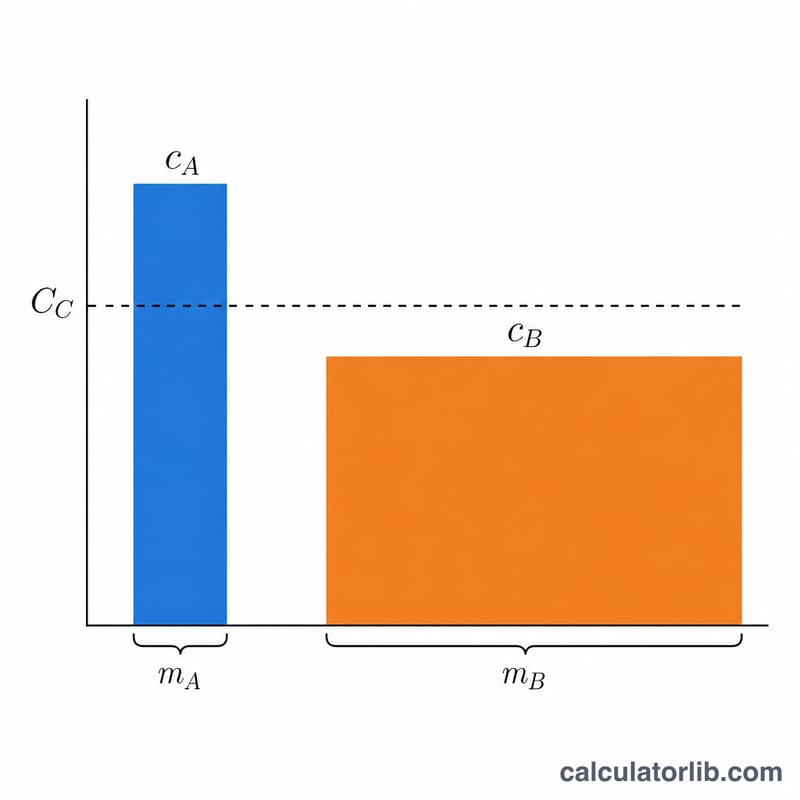
The salt in a solution is its mass multiplied by its concentration written as a fraction: \(\text{salt} = \text{mass} \times (\text{percent} \div 100)\). Add the salt from both solutions and divide by the combined mass, then multiply by 100 to get back to a percentage. Algebraically this is a mass-weighted average of the two concentrations, so the result always lies between the smaller and larger input concentration.
$$C_{C} = \frac{\text{Mass A} \cdot \frac{\text{Conc. A}}{100} + \text{Mass B} \cdot \frac{\text{Conc. B}}{100}}{\text{Mass A} + \text{Mass B}} \times 100$$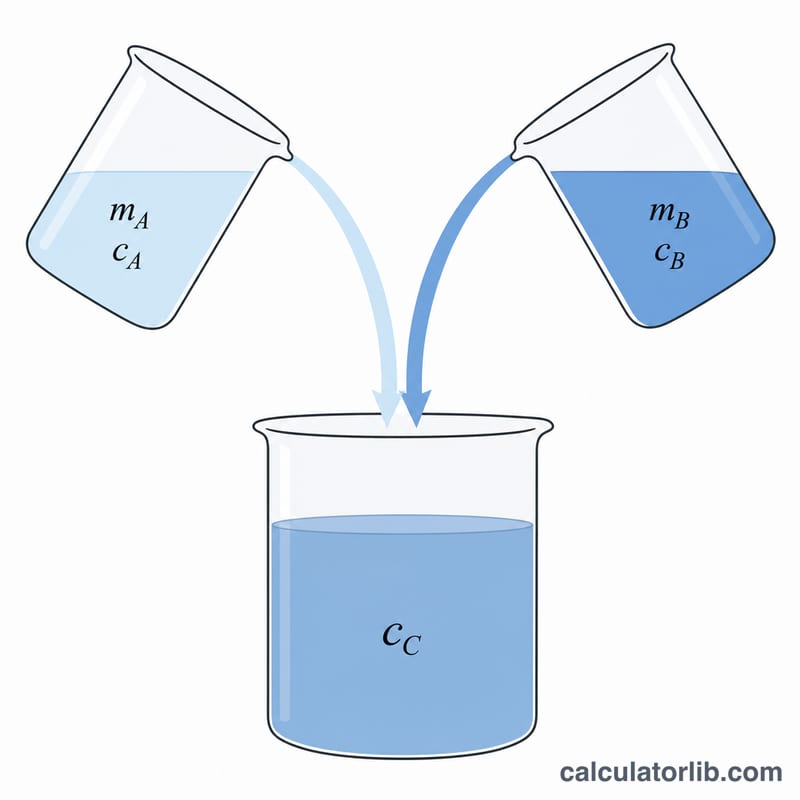
Worked example
Mix 300 g of 12% saline with 200 g of 20% saline. Salt in A = \(300 \times 0.12 = 36\) g. Salt in B = \(200 \times 0.20 = 40\) g. Total salt = 76 g and total mass = 500 g. Concentration $$C = 76 \div 500 \times 100 = 15.2\%$$ The mixture is 500 g of 15.2% saline containing 76 g of salt.
FAQ
Why is the result always between the two concentrations? Because it is a weighted average — mixing can never produce a concentration outside the range of its ingredients.
Can I use this for alcohol or other liquids? The math applies to any mass-fraction concentration. For alcohol by volume you would need to account for differing densities (ethanol is about 0.8 g/mL), which this simple mass-based model does not.
What if both masses are zero? The concentration is undefined, so the calculator returns zero rather than dividing by zero.