
What Is the Future Value of Cash Flows?
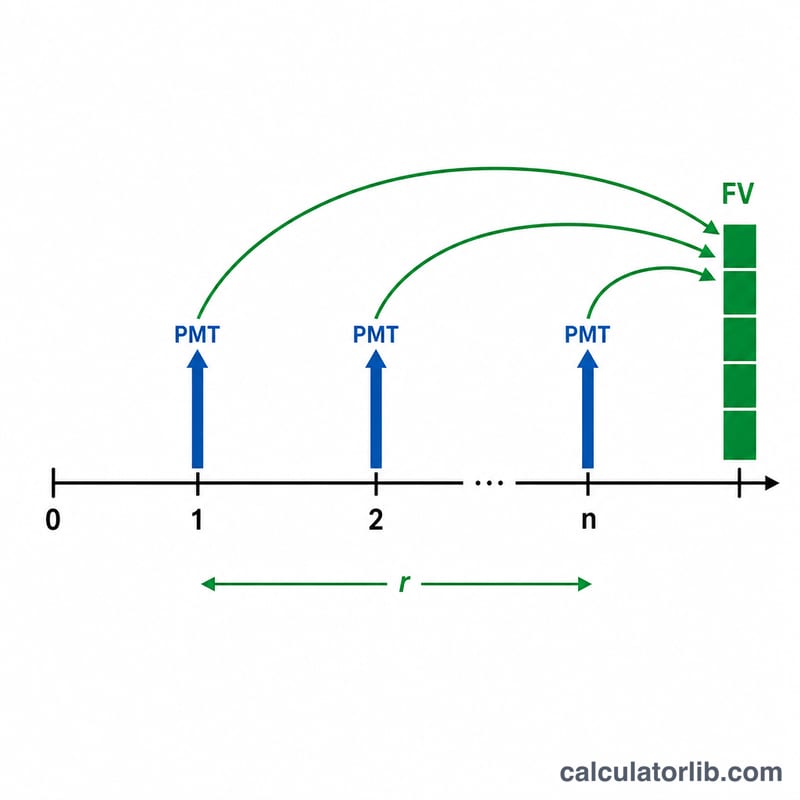
The future value of cash flows tells you how much a stream of equal, regularly spaced payments will be worth at a chosen point in the future, once compound interest has been applied. This is the classic ordinary annuity calculation, used for savings plans, retirement contributions, sinking funds, and recurring investments where each payment is assumed to occur at the end of every period.
How to Use This Calculator
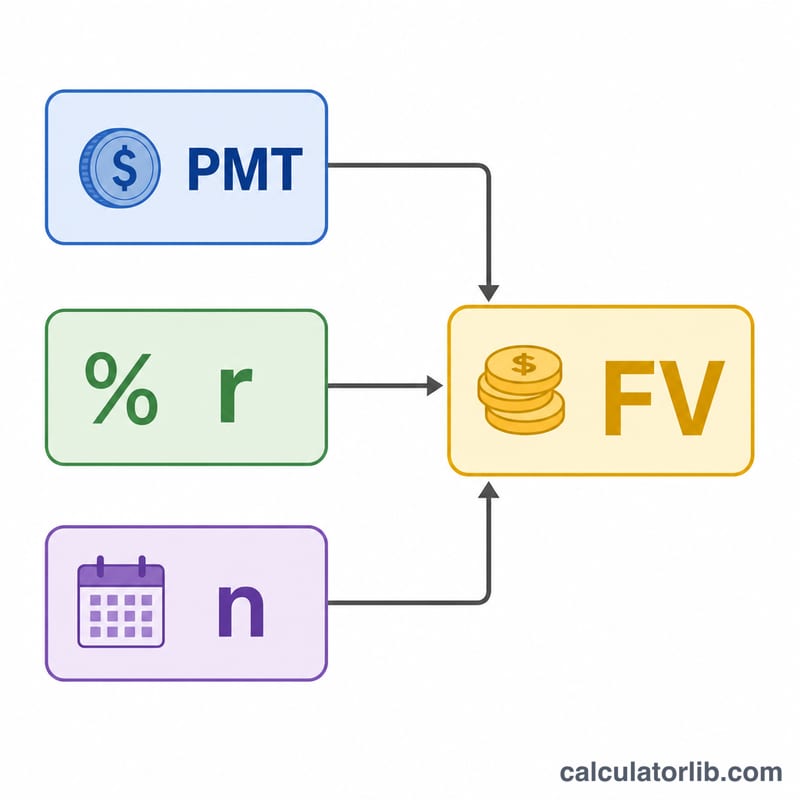
Enter three values: the payment made each period (PMT), the interest rate earned per period as a percentage, and the total number of periods (n). The calculator returns the accumulated future value, plus a breakdown showing how much you contributed versus how much was earned as interest. Make sure your rate and period match the same frequency — if you pay monthly, use a monthly rate and count months.
The Formula Explained
The future value of an ordinary annuity is $$FV = \text{PMT} \cdot \frac{\left(1 + r\right)^{\text{n}} - 1}{r}$$ where \(r\) is the periodic rate written as a decimal (\(5\% = 0.05\)). Each payment compounds for a different length of time; summing this geometric series gives the compact closed form above. When the rate is zero, the formula simplifies to \(FV = \text{PMT} \times n\), which this tool handles automatically.
Worked Example
Suppose you invest $1,000 at the end of each year for 10 years and earn 5% annually. Then \(r = 0.05\) and \(n = 10\). $$FV = 1000 \times \frac{1.05^{10} - 1}{0.05} = 1000 \times \frac{1.628895 - 1}{0.05} = 1000 \times 12.5779 \approx 12{,}577.89$$ You contributed $10,000, so about $2,577.89 came from interest.
FAQ
Does this assume payments at the start or end of each period? The end (an ordinary annuity). For payments at the start (annuity due), multiply the result by \((1 + r)\).
What if my interest rate is 0%? The future value is simply the payment multiplied by the number of periods, since no interest accrues.
Can I use monthly contributions? Yes — convert your annual rate to a monthly rate (divide by 12) and use the number of months as n.