
What This Calculator Does
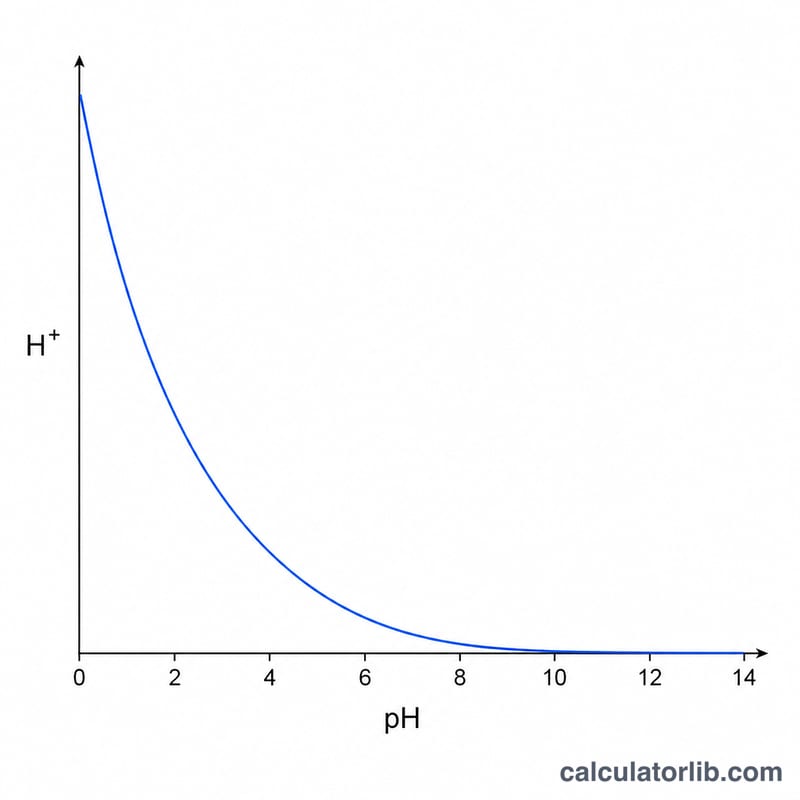
This tool converts a pH value into its corresponding hydrogen ion concentration, written as [H+], measured in moles per liter (mol/L). pH is a logarithmic measure of acidity, so even a single-unit change in pH represents a tenfold change in [H+]. The calculator also returns pOH and the hydroxide concentration [OH−] using the standard relationship at 25 degrees C.
How to Use It
Enter any pH value, typically between 0 and 14 (though strongly acidic or basic solutions can fall slightly outside this range). Press calculate to instantly see the hydrogen ion concentration in mol/L, along with the pOH and [OH−]. No units need to be entered for pH because it is a dimensionless quantity.
The Formula Explained
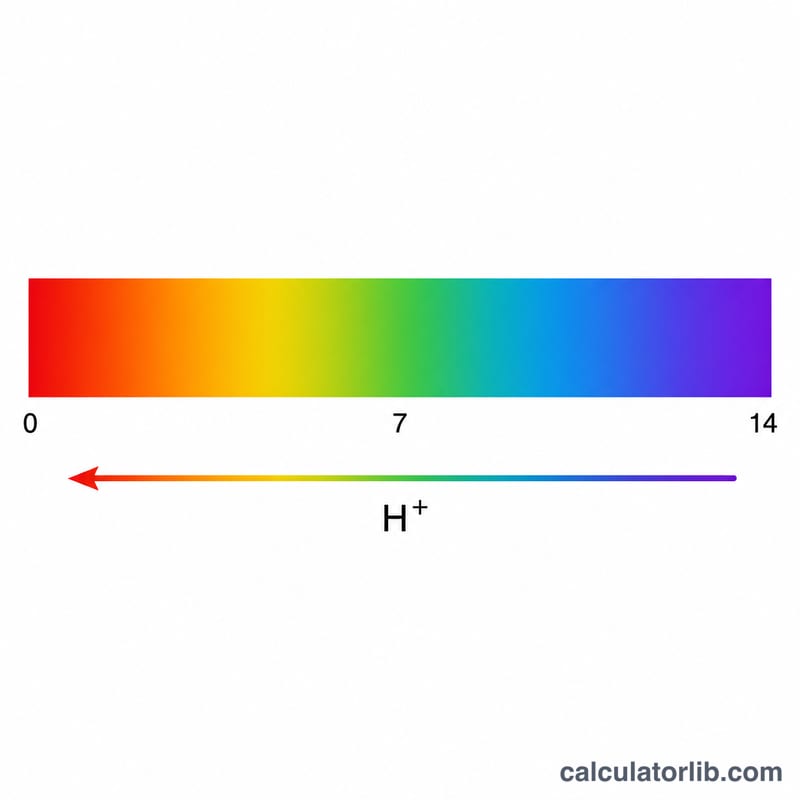
The defining equation is $$[\text{H}^{+}] = 10^{-\text{pH}}$$ Because \(\text{pH} = -\log_{10}[\text{H}^{+}]\), taking the inverse logarithm recovers the concentration. Likewise, \([\text{OH}^{-}] = 10^{-\text{pOH}}\), where \(\text{pOH} = 14 - \text{pH}\) at 25 degrees C. A lower pH means a higher [H+] and a more acidic solution; a higher pH means a lower [H+] and a more basic solution.
Worked Example
Suppose a solution has a pH of 3. Then $$[\text{H}^{+}] = 10^{-3} = 0.001 \text{ mol/L}$$ The \(\text{pOH} = 14 - 3 = 11\), so \([\text{OH}^{-}] = 10^{-11} = 0.00000000001 \text{ mol/L}\). This confirms the solution is acidic, since [H+] greatly exceeds [OH−].
FAQ
What is a neutral pH? At 25 degrees C, pure water has pH 7, giving \([\text{H}^{+}] = 10^{-7} = 0.0000001 \text{ mol/L}\), equal to [OH−].
Can pH be negative? Yes. Very concentrated strong acids can have pH below 0, which corresponds to [H+] greater than 1 mol/L.
Does temperature matter? The \(\text{pH} + \text{pOH} = 14\) rule applies at 25 degrees C. At other temperatures the neutral point and the ion-product constant of water shift slightly.