
What is the Intrinsic Carrier Concentration?
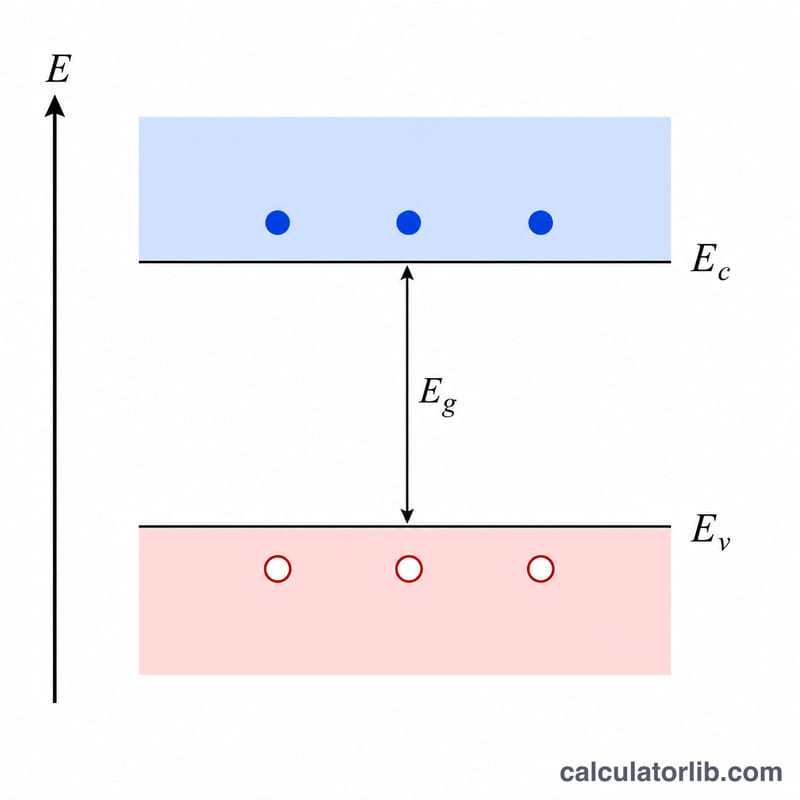
The intrinsic carrier concentration ni is the number of free electrons (equal to the number of holes) per cubic centimetre in a pure, undoped semiconductor at thermal equilibrium. It is one of the most fundamental quantities in device physics: it sets the leakage current of diodes, the dark current of detectors, and the temperature sensitivity of transistors. Wide-gap materials like silicon carbide have a tiny ni, while narrow-gap materials like germanium have a much larger one.
How to Use the Calculator
Enter the effective density of states in the conduction band (Nc) and valence band (Nv) in cm⁻³, the band gap energy Eg in electron-volts, and the absolute temperature T in kelvin. The calculator returns ni together with the geometric mean \(\sqrt{\text{N}_c \cdot \text{N}_v}\) and the exponential Boltzmann factor so you can see how each part contributes.
The Formula Explained
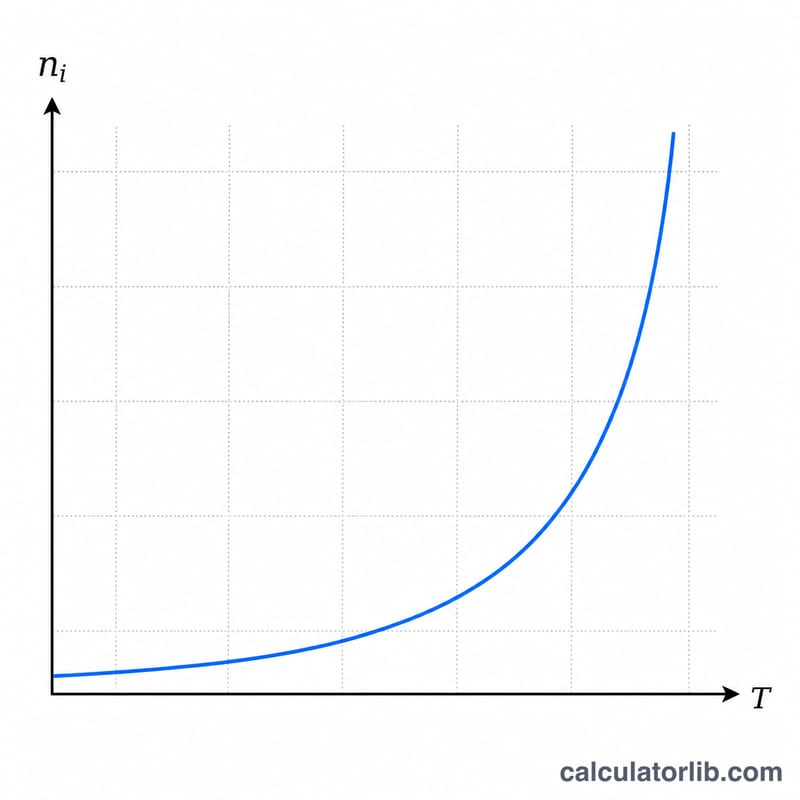
The expression is $$n_i = \sqrt{\text{N}_c \cdot \text{N}_v}\;\exp\!\left(-\frac{\text{E}_g}{2\,k\,\text{T}}\right)$$. The prefactor \(\sqrt{\text{N}_c \cdot \text{N}_v}\) reflects the available states near the band edges, while the exponential term — the Boltzmann factor — describes how thermal energy promotes electrons across the gap. Because ni depends exponentially on \(-\text{E}_g/2k\text{T}\), it rises steeply with temperature and falls sharply for wider gaps. Here \(k = 8.617333262\times10^{-5}\ \text{eV/K}\) so that Eg and kT share the same energy units.
Worked Example
For silicon at 300 K with Nc = 2.8×10¹⁹, Nv = 1.04×10¹⁹ cm⁻³ and Eg = 1.12 eV: $$\sqrt{\text{N}_c \cdot \text{N}_v} = \sqrt{2.912\times10^{38}} \approx 1.7065\times10^{19}$$ The exponent is $$-\frac{1.12}{2 \cdot 8.617333262\times10^{-5} \cdot 300} \approx -21.66,$$ giving \(\exp \approx 3.91\times10^{-10}\). Therefore \(n_i \approx 6.68\times10^{9}\ \text{cm}^{-3}\), close to the textbook value of about 10¹⁰ cm⁻³ (small differences come from the chosen effective masses).
FAQ
Why does ni use 2kT instead of kT? Because the Fermi level sits roughly mid-gap, each carrier is "half" of an electron-hole pair, so the gap energy is shared, giving the factor of 2 in the denominator.
Which units should I use? Nc and Nv in cm⁻³, Eg in eV, and T in kelvin. The result is then in cm⁻³.
Does this work for any semiconductor? Yes — it is a universal physics relation. Just supply the correct Nc, Nv and Eg for your material and temperature.