
What Is Poisson's Ratio?
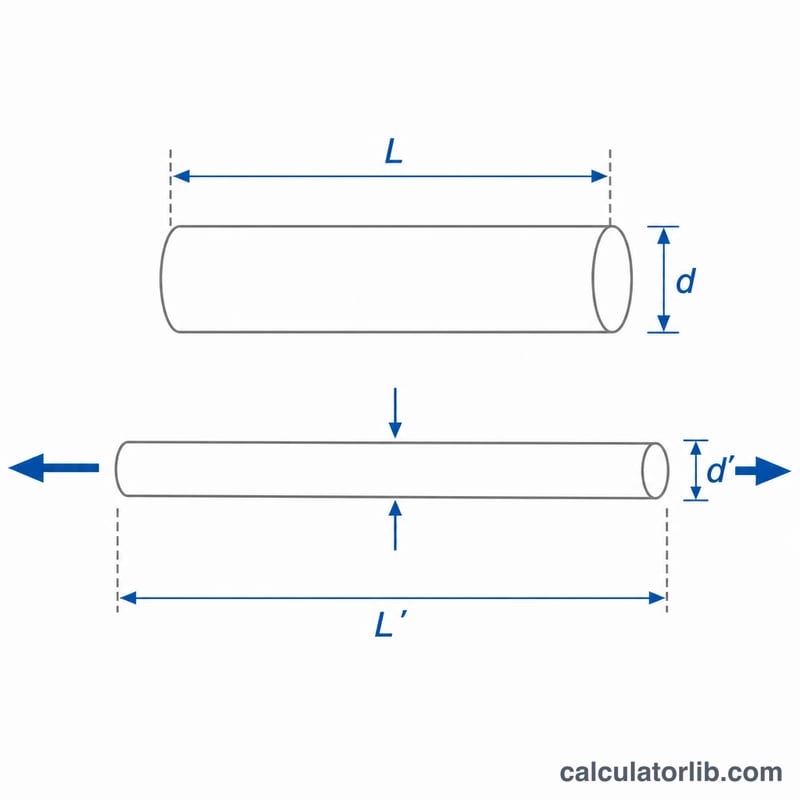
Poisson's ratio (\(\nu\), "nu") is a fundamental material property that describes how a material deforms perpendicular to the direction of an applied load. When you stretch a bar, it gets longer (axial strain) but also gets thinner (lateral strain). Poisson's ratio is the negative of the ratio between these two strains, and it is dimensionless. Most engineering metals have a value around 0.3, rubber approaches 0.5 (nearly incompressible), and cork is near 0.
How to Use This Calculator
Enter the lateral (transverse) strain and the axial (longitudinal) strain. Strain is the change in length divided by the original length in each direction. Under tension, the axial strain is positive while the lateral strain is negative, which produces a positive Poisson's ratio. The calculator instantly returns the dimensionless value.
The Formula Explained
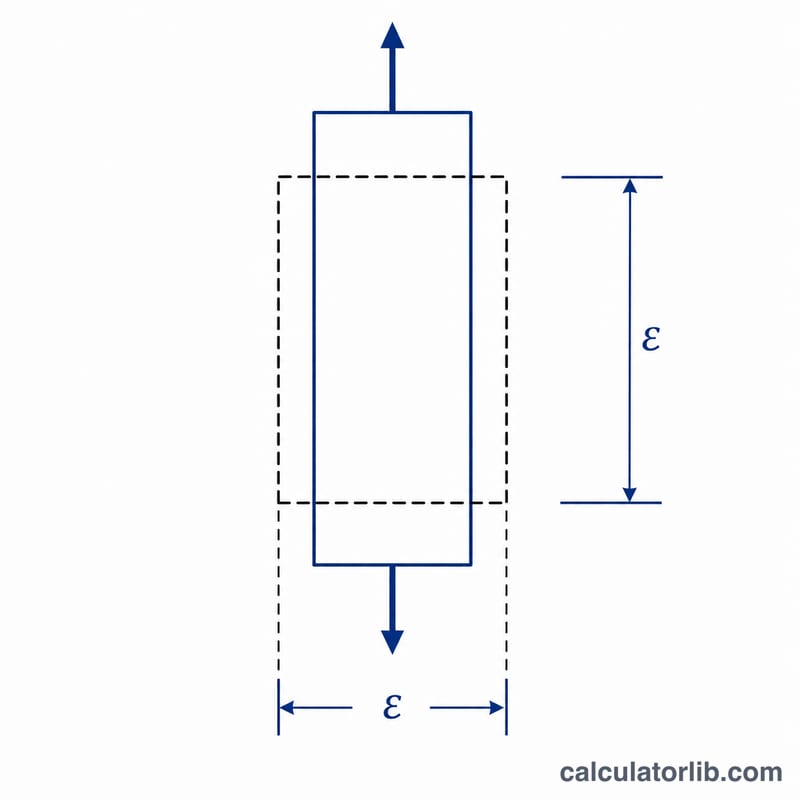
The equation is $$\nu = -\frac{\varepsilon_{\text{lateral}}}{\varepsilon_{\text{axial}}}$$ The minus sign ensures that for normal materials, where stretching causes contraction sideways, the result comes out positive. Materials with a negative Poisson's ratio (they get fatter when stretched) are called auxetic.
Worked Example
A steel rod is stretched, producing an axial strain of 0.01 and a lateral strain of −0.0025. Then $$\nu = -\frac{-0.0025}{0.01} = \frac{0.0025}{0.01} = 0.25$$ This is a typical value for many steels.
FAQ
What is the theoretical range of Poisson's ratio? For isotropic materials it ranges from −1.0 to 0.5.
Why is the result negative sometimes? If you enter strains with signs that don't match a normal tensile or compressive test, you may see a negative ratio — auxetic materials genuinely have negative values.
Can I use percentages? Yes, as long as both strains use the same units; the ratio is dimensionless so the units cancel.