What Is Margin on Selling Price?
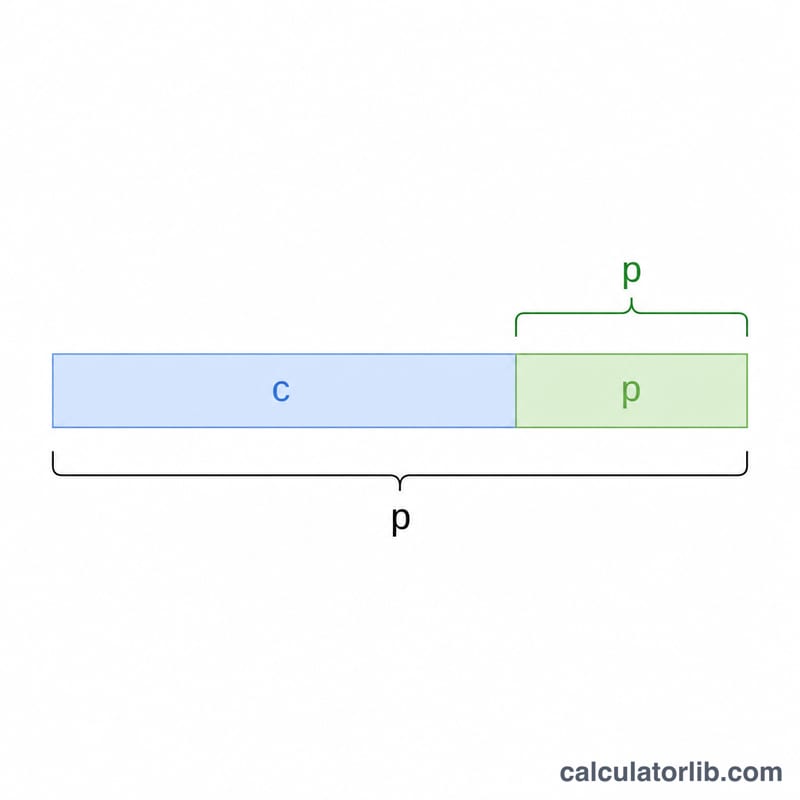
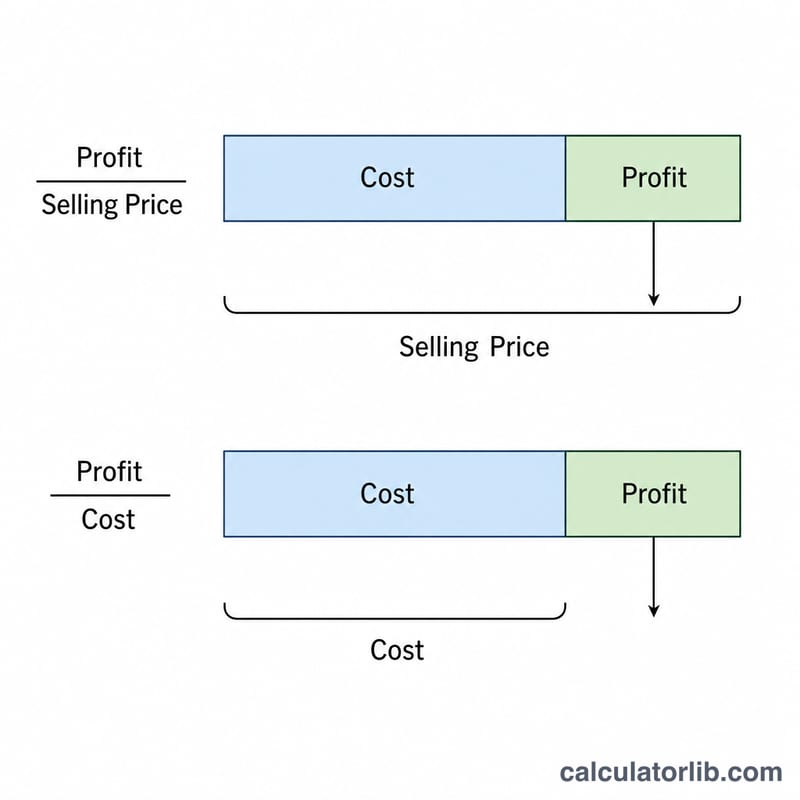
Gross margin (or margin on selling price) measures how much of each sales dollar is profit after covering the cost of the item. Unlike markup, which is calculated against cost, margin is calculated against the selling price. This makes margin the standard way retailers and finance teams express profitability, because it directly relates to revenue.
How to Use This Calculator
Enter the cost of the product (what you paid) and the selling price (what the customer pays). The calculator returns the gross margin as a percentage of the selling price, the gross profit in dollars, and the equivalent markup on cost so you can compare both views.
The Formula Explained
The core equation is:
$$\text{Margin \%} = \frac{\text{Selling Price} - \text{Cost}}{\text{Selling Price}} \times 100$$
The numerator is the gross profit per unit. Dividing by the selling price and multiplying by 100 converts it into a percentage of revenue. Because the denominator is the selling price (which is always larger than cost for a profitable item), the margin percentage is always lower than the markup percentage.
Worked Example
Suppose an item costs $60 and you sell it for $100. The gross profit is \(\$100 - \$60 = \$40\). The margin is $$\$40 / \$100 \times 100 = 40\%.$$ The markup on cost, for comparison, is \(\$40 / \$60 \times 100 \approx 66.67\%\). Same dollars of profit, two different percentages.
Margin to Markup Conversion Table
Margin is measured against the selling price, while markup is measured against cost. The same price therefore gives a smaller margin than markup. The table converts common gross margin values into the equivalent markup and the price multiplier you apply to cost.
| Gross Margin % | Equivalent Markup % | Price Multiplier (× cost) |
|---|---|---|
| 10% | 11.11% | 1.111 |
| 20% | 25.00% | 1.250 |
| 25% | 33.33% | 1.333 |
| 30% | 42.86% | 1.429 |
| 33.3% | 49.93% | 1.499 |
| 40% | 66.67% | 1.667 |
| 50% | 100.00% | 2.000 |
| 60% | 150.00% | 2.500 |
| 75% | 300.00% | 4.000 |
Formulas
Margin to markup:
$$\text{Markup \%} = \frac{\text{Margin \%}}{100 - \text{Margin \%}} \times 100$$
Markup to margin (reverse):
$$\text{Margin \%} = \frac{\text{Markup \%}}{100 + \text{Markup \%}} \times 100$$
Price multiplier, with the margin written as a decimal (for example 0.25 for 25%):
$$\text{Selling Price} = \frac{\text{Cost}}{1 - \text{Margin}}$$
Example: a 25% margin gives \(\frac{1}{1 - 0.25} = 1.333\), so an item costing $60 sells for $80.
Margin Comparison Across Scenarios
The table holds cost fixed at $50 and varies the selling price. Gross profit = selling price − cost, margin = profit ÷ selling price, and markup = profit ÷ cost.
| Cost | Selling Price | Gross Profit | Gross Margin % | Markup % |
|---|---|---|---|---|
| $50 | $55 | $5.00 | 9.09% | 10% |
| $50 | $62.50 | $12.50 | 20% | 25% |
| $50 | $75 | $25.00 | 33.33% | 50% |
| $50 | $100 | $50.00 | 50% | 100% |
| $50 | $200 | $150.00 | 75% | 300% |
Worked check for the $62.50 row: \(\frac{62.50 - 50}{62.50} \times 100 = \frac{12.50}{62.50} \times 100 = 20\%\) margin, and \(\frac{12.50}{50} \times 100 = 25\%\) markup.
Margin can never reach 100% (that would mean zero cost), but markup has no upper limit. Doubling the price from $100 to $200 raises the margin only from 50% to 75%, while markup goes from 100% to 300%.
Key Terms and Definitions
- Selling price (revenue): the amount a customer pays for the product or service, before any sales tax added at checkout.
- Cost (COGS): cost of goods sold, meaning the direct costs of making or buying the item, such as materials, direct labor, and the purchase price from a supplier.
- Gross profit: selling price minus cost, expressed in currency: \(\text{Gross Profit} = \text{Selling Price} - \text{Cost}\).
- Gross margin: gross profit as a percentage of the selling price: \(\frac{\text{Selling Price} - \text{Cost}}{\text{Selling Price}} \times 100\).
- Markup: gross profit as a percentage of cost: \(\frac{\text{Selling Price} - \text{Cost}}{\text{Cost}} \times 100\).
Note: gross margin only subtracts direct costs of goods sold. It excludes operating expenses such as rent, salaries, marketing, utilities, interest, and taxes. Net margin subtracts all of these, so it is always lower than gross margin for a business with such expenses.
FAQ
Is margin the same as markup? No. Markup is profit divided by cost; margin is profit divided by selling price. A 50% markup equals a 33.3% margin.
Can margin exceed 100%? No. Since profit can never exceed the selling price (cost cannot be negative), margin tops out below 100%.
What if cost equals selling price? The margin is 0% — you make no profit.