
What Is Gross Profit Margin?
Gross profit margin is the share of every sales dollar you keep after covering the direct cost of the goods or services sold. It is one of the most widely used profitability metrics because it reveals how efficiently a business turns revenue into profit, independent of overhead and taxes. A higher margin percentage means more room to absorb expenses and reinvest in growth.
How to Use This Calculator
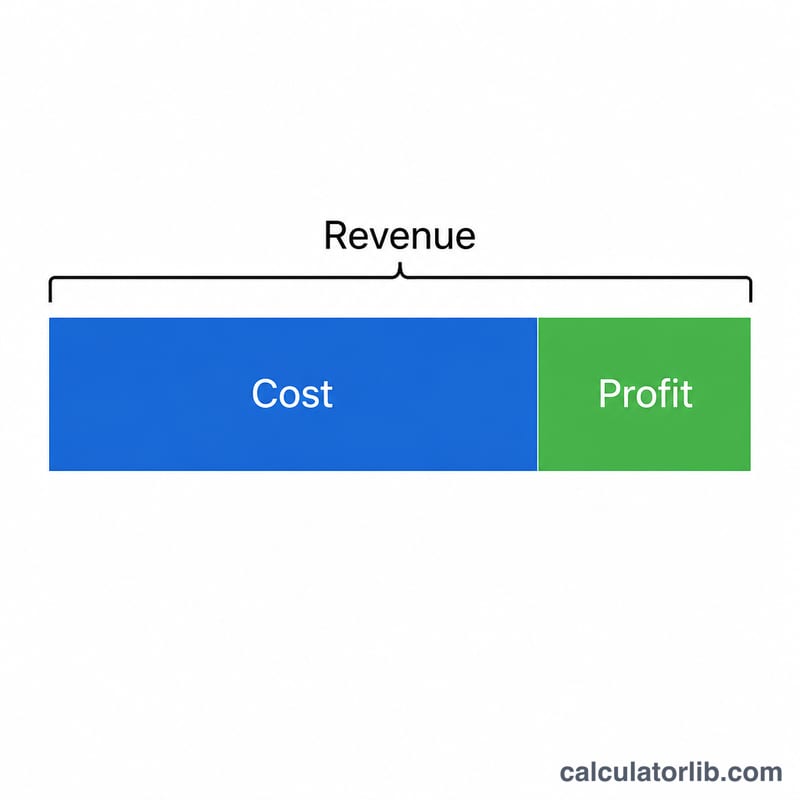
Enter your total Revenue (the price you sell for) and your Cost (the direct cost to produce or buy what you sold). The calculator instantly returns your gross profit margin percentage, the dollar amount of gross profit, and your markup on cost. Use it per unit, per order, or for a whole period.
The Formula Explained
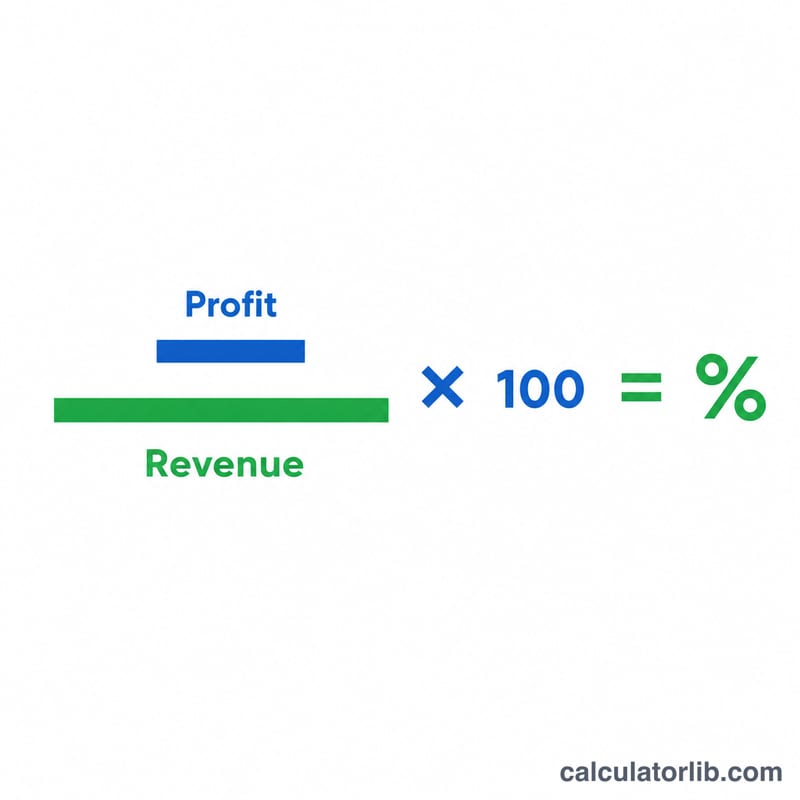
The core formula is:
$$\text{Margin \%} = \frac{\text{Revenue} - \text{Cost}}{\text{Revenue}} \times 100$$
The numerator, Revenue − Cost, is your gross profit. Dividing it by revenue expresses that profit as a fraction of sales, and multiplying by 100 converts it to a percentage. Note that margin and markup are different: markup divides profit by cost instead of revenue, so markup is always a larger number than margin for the same sale.
Worked Example
Suppose you sell a product for $1,000 (revenue) and it costs you $600 to make. Gross profit is \(1{,}000 - 600 = \$400\). $$\text{Margin} = \frac{400}{1{,}000} \times 100 = 40\%$$ Markup on cost = \(\frac{400}{600} \times 100 \approx 66.67\%\). So 40 cents of every dollar in sales is profit.
FAQ
Is margin the same as markup? No. Margin is profit divided by revenue; markup is profit divided by cost. A 40% margin equals a roughly 66.7% markup.
What is a good gross margin? It varies by industry — software often exceeds 70%, while grocery retail may be under 25%. Compare against peers in your sector.
Can margin be negative? Yes. If your cost exceeds revenue, the margin is negative, meaning you are selling at a loss.