
What This Calculator Does
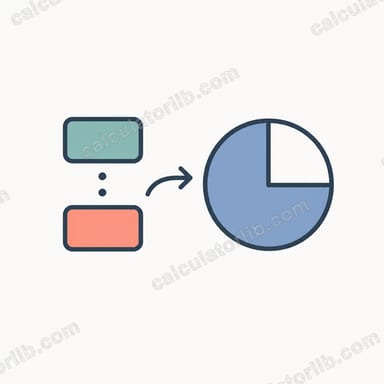
The Card Drawing Probability Calculator finds the chance of drawing exactly a chosen number of specific cards when you deal a hand from a standard 52-card deck. It uses the hypergeometric distribution, the correct model for drawing without replacement, where each card removed changes the composition of the remaining deck. This is the right tool for poker hands, magic and trading card games, and classic probability homework.
How to Use It
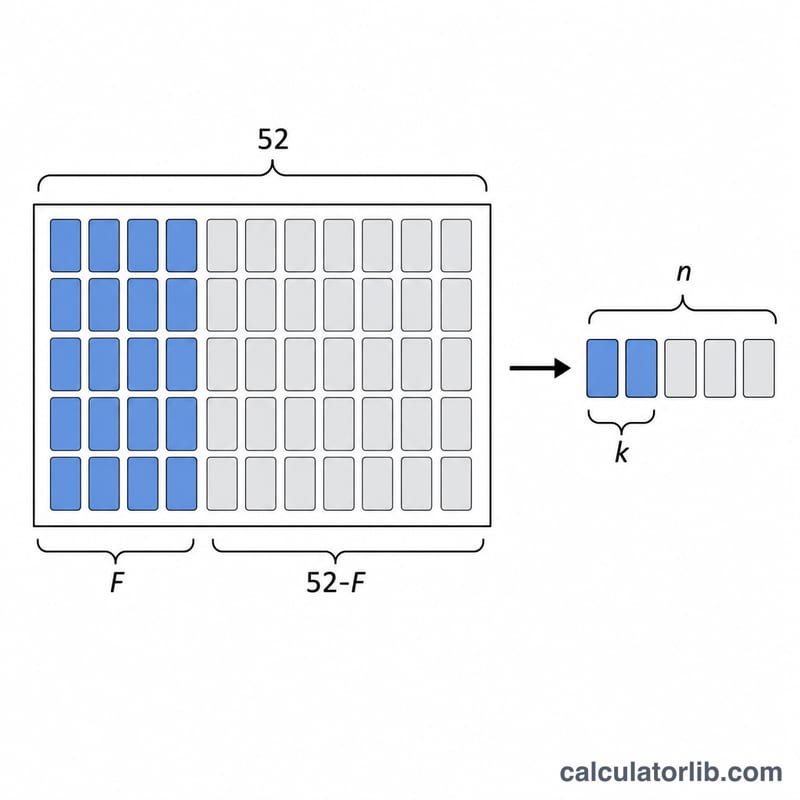
Enter three values: the number of favorable cards in the deck (for example, 4 aces or 13 hearts), the number of cards drawn (your hand size, n), and the number of desired successes (k, how many of the favorable cards you want in that hand). The calculator returns the probability as a percentage, as a decimal, and as odds expressed as "1 in X".
The Formula Explained
The hypergeometric probability is $$P = \frac{\dbinom{F}{k} \times \dbinom{52-F}{n-k}}{\dbinom{52}{n}}$$ The numerator counts the favorable hands: choose k of the F favorable cards and fill the remaining n−k slots from the 52−F non-favorable cards. The denominator \(\dbinom{52}{n}\) counts every possible hand of size n. Dividing gives the fraction of hands that contain exactly k successes.
Worked Example
What is the chance of drawing exactly one ace in a 5-card hand? Here F = 4 aces, n = 5, k = 1. The numerator is \(\dbinom{4}{1} \times \dbinom{48}{4} = 4 \times 194{,}580 = 778{,}320\). The denominator is \(\dbinom{52}{5} = 2{,}598{,}960\). So $$P = \frac{778{,}320}{2{,}598{,}960} = 0.29947$$ or about 29.95% — roughly 1 in 3.34.
FAQ
Does this assume cards are not replaced? Yes. Cards are drawn without replacement, which is why the hypergeometric distribution applies rather than the binomial.
What does "exactly" mean here? The result is the probability of getting precisely k successes — not at least k. For "at least" probabilities, sum the results for k, k+1, up to n.
Can I use this for 13 hearts or 12 face cards? Absolutely. Set the favorable cards to any group you define, as long as it is between 0 and 52.