What Is a Stadium Shape?
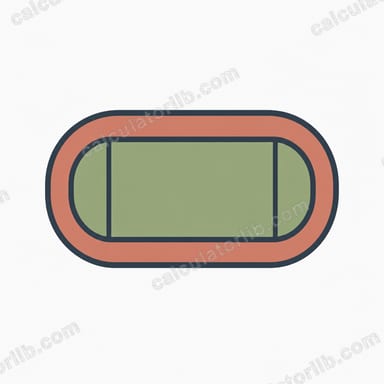
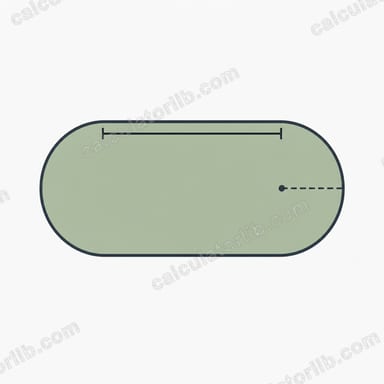
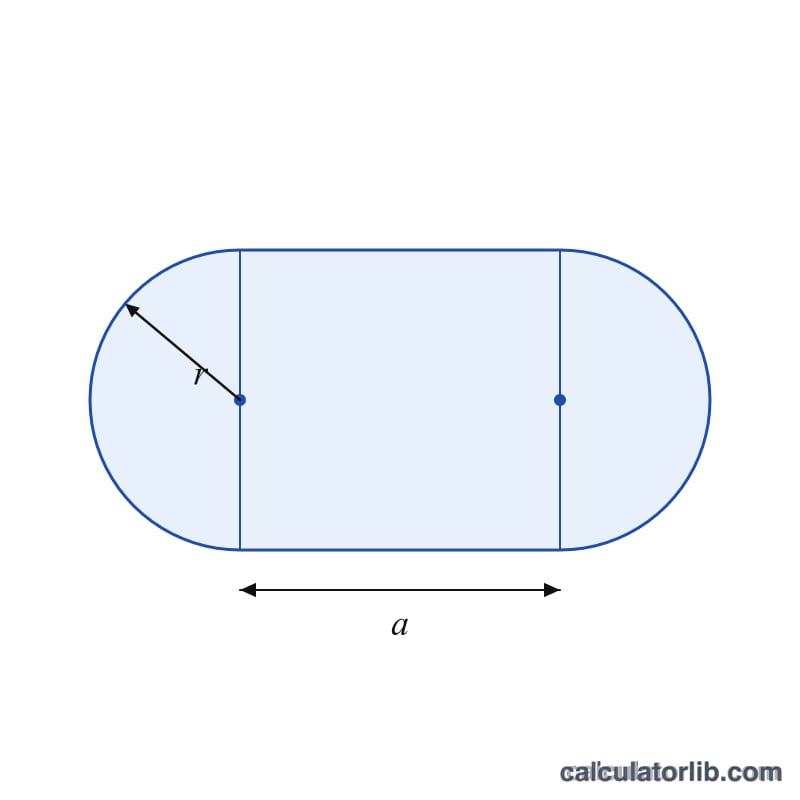
A stadium — also called a discorectangle — is a two-dimensional geometric figure made of a rectangle with two semicircular ends. It gets its name from the running tracks of athletic stadiums, which trace this exact outline. This calculator finds the area and perimeter of a stadium from two measurements: the radius r of the semicircular ends and the length a of each straight side.
How to Use It
Enter the radius r of the rounded ends and the straight side length a (the length of the flat top and bottom). Both values must use the same unit. Click calculate to see the enclosed area in square units and the total perimeter in linear units.
The Formula Explained
A stadium is simply a rectangle of dimensions a × 2r with a semicircle stuck on each short end. The two semicircles together form one complete circle of radius r, so:
Area = \(\pi r^2 + 2ra\) — the circle (\(\pi r^2\)) plus the rectangle (length a, height 2r).
Perimeter = \(2\pi r + 2a\) — the full circle's circumference (\(2\pi r\)) plus the two straight sides (\(2a\)).

Worked Example
Suppose r = 5 and a = 10. $$A = \pi(5^2) + 2(5)(10) = 25\pi + 100 \approx 78.5398 + 100 = 178.5398 \text{ square units.}$$ $$P = 2\pi(5) + 2(10) = 10\pi + 20 \approx 31.4159 + 20 = 51.4159 \text{ units.}$$
Stadium Area and Perimeter for Common Shapes
A stadium (discorectangle) is a rectangle of width \(2r\) and length \(a\) with a semicircle of radius \(r\) on each of two opposite ends. Its area is \(A = \pi r^2 + 2ra\) and its perimeter is \(P = 2\pi r + 2a\). Values are in the same units as the inputs (area in squared units) and are rounded to two decimals.
| Shape | Radius r | Straight side a | Width 2r | Total length a + 2r | Area | Perimeter |
|---|---|---|---|---|---|---|
| Circle (a = 0) | 5 | 0 | 10 | 10 | 78.54 | 31.42 |
| Small stadium | 5 | 10 | 10 | 20 | 178.54 | 51.42 |
| Medium stadium | 10 | 20 | 20 | 40 | 714.16 | 102.83 |
| Approx. 400 m running track | 36.5 | 84.39 | 73 | 157.39 | 10,345.86 | 398.12 |
| 400 m track, measured along the lane-1 line | 36.8 | 84.39 | 73.6 | 157.99 | 10,465.57 | 400.00 |
Worked check for r = 10, a = 20
\(A = \pi(10)^2 + 2(10)(20) = 314.16 + 400 = 714.16\)
\(P = 2\pi(10) + 2(20) = 62.83 + 40 = 102.83\)
Note on the running track
A standard 400 m athletics track has two straights of about 84.39 m and two semicircular bends. The 400 m length is measured along a line about 0.30 m outside the inner kerb, which corresponds to a radius of roughly 36.8 m. With r = 36.5, the perimeter is 398.12 m, which is close to 400 m but not exact. With r = 36.8, the perimeter is 400.00 m. The kerb radius and the measuring-line radius differ, so use the measuring-line radius when you want the 400 m figure.
Key Terms and Variables
- Stadium (discorectangle): a 2D shape made of a rectangle with a semicircle attached to each of two opposite sides. It is also called an obround or sometimes a capsule shape.
- Radius r: the radius of each semicircular end. It is also half the width of the shape.
- Straight side length a: the length of each flat, parallel side. This is the flat segment only, not the overall length of the shape.
- Semicircular end: a half-circle of radius \(r\) closing each end. The two ends together form one full circle with area \(\pi r^2\) and circumference \(2\pi r\).
- Total length: the overall extent from one end to the other, \(a + 2r\).
- Width: the distance between the two straight sides, \(2r\).
- Area: the surface enclosed by the shape, \(A = \pi r^2 + 2ra\). It is the sum of the circle's area and the rectangle's area \(2r \times a\).
- Perimeter: the distance around the outline, \(P = 2\pi r + 2a\). It is the sum of the circle's circumference and two straight sides.
Important: \(a\) is the length of the flat segment, not the overall length. If you measured the overall length \(L\), use \(a = L - 2r\).
FAQ
What if a = 0? The stadium becomes a full circle: area = \(\pi r^2\) and perimeter = \(2\pi r\).
Is the width of a stadium 2r? Yes — the total height (short dimension) equals the diameter of the semicircles, which is \(2r\).
What units does it use? Any consistent unit. If r and a are in meters, area is in square meters and perimeter in meters.