
What Is the Feed Conversion Ratio?
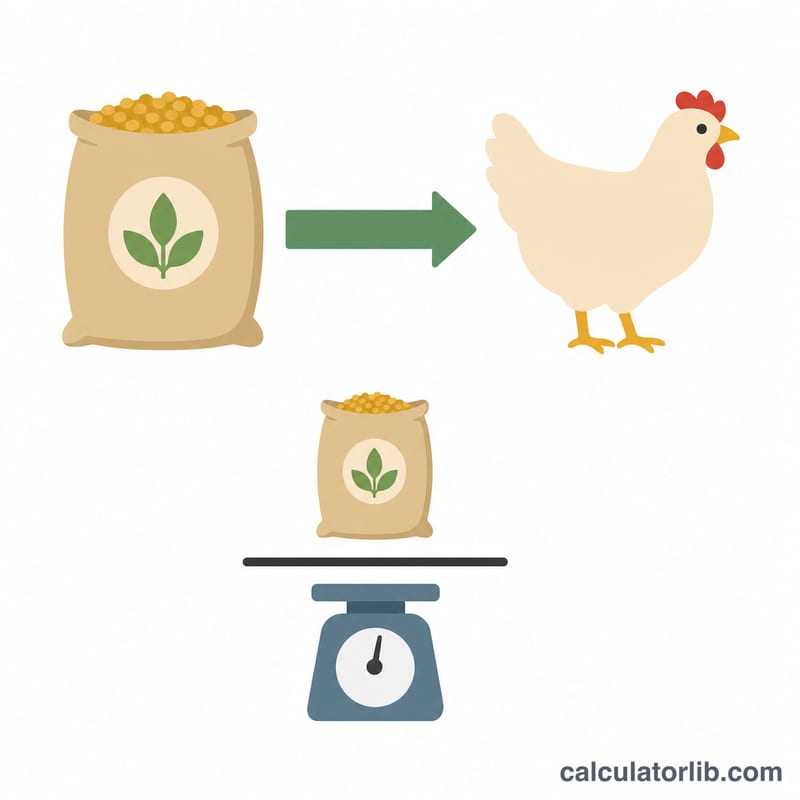
The Feed Conversion Ratio (FCR) measures how efficiently an animal converts feed into body weight. It is one of the most important performance indicators in livestock farming, poultry production, aquaculture, and pet nutrition. A lower FCR means the animal needs less feed to gain each unit of weight, which translates directly into lower feed costs and better profitability.
How to Use This Calculator
Enter the total feed intake (the amount of feed consumed over the period) and the total weight gain (how much the animal or group grew during the same period). Use consistent units — kilograms with kilograms, or pounds with pounds. The calculator returns the FCR plus the feed efficiency expressed as a percentage.
The Formula Explained
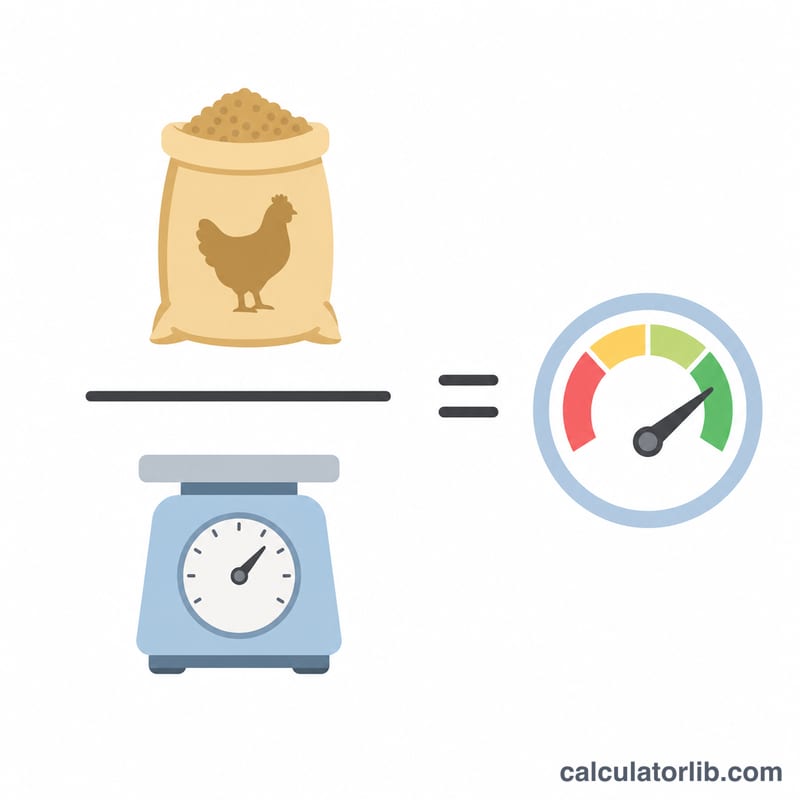
FCR is a simple ratio: $$\text{FCR} = \dfrac{\text{Total Feed Intake}}{\text{Total Weight Gain}}$$ Because it is a ratio of like units, FCR is dimensionless. Feed efficiency is the inverse, written as a percentage: \(\text{Efficiency} = \dfrac{\text{Weight Gain}}{\text{Feed Intake}} \times 100\%\). An FCR of 2.0 means it takes 2 kg of feed to produce 1 kg of weight gain (50% efficiency).
Worked Example
A flock of broiler chickens consumed 1,000 kg of feed and gained 500 kg of body weight. $$\text{FCR} = 1{,}000 \div 500 = \mathbf{2.0}$$ The feed efficiency is \(500 \div 1{,}000 \times 100 = 50\%\). Comparing this to industry benchmarks tells the farmer whether the operation is on target.
FAQ
What is a good FCR? It depends on the species: modern broilers target ~1.5–1.8, pigs around 2.5–3.5, and farmed salmon close to 1.1. Lower is always better.
Can FCR be below 1? Yes, for some fish species fed energy-dense diets, FCR can dip below 1.0 because feed contains less water than the wet body mass gained.
Why is my FCR rising over time? Mature animals gain weight more slowly relative to maintenance feed, so FCR naturally worsens with age. Disease, poor feed quality, or environmental stress can also increase it.