
What This Calculator Does
Plants in an enriched grow environment can photosynthesize faster when carbon dioxide levels are raised above ambient (roughly 400 ppm) toward an optimal range of 1,000–1,500 ppm. This CO₂ Grow Room Calculator tells you exactly how many cubic feet of pure CO₂ are required to lift your sealed room from its current ambient level to your target concentration in one charge. It is a universal physics-based tool — no country or jurisdiction restrictions apply.
How to Use It
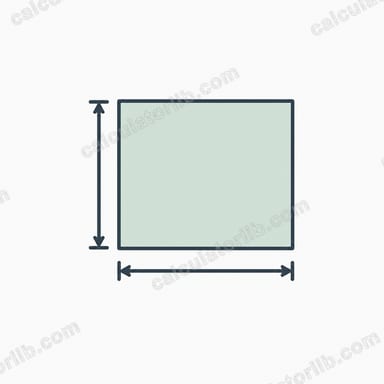
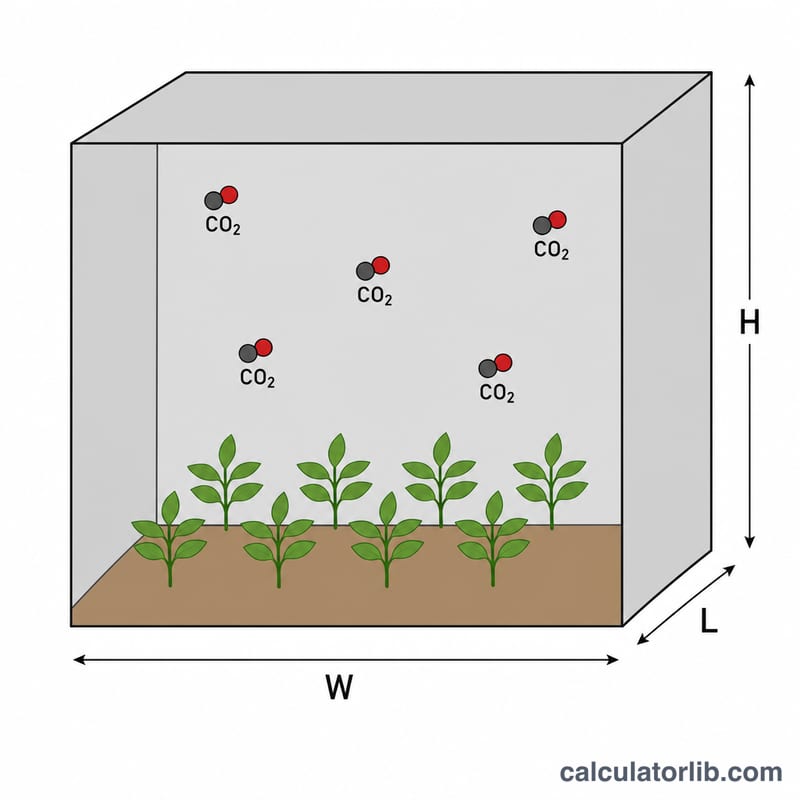
Enter the length, width and height of your room in feet. The calculator multiplies these to find the air volume. Then enter your target CO₂ in parts per million (commonly 1,200–1,500 ppm for flowering plants) and your ambient/starting CO₂ (typically about 400 ppm outdoors, sometimes higher indoors). The result shows the volume of CO₂ to release.
The Formula Explained
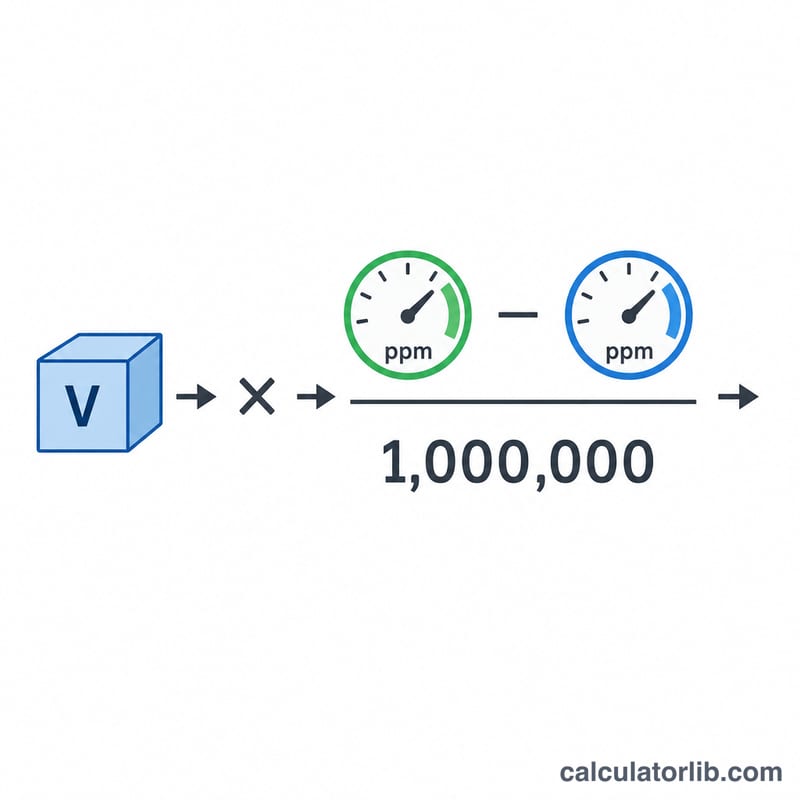
Because ppm means "parts per million," the fraction of the room that must become CO₂ equals the ppm increase divided by 1,000,000. Multiplying that fraction by the room volume gives the CO₂ volume:
$$\text{CO}_2\ (\text{ft}^3) = V \times \frac{\text{Target ppm} - \text{Ambient ppm}}{1{,}000{,}000}$$
The tool also converts cubic feet to liters (\(\times 28.3168\)) for those metering from a tank.
Worked Example
A 10 ft × 10 ft × 8 ft room has a volume of 800 cubic feet. To go from 400 ppm to 1,500 ppm, the increase is 1,100 ppm. CO₂ needed = $$800 \times \frac{1{,}100}{1{,}000{,}000} = 800 \times 0.0011 = \mathbf{0.88}\ \textbf{cubic feet}$$ (about 24.9 liters).
FAQ
Does this account for ventilation or leaks? No — it assumes a sealed room for a single dosing event. In leaky rooms you must re-dose periodically.
What target ppm should I use? Most growers aim for 1,200–1,500 ppm during the light cycle; levels above 2,000 ppm can harm plants and people.
Why convert to liters? Many regulators and flow meters are calibrated in liters per minute, so the liter figure helps you set dosing time.