
What Is the Daily Light Integral?
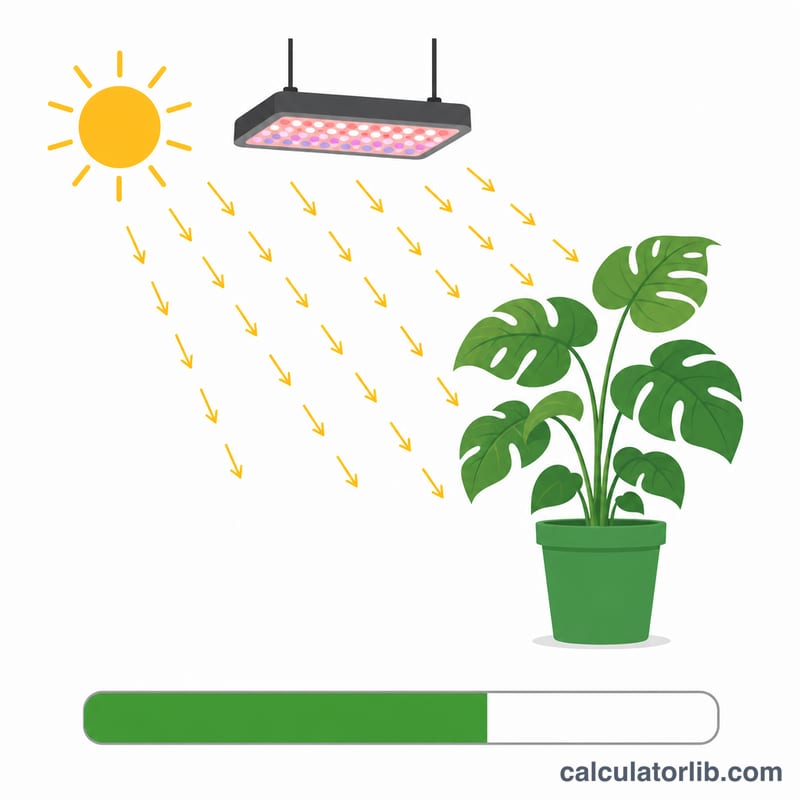
The Daily Light Integral (DLI) is the total amount of photosynthetically active light delivered to a plant over a 24-hour period, measured in moles of photons per square meter per day (mol/m²/day). While PPFD (Photosynthetic Photon Flux Density) tells you the light intensity at a single moment, DLI sums that intensity over the entire photoperiod, giving a far better picture of how much light a crop actually receives.
How to Use This Calculator
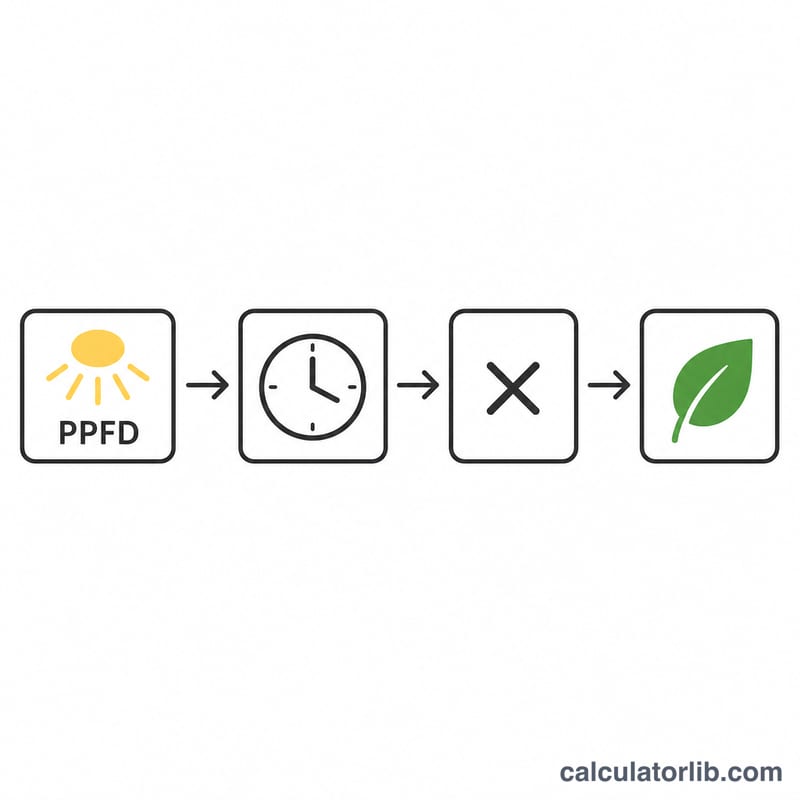
Enter the average PPFD measured at the canopy in µmol/m²/s and the number of hours per day your lights are on (the photoperiod). The calculator multiplies these values, converts hours to seconds, and scales micromoles to moles to return your DLI instantly.
The Formula Explained
$$\text{DLI} = \dfrac{\text{PPFD} \times \text{Photoperiod} \times 3600}{1{,}000{,}000}$$ There are 3,600 seconds in an hour, so multiplying PPFD (a per-second value) by hours and 3,600 yields total µmol per square meter. Dividing by 1,000,000 converts micromoles to moles.
Worked Example
Suppose a grow light delivers a PPFD of 400 µmol/m²/s for 16 hours a day. $$\text{DLI} = \dfrac{400 \times 16 \times 3600}{1{,}000{,}000} = 23.04 \text{ mol/m}^2\text{/day}$$ That falls comfortably in the range many flowering vegetables and herbs prefer.
FAQ
What DLI do most plants need? Leafy greens thrive around 12–17 mol/m²/day, while fruiting crops like tomatoes often want 20–30 or more.
Does DLI replace PPFD? No — PPFD measures instantaneous intensity, DLI accumulates it over the day. You need PPFD to compute DLI.
Can I exceed 24 hours of photoperiod? No. The maximum photoperiod is 24 hours, and many plants require a dark period for healthy growth.