
What this calculator does
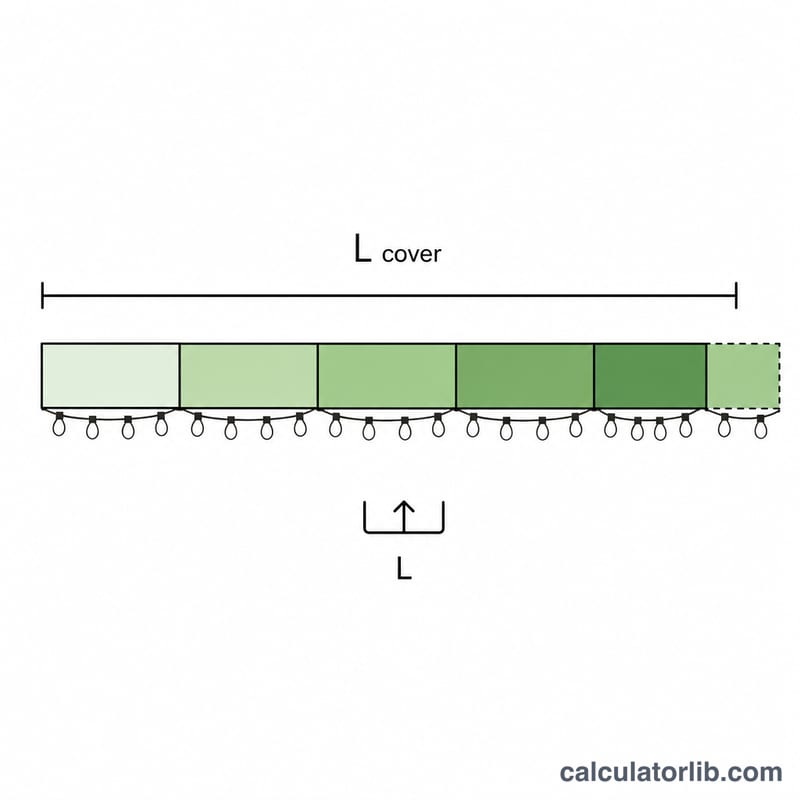
The Christmas String Light Count Calculator tells you how many strings of holiday lights you need to cover a run of a given length — a roofline, fence, railing, tree, or mantel — and how much electrical power those lights will draw. It rounds up to whole strings, because you can't buy a fraction of a light strand.
How to use it
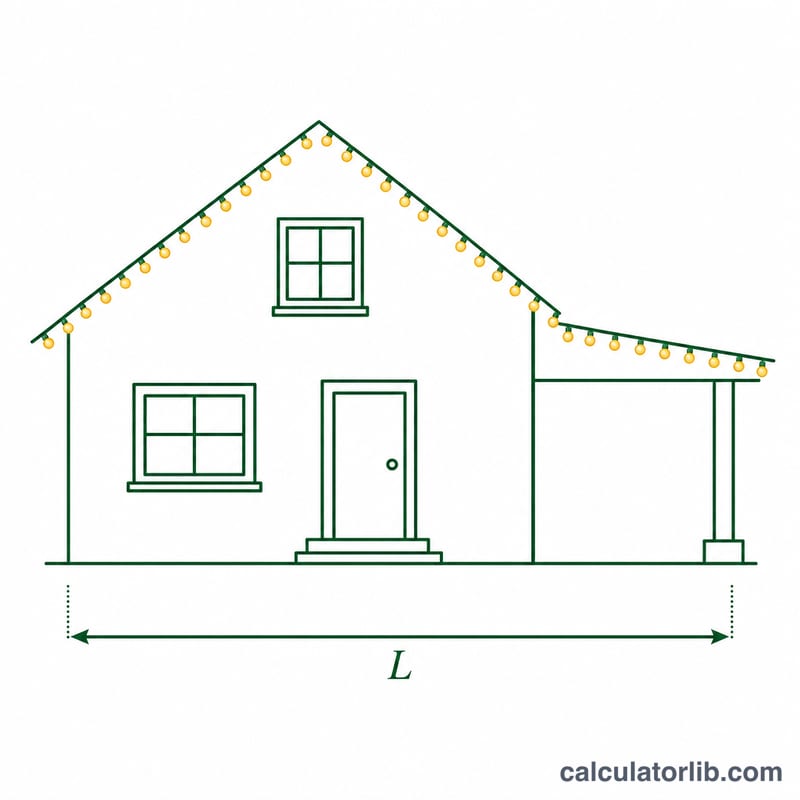
Enter the total length you want to cover in feet, the lit length of one string of lights (check the package — common values are 8–25 ft), and the wattage of a single string (often printed on the box or plug tag, e.g. 40 W for an incandescent set or 5 W for LEDs). The calculator returns the number of strings to buy and the combined power draw so you can avoid overloading a circuit.
The formula explained
$$\text{Strings} = \left\lceil \frac{\text{Length to cover}}{\text{Length per string}} \right\rceil$$ The ceiling function rounds any partial string up to the next whole one. $$\text{Total Watts} = \text{Strings} \times \text{Watts per string}$$ Knowing total watts matters: a standard 15-amp, 120-volt household circuit safely supplies about 1,440 W, so staying well under that prevents tripped breakers.
Worked example
You want to cover a 30 ft roofline with strings that are 12 ft long, each drawing 40 W. $$\text{Strings} = \left\lceil \frac{30}{12} \right\rceil = \lceil 2.5 \rceil = 3 \text{ strings}$$ $$\text{Total Watts} = 3 \times 40 = 120 \text{ W}$$ — comfortably within one circuit.
FAQ
Why round up? Lights come in fixed lengths, so any leftover gap still needs a full additional string.
Can I connect them end to end? Yes, but most manufacturers limit how many strings you can chain (commonly 3–5 incandescent or many more LED). Always follow the package's max-connection rating.
Does this work in metric? Yes — just use the same unit (e.g. meters) for both lengths; the ratio is unitless.