
What Is the Grass Seed Calculator?
This tool tells you how many pounds of grass seed to buy for a lawn project. It multiplies your lawn area by the recommended seeding rate (pounds per 1,000 square feet) so you neither run short nor waste expensive seed. It works for new lawns, patch repairs, and overseeding an existing lawn.
How to Use It
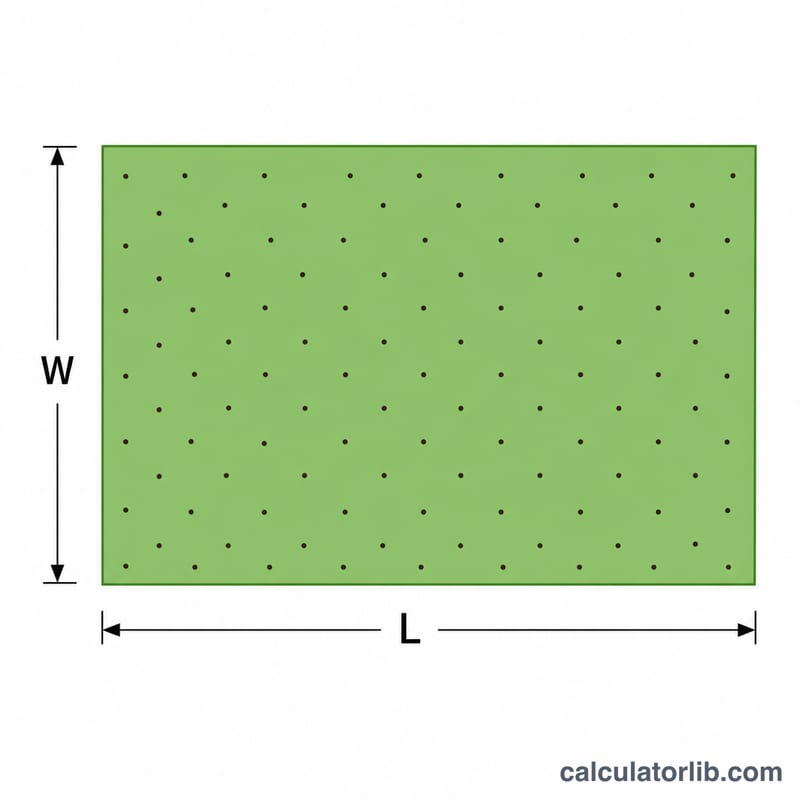
Measure the length and width of your lawn area in feet and enter them. Then choose a seeding rate based on your project: roughly 5–8 lb per 1,000 sq ft for establishing a new lawn from bare soil, or 2–4 lb per 1,000 sq ft when overseeding to thicken existing turf. The calculator returns the total area and the pounds of seed needed.
The Formula Explained
First the area is found with \(\text{Area} = \text{Length} \times \text{Width}\). Seeding rates are quoted per 1,000 square feet, so the seed required is \(\text{Seed} = \text{Area} \times \text{Rate} \div 1000\). Dividing by 1,000 converts the per-1,000-sq-ft rate to your actual area.
$$\text{Seed (lb)} = \dfrac{\text{Area (sq ft)} \times \text{Rate (lb/1000 sq ft)}}{1000}$$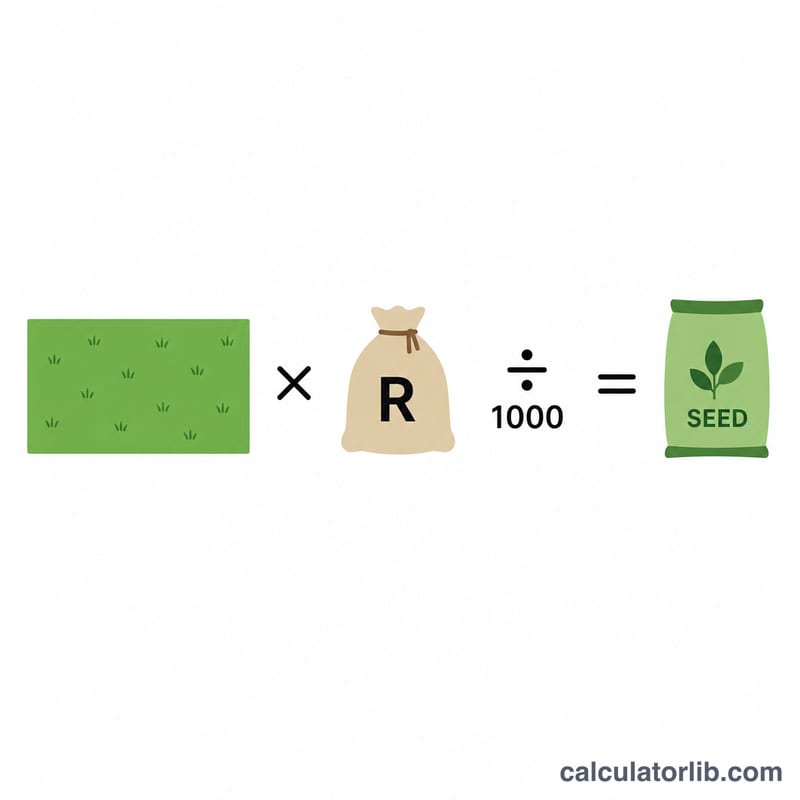
Worked Example
A lawn measuring 50 ft by 30 ft has an area of 1,500 sq ft. Using a new-lawn rate of 6 lb per 1,000 sq ft:
$$\text{Seed} = \frac{1{,}500 \times 6}{1{,}000} = \textbf{9 lb}$$of grass seed.
FAQ
What seeding rate should I use? Check the seed bag — rates vary by species. As a guide, new lawns use 5–8 lb/1,000 sq ft and overseeding uses 2–4 lb/1,000 sq ft.
Does shape matter? This assumes a rectangle. For irregular yards, break the area into rectangles and add the seed totals, or use an average length and width.
Should I buy extra? Buying 5–10% more is wise to cover edges, uneven coverage, and a light second pass.