
What Is the Grain Bin Calculator?
The Grain Bin Calculator estimates how many bushels of grain a round, flat-bottom storage bin holds based on the bin's diameter and the depth (height) of grain inside it. It treats the grain mass as a cylinder, computes its volume in cubic feet, then converts to bushels using the standard factor of 0.8036 bushels per cubic foot.
How to Use It
Enter the inside diameter of the bin in feet and the height of the grain (not the bin) in feet. The calculator returns the approximate capacity in bushels, along with the raw cubic-foot volume. Use the actual grain depth to estimate how much is currently stored, or the full bin height to find total capacity.
The Formula Explained
A cylinder's volume is \(V = \pi \times r^2 \times h\), where r is the radius (diameter \(\div\) 2) and h is the grain height. Because one cubic foot equals about 0.8036 bushels, multiply the volume by 0.8036 to get bushels:
$$\text{Bushels} = \pi \times r^2 \times h \times 0.8036$$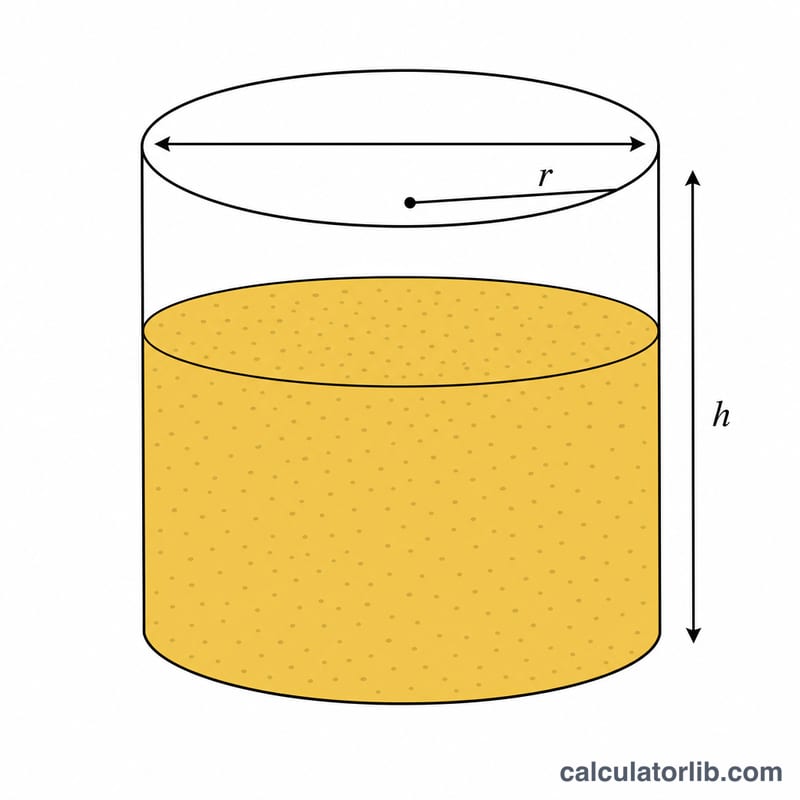
Worked Example
Suppose a bin is 18 ft in diameter with grain 20 ft deep. The radius is 9 ft, so \(r^2 = 81\). Volume:
$$V = \pi \times 81 \times 20 \approx 5{,}089.38 \text{ ft}^3$$Multiply by 0.8036 to get \(\approx 4{,}089.83\) bushels.
FAQ
Does this account for the bin's cone or roof peak? No. This calculation assumes a flat, level grain surface. Peaked grain or a hopper bottom requires additional cone-volume math.
Why 0.8036? One U.S. bushel is defined as 1.244 cubic feet, and \(1 \div 1.244 \approx 0.8036\) bushels per cubic foot.
Does grain type change the number? The bushel-by-volume estimate is the same for any grain, but test weight (lbs per bushel) varies by crop and moisture, so actual weight differs.