
What Is the Acres Per Hour Calculator?
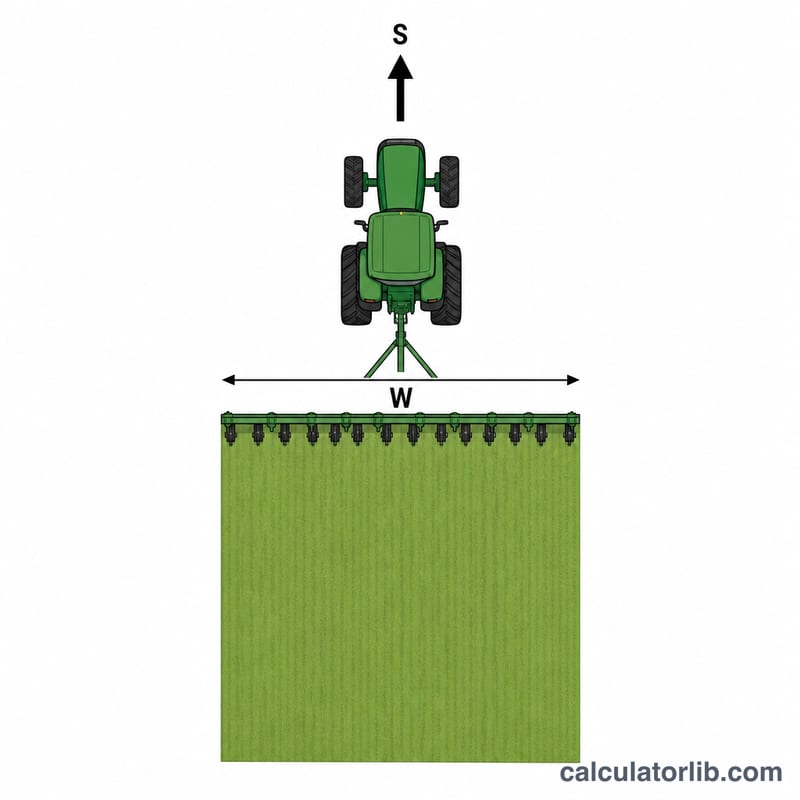
This calculator estimates the effective field capacity of a farm implement — how many acres you can actually cover in one hour of work. It combines the working width of your implement, your travel speed, and a field efficiency factor that accounts for real-world losses like turning, overlap, refilling, and stops.
How to Use It
Enter three values: the implement width in feet (the actual working swath), your travel speed in miles per hour, and the field efficiency as a percentage. Typical field efficiencies range from 70% to 90% for most tillage and planting operations. The tool returns acres per hour, the total acres covered in a standard 8-hour day, and the time it takes to cover a single acre.
The Formula Explained
The core equation is:
$$\text{Acres per Hour} = \dfrac{\text{Width ft} \times \text{Speed mph} \times \text{Efficiency}}{8.25}$$The constant 8.25 comes from unit conversion. One mile is 5,280 feet, and an acre is 43,560 square feet. Traveling at 1 mph with a 1-foot swath covers 5,280 sq ft per hour, which equals \(5{,}280 \div 43{,}560 = 0.1212\) acres. Dividing width × speed by the reciprocal (8.25) gives acres per hour directly, then multiplying by efficiency adjusts for non-productive time.
Worked Example
Suppose you run a 20-foot implement at 5 mph with 85% field efficiency:
$$(20 \times 5 \times 0.85) \div 8.25 = 85 \div 8.25 = 10.30 \text{ acres per hour}$$Over an 8-hour day that is about 82.4 acres, or roughly 5.8 minutes per acre.
FAQ
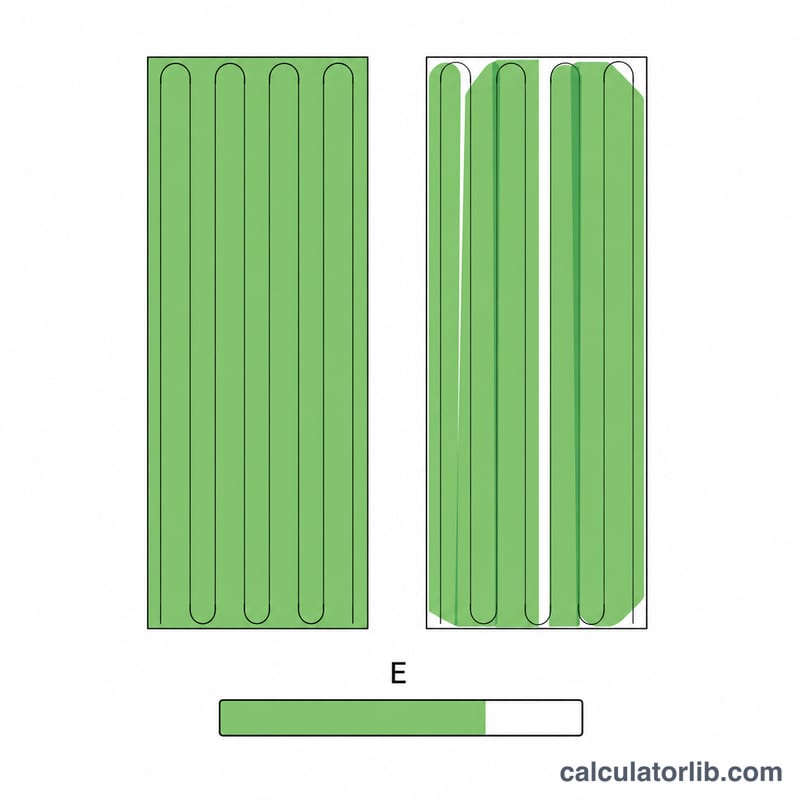
What is field efficiency? It is the ratio of productive time to total time in the field, accounting for turns, overlap, and stops. Planters often run 60–75%, while wide tillage tools may reach 80–90%.
Should I use the manufacturer's listed width? Use the actual effective working width. Overlap between passes effectively reduces it, which is part of why field efficiency is below 100%.
Does speed unit matter? Yes — this formula expects miles per hour and width in feet. Convert other units first.