
What is a stadium shape?
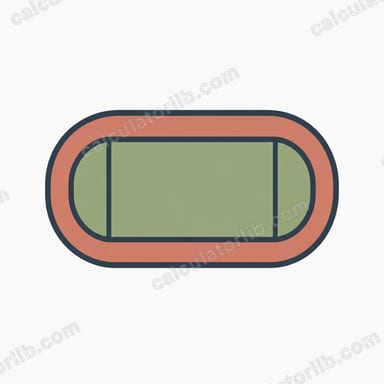
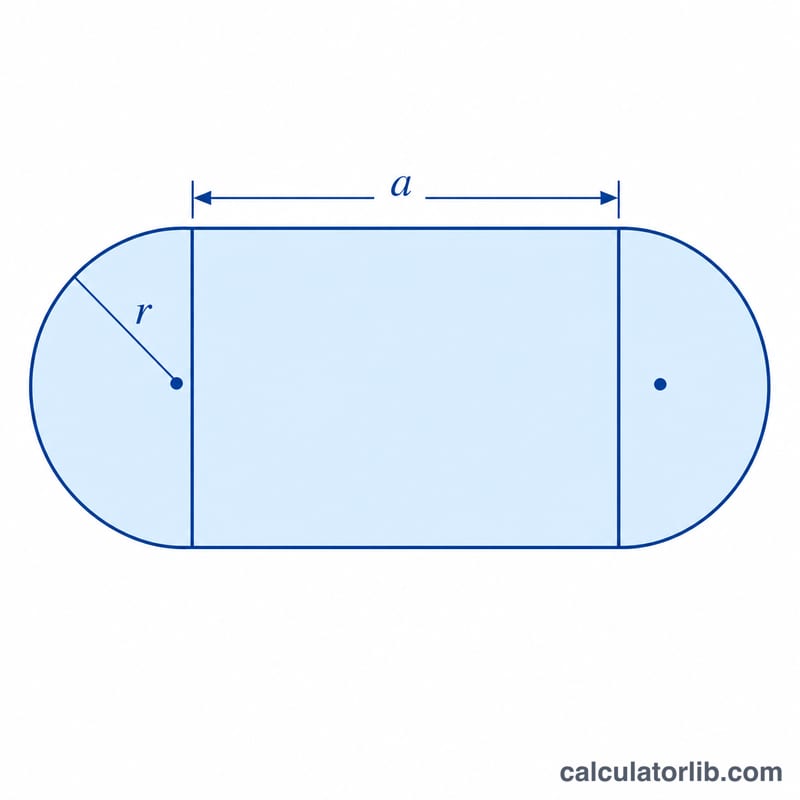
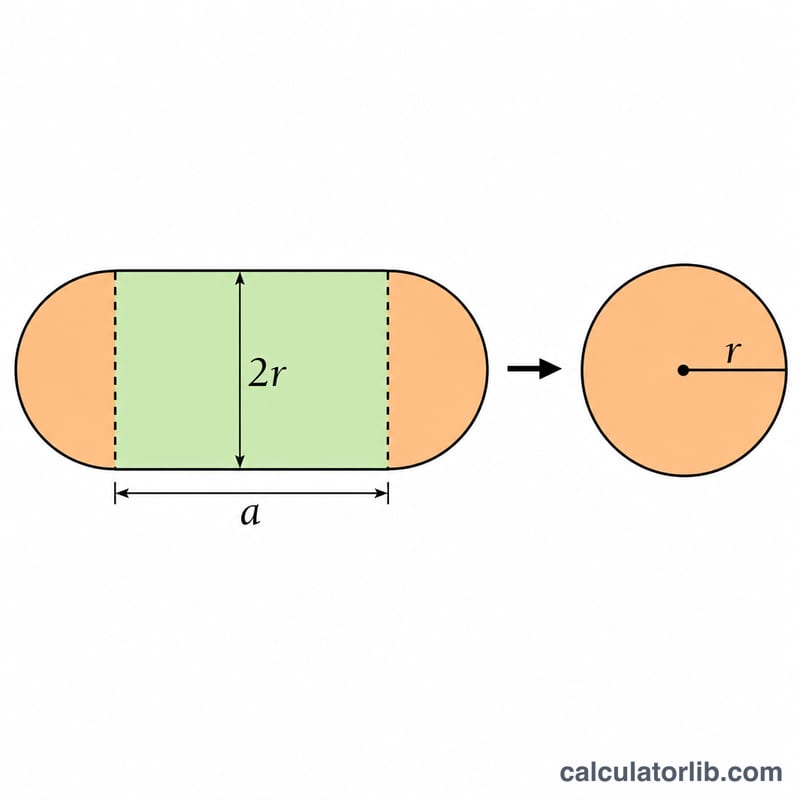
In geometry, a stadium is a two-dimensional figure made of a rectangle with a semicircle attached to each of its two ends. If the semicircles have radius r, the rectangle is a long and 2r wide (its width equals the diameter). The two semicircular caps, placed together, form one complete circle of radius r. The name comes from the running tracks and arenas that share this rounded-rectangle outline.
How to use this calculator
Pick a calculation mode from the Choose a Calculation dropdown, depending on which two quantities you already know. Enter those two values, optionally change the value of pi or the display unit, choose how many significant figures to round to, and the calculator returns all four defining measurements: radius r, side length a, perimeter P, and area A. The unit you select is cosmetic only - it is appended to the results (with the square unit on area) and never triggers any conversion, so keep all of your inputs in the same unit.
The formulas
The perimeter is the two straight sides plus the full circumference of the combined semicircles: $$P = 2a + 2\pi r$$ The area is the rectangle plus the full circle made by the two halves: $$A = 2ar + \pi r^2$$ Every mode is just an algebraic rearrangement: given r and A, solve \(a = (A - \pi r^2) / (2r)\); given r and P, solve \(a = (P - 2\pi r) / 2\); and given a and P, solve \(r = (P - 2a) / (2\pi)\).
Worked example
Take \(r = 5\) and \(a = 10\) with \(\pi = 3.14159265\). Then $$P = 2(10) + 2\pi(5) = 20 + 31.4159 = 51.4159,$$ and $$A = 2(10)(5) + \pi(5)^2 = 100 + 78.5398 = 178.540.$$ Working backwards from \(r = 5\) and \(P = 51.4159\) gives \(a = (51.4159 - 31.4159) / 2 = 10\), confirming the same area of 178.540.
FAQ
Why must the radius be greater than zero? A zero radius removes the curved caps and the formula \(a = (A - \pi r^2) / (2r)\) would divide by zero, so the shape is no longer a stadium.
What if my area or perimeter is too small? In the area mode you need \(A \ge \pi r^2\), and in the perimeter modes you need \(P \ge 2\pi r\) (or \(P \ge 2a\)), otherwise the implied side or radius would be negative and the calculator flags the input as invalid.
Can I change pi? Yes - the "Let pi" field lets you override the constant, useful for textbook problems that specify a rounded value such as 3.14.