
What this calculator does
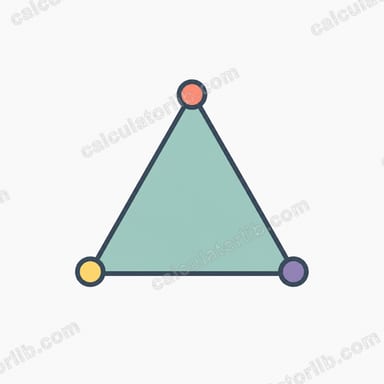
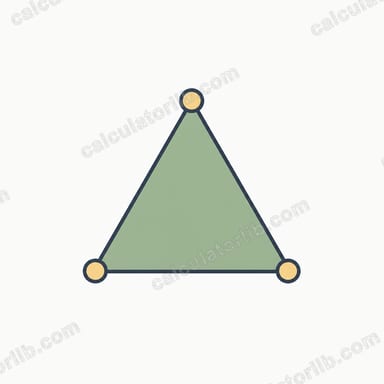
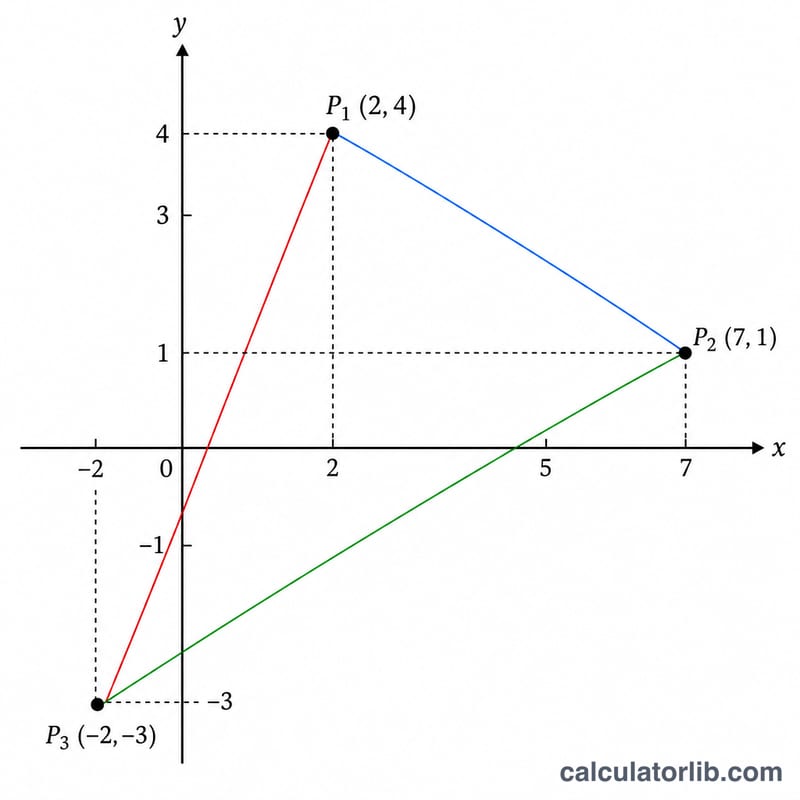
This tool finds the area and perimeter of a triangle when you know the Cartesian coordinates of its three corners: A(\(x_1\), \(y_1\)), B(\(x_2\), \(y_2\)), and C(\(x_3\), \(y_3\)). The inputs are plain real numbers on the coordinate plane, so they can be negative, zero, integer, or decimal. The results carry the same units as your coordinates: area in square units, perimeter in linear units. If your coordinates are pure numbers, the answers are dimensionless.
How to use it
Enter the x and y value for each of the three points A, B, and C, then read the area and the perimeter. The table also breaks the perimeter into its three sides AB, BC, and CA so you can check individual edge lengths.
The formulas explained
The area comes from the shoelace formula. The signed quantity \((x_1 \cdot y_2 + x_2 \cdot y_3 + x_3 \cdot y_1 - y_1 \cdot x_2 - y_2 \cdot x_3 - y_3 \cdot x_1)\) equals twice the signed area; dividing by 2 and taking the absolute value gives a positive area no matter whether the vertices are listed clockwise or counter-clockwise. The perimeter is simply the sum of the three side lengths, each found with the Pythagorean distance formula between two points.
$$A = \frac{1}{2}\left| x_1(y_2 - y_3) + x_2(y_3 - y_1) + x_3(y_1 - y_2) \right|$$ $$\text{where}\quad \left\{ \begin{aligned} x_1, y_1 &= \text{A}_x,\ \text{A}_y \\ x_2, y_2 &= \text{B}_x,\ \text{B}_y \\ x_3, y_3 &= \text{C}_x,\ \text{C}_y \end{aligned} \right.$$ $$P = \overline{AB} + \overline{BC} + \overline{CA}$$ $$\text{where}\quad \left\{ \begin{aligned} \overline{AB} &= \sqrt{(x_1 - x_2)^2 + (y_1 - y_2)^2} \\ \overline{BC} &= \sqrt{(x_2 - x_3)^2 + (y_2 - y_3)^2} \\ \overline{CA} &= \sqrt{(x_3 - x_1)^2 + (y_3 - y_1)^2} \end{aligned} \right.$$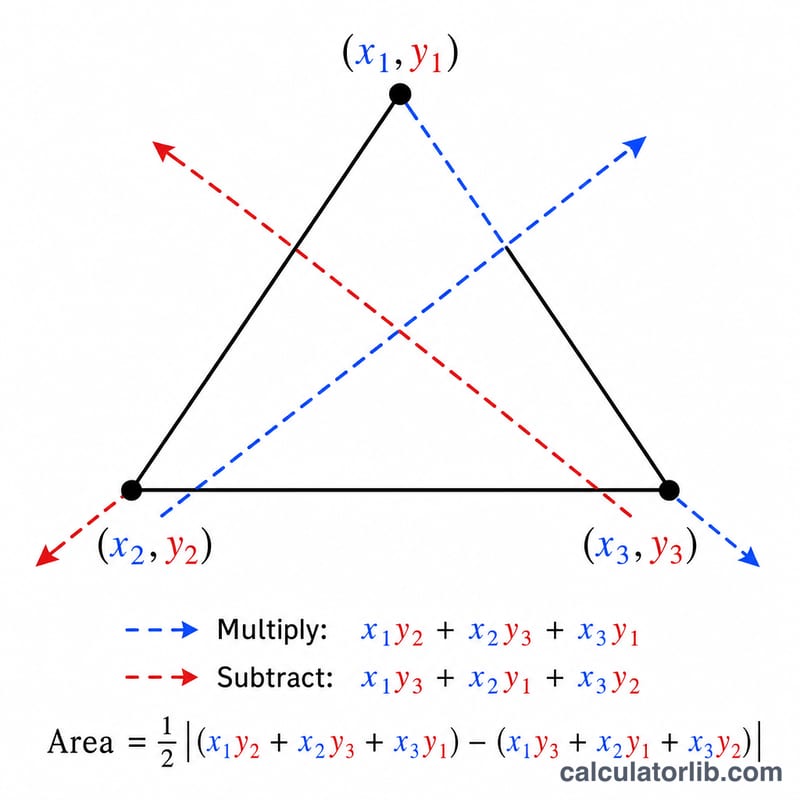
Worked example
For A(-2, 3), B(-3, -1), C(3, -2): the cross-product term is \(2 + 6 + 9 + 9 + 3 - 4 = 25\), so \(S = \left|\frac{25}{2}\right| =\) 12.5. The sides are \(AB = \sqrt{17} \approx 4.1231\), \(BC = \sqrt{37} \approx 6.0828\), \(CA = \sqrt{50} \approx 7.0711\), giving a perimeter \(L \approx\) 17.27694.
FAQ
What if the area is zero? A zero area means the three points are collinear (they lie on one straight line), so they do not form a real triangle.
Does the order of the points matter? No. The absolute value in the shoelace formula makes the area independent of whether you list the vertices clockwise or counter-clockwise.
Can I use negative coordinates? Yes. Any real numbers are valid, including negatives and decimals.