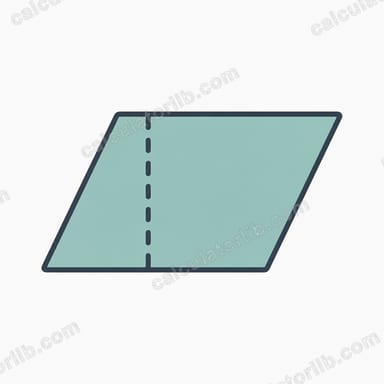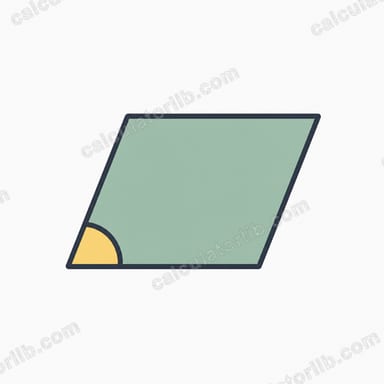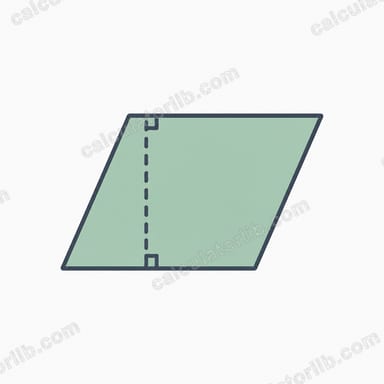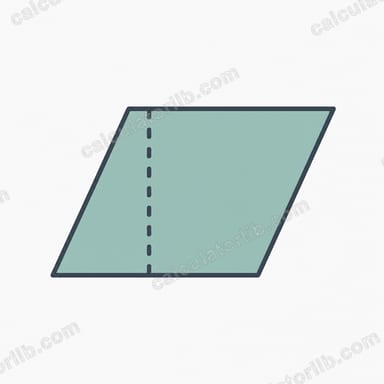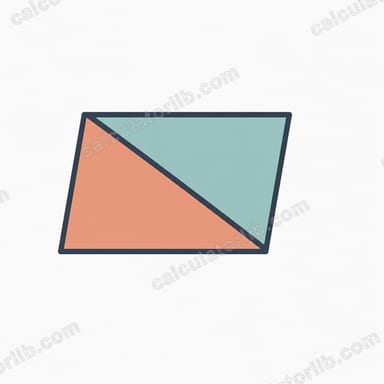

What this parallelogram calculator does
This tool solves for the unknown properties of a parallelogram — side lengths, corner angles, diagonals, height, perimeter and area — from whatever combination of values you already know. Choose a "Calculation" mode from the dropdown, enter the required quantities, and the calculator returns every dependent measurement. It is a pure geometry tool, so it applies everywhere; the unit selector is just a display label (all lengths must share the same unit).
How to use it
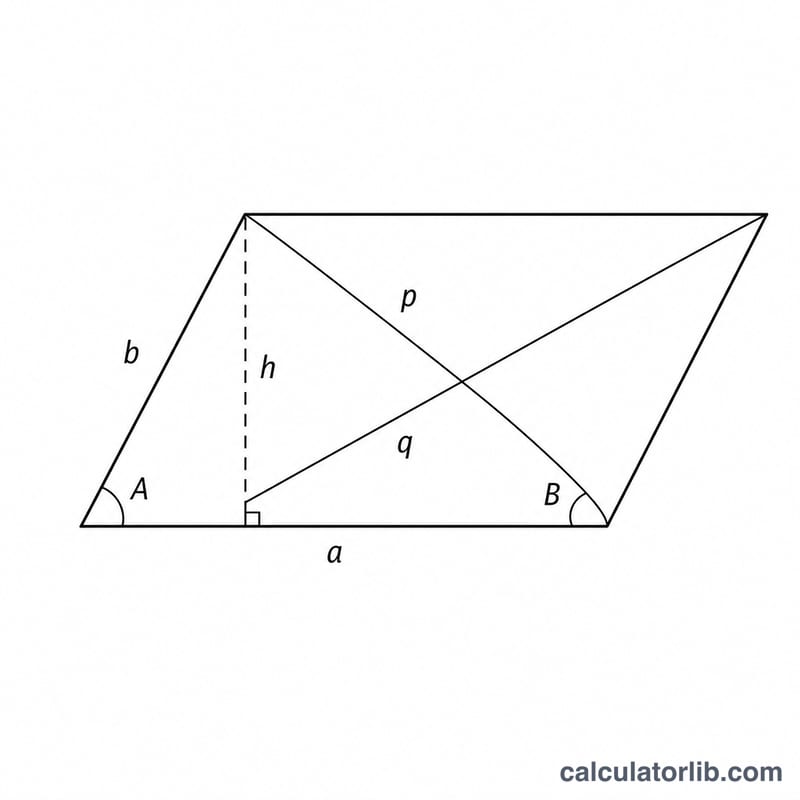
1) Pick a mode that matches your known values (for example "Given a, b, A" or the default "Given b, h"). 2) Fill in the inputs that appear. 3) Optionally set a display unit and the number of significant figures. 4) Read the answer panel, which lists angles (A = C and B = D), both sides, both diagonals, height, perimeter and area.
The formulas
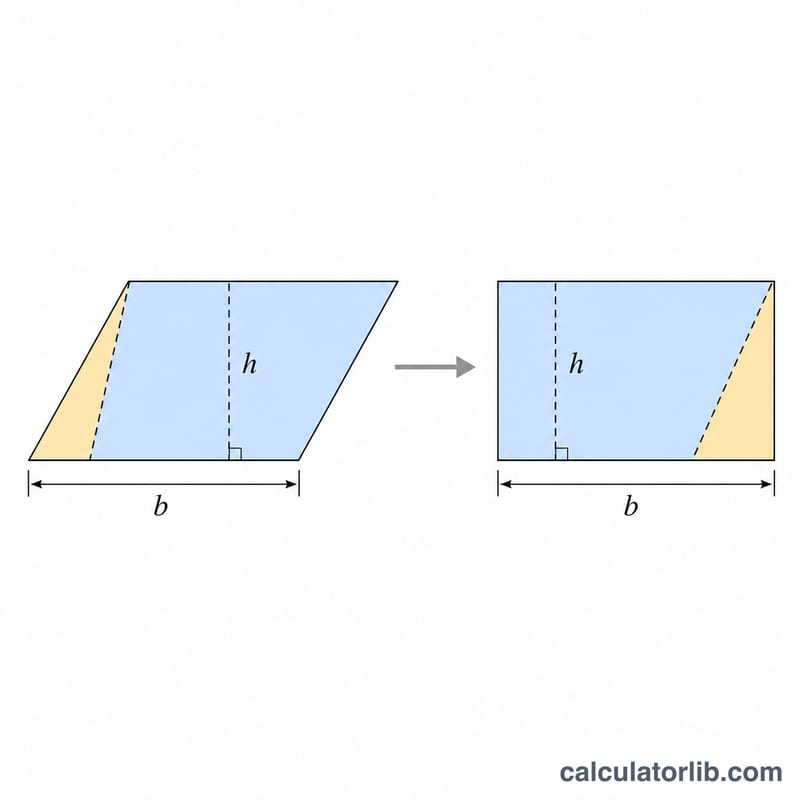
Angles are supplementary: \(B = 180^\circ - A\), and opposite angles are equal (\(C = A\), \(D = B\)). The perimeter is \(P = 2(a + b)\). The area is \(K = b\cdot h = a\cdot b\cdot\sin A\), with height \(h = a\cdot\sin A\). The diagonals come from the law of cosines: \(p = \sqrt{a^2 + b^2 - 2ab\cdot\cos A}\) and \(q = \sqrt{a^2 + b^2 + 2ab\cdot\cos A}\). A handy cross-check is the parallelogram law, \(p^2 + q^2 = 2(a^2 + b^2)\). Angles are computed internally in radians and reported in degrees.
Worked example
Mode "Given a, b, A" with \(a = 5\), \(b = 8\), \(A = 60^\circ\): \(B = 120^\circ\); $$h = 5\cdot\sin 60^\circ = 4.33013$$ $$K = 8\cdot 4.33013 = 34.6410$$ $$P = 2(13) = 26$$ $$p = \sqrt{25+64-40} = 7$$ $$q = \sqrt{89+40} = 11.3578$$ The parallelogram law confirms \(49 + 129 = 178 = 2\cdot 89\).
FAQ
Does the unit rescale my numbers? No — all lengths are assumed to be in the same unit, which is simply attached to the results. Area carries that unit squared.
Why do I sometimes get an error? Some inputs describe an impossible figure, e.g. an area larger than \(a\cdot b\) (\(\sin A\) would exceed 1) or a diagonal that violates the cosine domain. Adjust the values so they are geometrically consistent.
Which diagonal is p and which is q? \(p\) is opposite angle A and \(q\) is opposite angle B; whichever is longer depends on whether A is acute or obtuse.