
What is the Pythagorean Theorem?
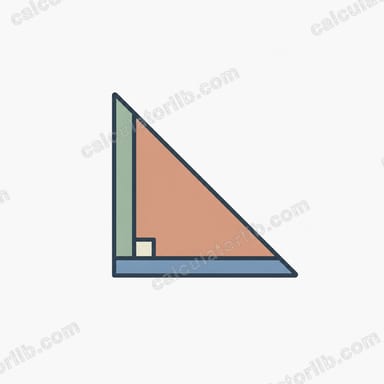
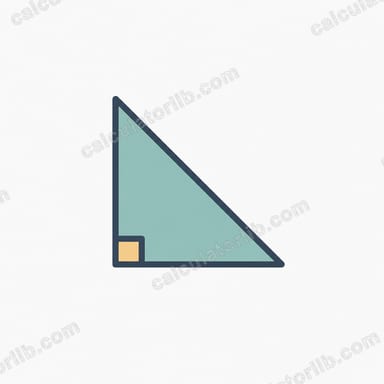
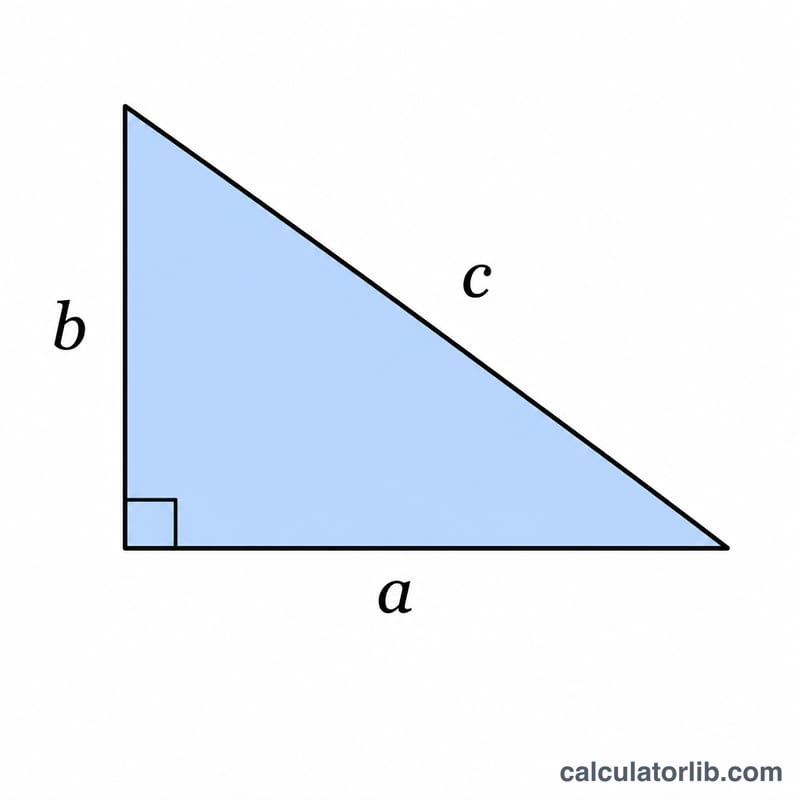
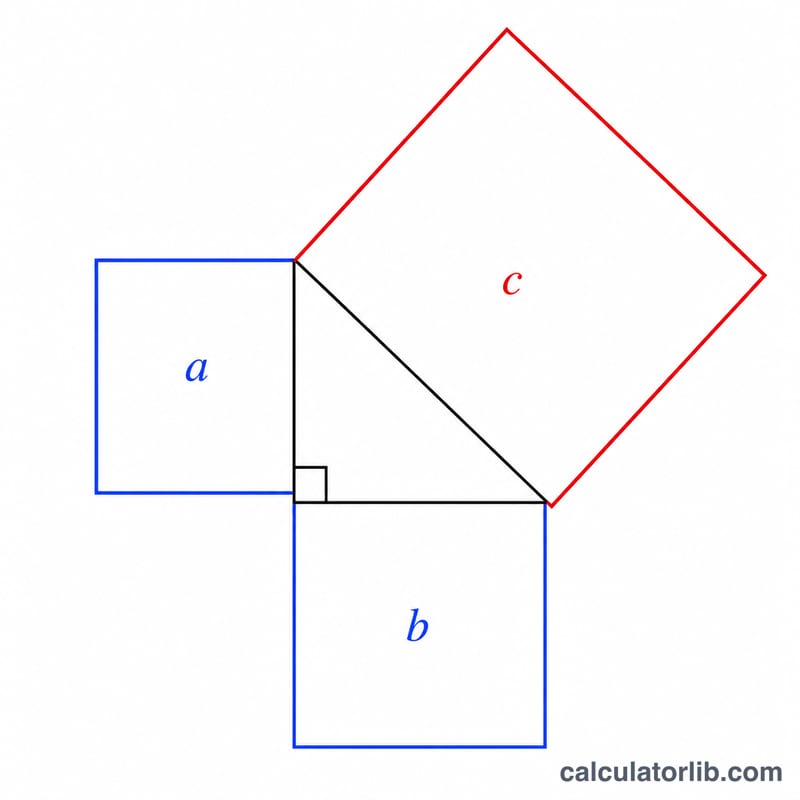
The Pythagorean theorem describes the relationship between the three sides of a right triangle (a triangle with one 90° angle). It states that the square of the hypotenuse — the longest side, opposite the right angle — equals the sum of the squares of the two shorter sides (the legs): \(a^2 + b^2 = c^2\). This calculator rearranges that equation so you can solve for whichever side is unknown, and it also reports the triangle's area.
How to use this calculator
Pick what you want to Solve for: side a, side b, hypotenuse c, or area A. The calculator then uses the two values that make sense for that choice. To find the hypotenuse, enter both legs a and b. To find a leg, enter the hypotenuse and the other leg. To find the area, enter the two legs. Choose a unit (it is only a label — no conversion is performed) and the number of significant figures, then submit.
The formula explained
Rearranging \(a^2 + b^2 = c^2\) gives three solving formulas: the hypotenuse is $$c = \sqrt{a^2 + b^2}$$ a missing leg is $$a = \sqrt{c^2 - b^2} \quad \text{or} \quad b = \sqrt{c^2 - a^2}$$ Because a leg formula subtracts under the square root, the hypotenuse must be strictly longer than the known leg, otherwise no real triangle exists. The area of a right triangle is simply half the product of its two legs: $$A = \tfrac{1}{2}\,a\,b$$
Worked example
For the classic 3-4-5 triangle, set \(a = 3\) and \(b = 4\) and solve for the hypotenuse: $$c = \sqrt{3^2 + 4^2} = \sqrt{9 + 16} = \sqrt{25} = 5$$ The area is $$\tfrac{1}{2} \cdot 3 \cdot 4 = 6$$ So a 3-4-5 right triangle has a hypotenuse of 5 and an area of 6 square units — a perfect Pythagorean triple.
FAQ
Which side is the hypotenuse? The hypotenuse (c) is always the longest side and lies directly opposite the right angle.
Why do I get an error when solving for a leg? When solving for a leg, the hypotenuse must be longer than the known leg; if it is equal or shorter, \(c^2 - \text{leg}^2\) is not positive and no real triangle can be formed.
What are Pythagorean triples? They are whole-number side sets that satisfy \(a^2 + b^2 = c^2\), such as 3-4-5, 5-12-13, 8-15-17 and 7-24-25. The calculator works with any positive decimals, not only triples.