
What this calculator does
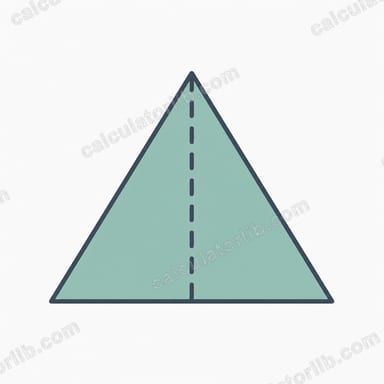
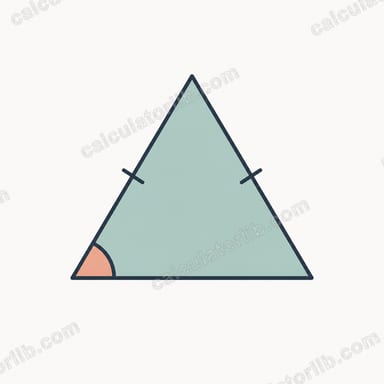
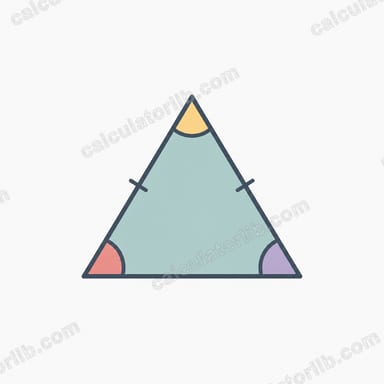
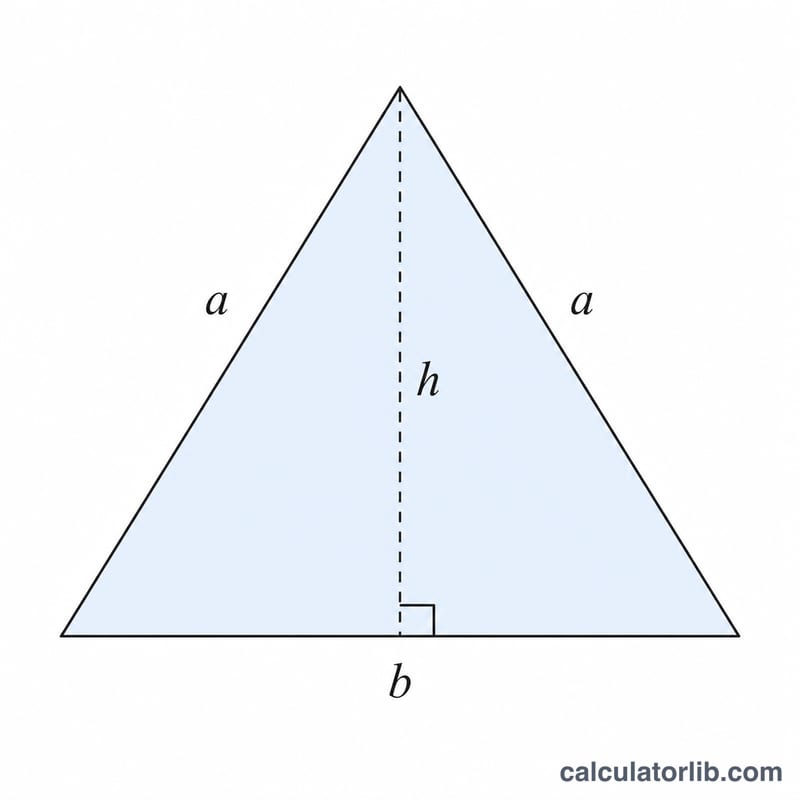
This tool solves an isosceles triangle from its two distinct side lengths: the equal-pair leg a (which also equals side c) and the base b. From these it returns the third side, perimeter, semiperimeter, area and the three altitudes. The geometry convention used here is that sides a and c are the two equal sides (a = c), the angles A and C are equal, and side b is the unequal base.
How to use it
Enter the length of one equal leg in the side a field and the length of the base in the side b field. Optionally pick a length unit — this is a display label only and does not scale the numbers, since the resulting lengths are always the same regardless of the unit chosen (area is expressed in that unit squared). Click calculate to see every derived quantity.
The formula explained
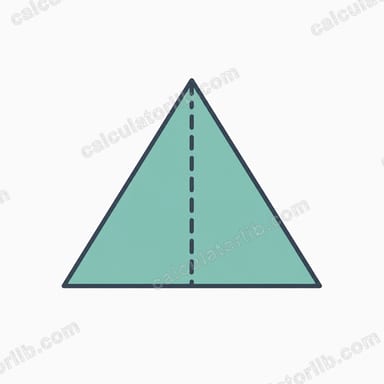
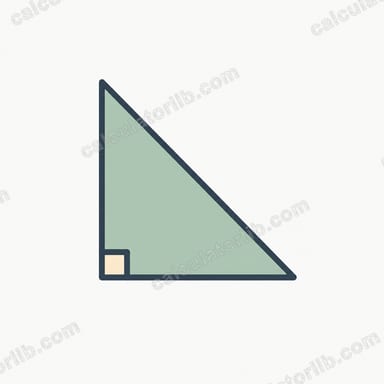
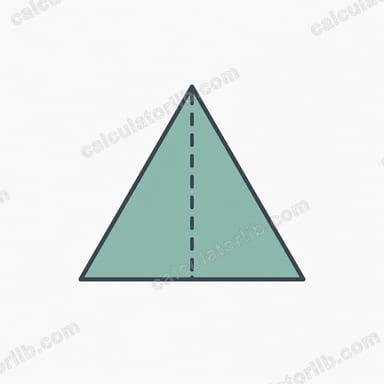
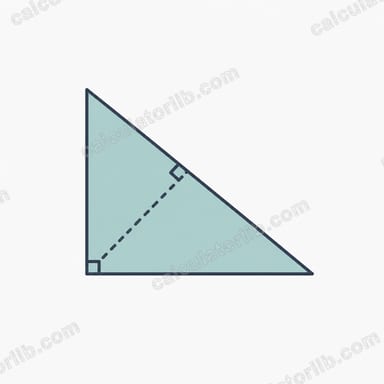
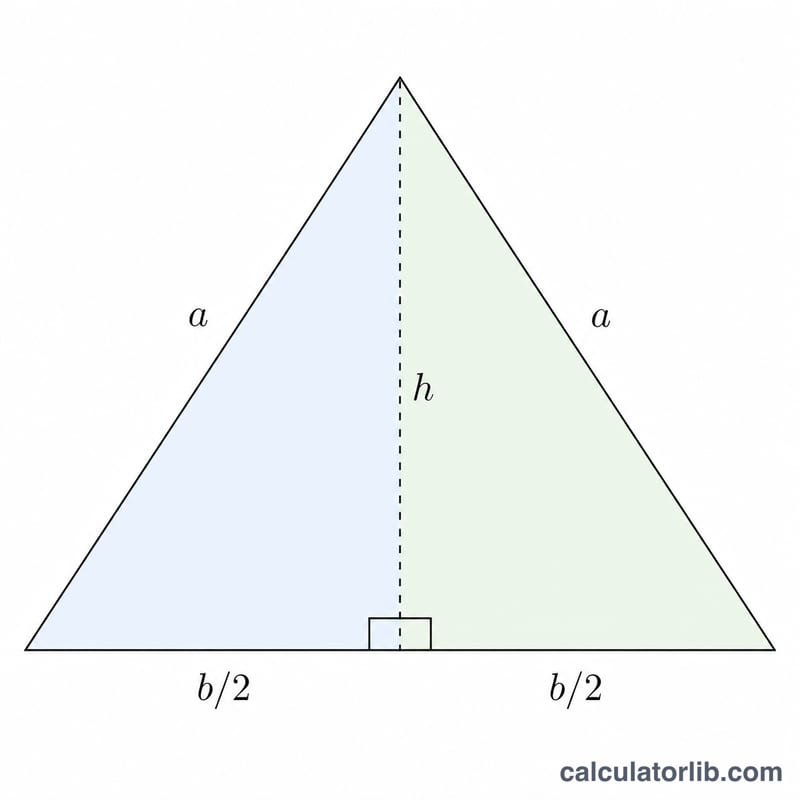
The altitude to the base splits the isosceles triangle into two congruent right triangles, each with horizontal leg b/2 and hypotenuse a. So the height to the base is \(h_b = \sqrt{a^2 - b^2/4}\). The area follows as $$K = \tfrac{1}{2} \times b \times h_b = \frac{b}{4}\sqrt{4a^2 - b^2},$$ identical to Heron's formula. Each altitude is then \(h_x = 2K / x\), so \(h_a = h_c = 2K/a\). The perimeter is \(P = 2a + b\) and the semiperimeter is \(s = P/2\).
Worked example
With a = 5 and b = 6: c = 5, \(P = 2(5) + 6 = 16\), s = 8. The base altitude is \(h_b = \sqrt{25 - 9} = 4\), so $$K = \tfrac{1}{2}(6)(4) = 12.$$ Then \(h_a = h_c = 24/5 = 4.8\). (Heron check: \(\sqrt{8\cdot 3\cdot 2\cdot 3} = \sqrt{144} = 12\).)
FAQ
When is the triangle invalid? It must satisfy the triangle inequality \(b < 2a\). If \(b = 2a\) the triangle is degenerate (zero area) and if \(b > 2a\) it cannot exist; the calculator reports an error in those cases.
Why are two altitudes equal? Because sides a and c are equal, the altitudes drawn to them, \(h_a\) and \(h_c\), are also equal.
Do the units matter? No — the unit is purely a label. Choosing cm versus m does not change the numbers; lengths come out in your chosen unit and area in that unit squared.