
What this calculator does
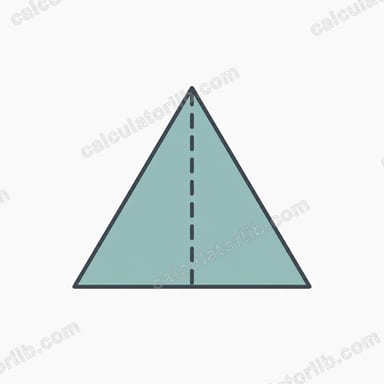
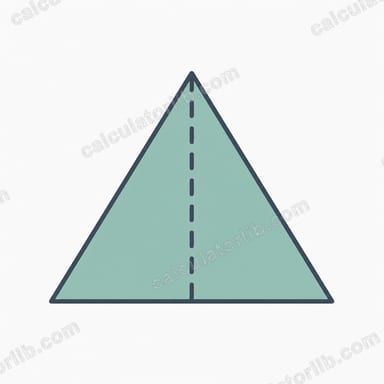
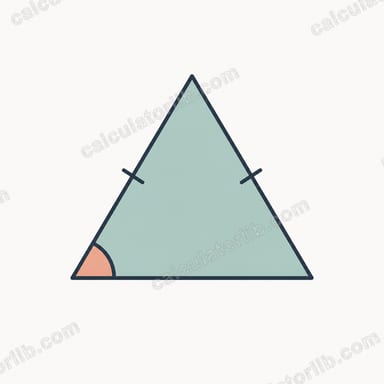
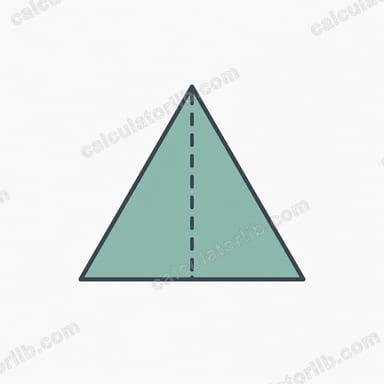
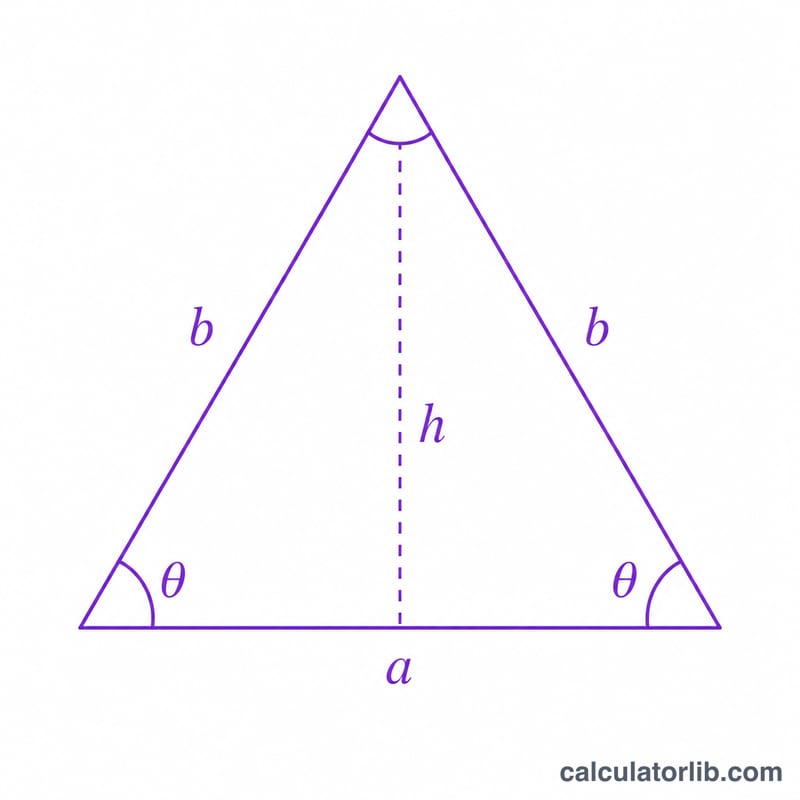
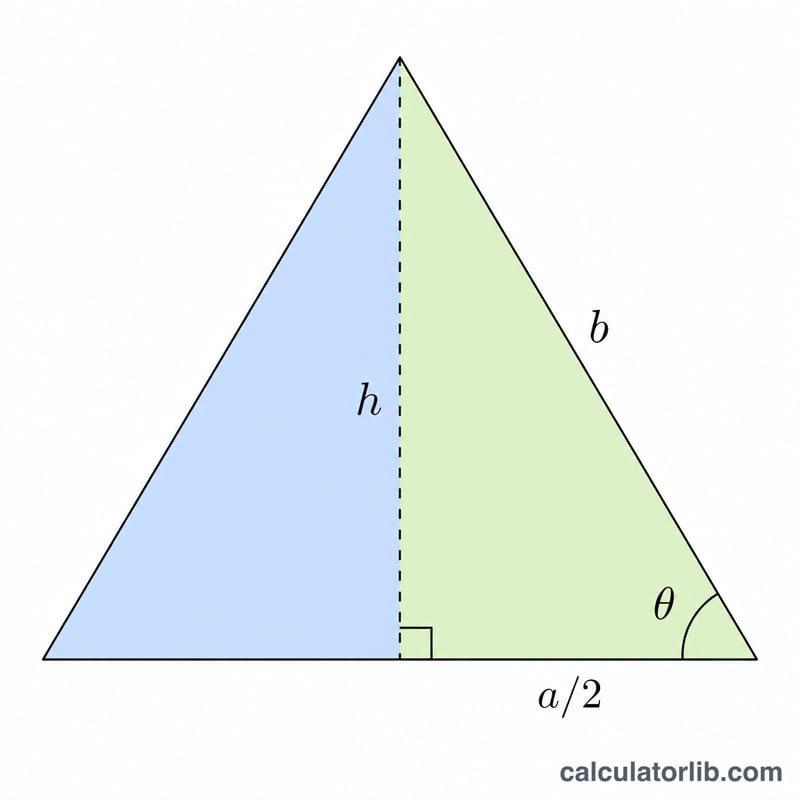
An isosceles triangle has two equal sides (the legs or slant sides, length b) and one unequal side (the base, length a). The two base angles are equal, and the altitude dropped from the apex perpendicular to the base bisects both the base and the apex angle. This solver computes every element of such a triangle — base, legs, height, base angle, apex angle, perimeter and area — from any two values you supply.
How to use it
Pick an input combination from the Input selection dropdown (for example "Base and Height" or "Leg/Slant and Base angle"). Then enter the two matching values in the x1 and x2 boxes in the order shown in the dropdown label. Lengths can be in any unit you like as long as you stay consistent; angles must be entered in degrees. Press calculate and the full set of triangle elements is returned.
The formulas explained
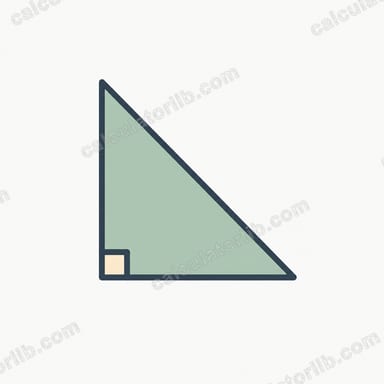
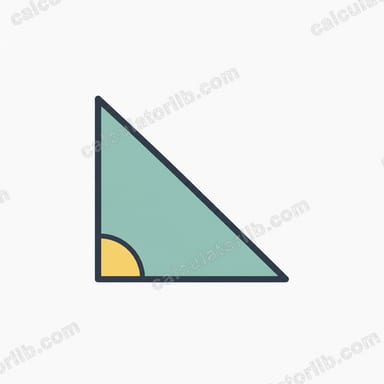
The altitude splits the isosceles triangle into two congruent right triangles whose legs are the half-base \(a/2\) and the height \(h\), with hypotenuse \(b\). From basic trigonometry: $$h = \frac{a}{2}\cdot\tan\theta = b\cdot\sin\theta,\quad a = 2b\cdot\cos\theta.$$ The base angle is \(\theta = \operatorname{atan}(2h/a)\), and the apex (vertex) angle is \(180^\circ - 2\theta\) because all interior angles sum to \(180^\circ\). The area follows from $$S = \tfrac12\cdot a\cdot h = \tfrac12\cdot b^2\cdot\sin(2\theta),$$ and the perimeter is \(a + 2b\).
Worked example
Choose "Base and Height" with \(a = 6\) and \(h = 4\). The half-base is 3, so \(\theta = \operatorname{atan}(4/3) = 53.13^\circ\). The leg is $$b = \sqrt{3^2 + 4^2} = \sqrt{25} = 5.$$ The apex angle is \(180 - 2\times 53.13 = 73.74^\circ\), the area is \(\tfrac12\times 6\times 4 = 12\), and the perimeter is \(6 + 2\times 5 = 16\). This is the familiar 3-4-5 right triangle doubled, confirming the relations.
FAQ
Why do I get "no valid triangle"? The inputs may violate the triangle inequality (for example a base that is at least twice the leg), or a base angle outside the open range 0° to 90°, or a non-positive length or area.
Are the two base angles always equal? Yes — that is the defining property of an isosceles triangle, which is why one base angle θ plus one length is enough to solve the whole figure.
Does the area-and-leg mode have two answers? Geometrically yes (an acute and an obtuse apex). This tool returns the principal acute solution from asin.