
What is the Triangle Sum Theorem?
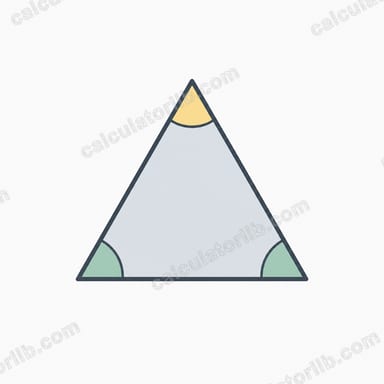
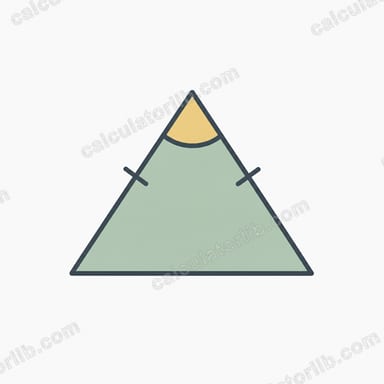
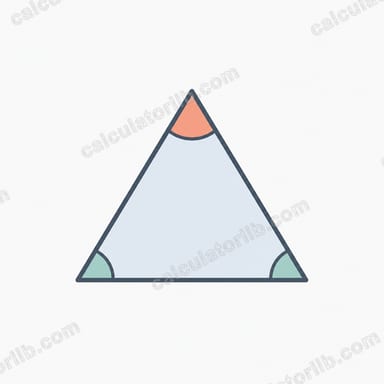
The Triangle Sum Theorem states that the three interior angles of any triangle always add up to exactly 180 degrees. This holds for every triangle — equilateral, isosceles, scalene, right, acute, or obtuse. Because of this rule, if you know any two angles of a triangle, you can always find the third.
How to use this calculator
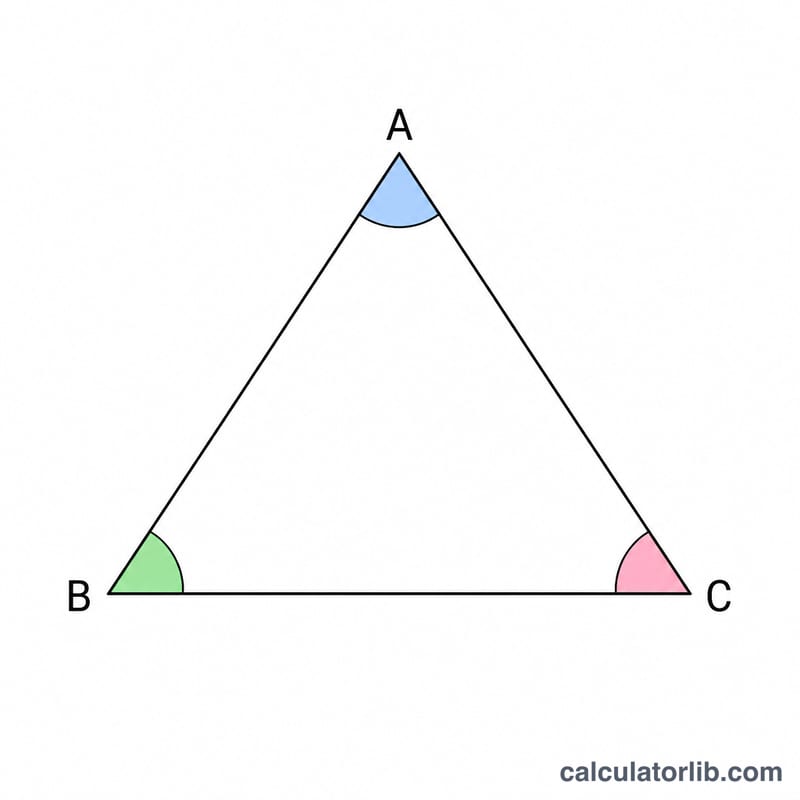
Enter the two angles you already know (Angle A and Angle B) in degrees. The calculator subtracts their sum from 180° to reveal the missing third angle, Angle C. It also checks that the result describes a valid triangle: every interior angle must be greater than 0°, which means the two known angles must total less than 180°.
The formula explained
Starting from $$\text{Angle A} + \text{Angle B} + \text{C} = 180^{\circ}$$ we isolate the unknown by rearranging: $$\text{C} = 180^{\circ} - \text{Angle A} - \text{Angle B}$$ Each known angle is simply subtracted from the total of 180°. If the two given angles already reach or exceed 180°, no valid triangle can be formed.
Worked example
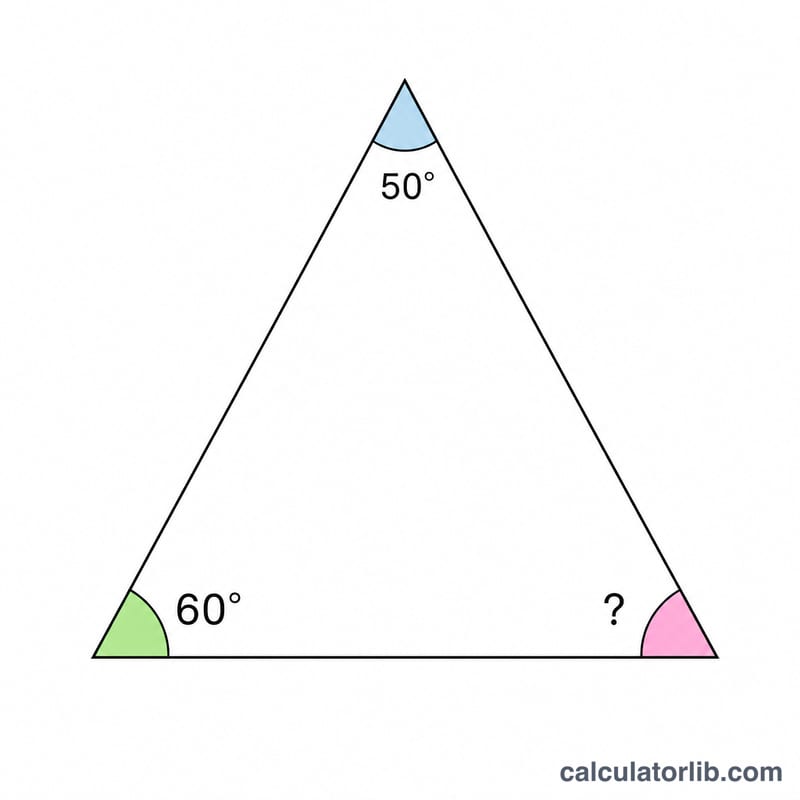
Suppose Angle A = 45° and Angle B = 75°. Then $$C = 180 - 45 - 75 = 60^{\circ}$$ Checking: \(45 + 75 + 60 = 180^{\circ}\), so this is a valid triangle. For a right triangle with A = 90° and B = 30°, $$C = 180 - 90 - 30 = 60^{\circ}$$
FAQ
Does this work for all triangles? Yes — the 180° rule applies to every triangle in Euclidean geometry.
What if my two angles add up to more than 180°? Then no valid triangle exists, and the calculator flags it as invalid.
Can a triangle have two right angles? No. Two 90° angles already total 180°, leaving 0° for the third angle, which is impossible.