
What this calculator does
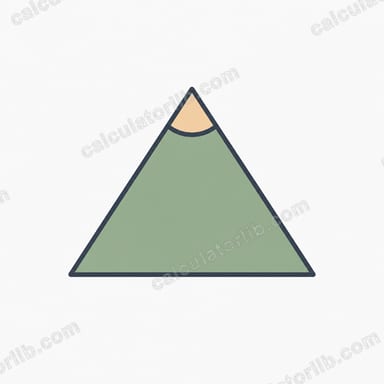
This is an SAS (Side-Angle-Side) triangle solver. Given two sides of a triangle and the angle between them, it computes the third side, both remaining angles, the perimeter and the area. It uses the Law of Cosines to find the missing side and the Law of Sines to recover the angles — the same approach used in trigonometry, surveying, navigation and engineering.
How to use it
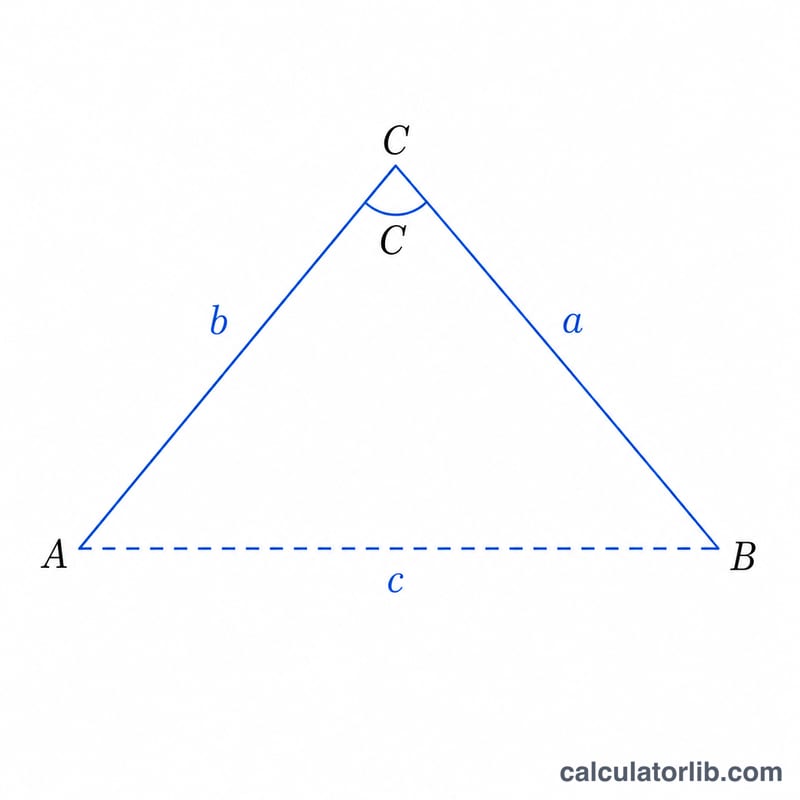
Enter the lengths of side a and side b (any unit, as long as both match), then enter the included angle C in degrees — this is the angle formed where sides a and b meet. Click calculate. The result shows side c (opposite angle C), angle A (opposite side a), angle B (opposite side b), the perimeter and the area.
The formulas explained
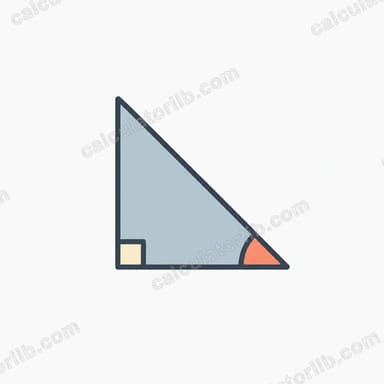
The Law of Cosines generalizes the Pythagorean theorem: c² = a² + b² − 2ab·cos C. When C is 90°, cos C = 0 and it reduces to c² = a² + b². Once c is known, the Law of Sines, a/sin A = c/sin C, gives angle A. The last angle follows from the fact that all three add to 180°: B = 180° − C − A. The area uses ½·a·b·sin C.
Worked example
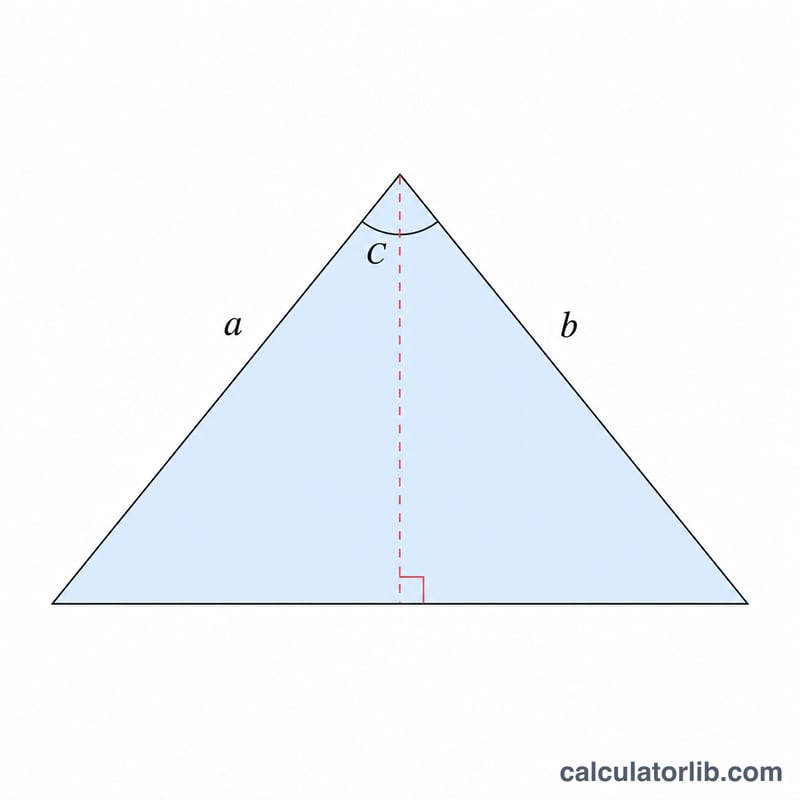
Suppose a = 5, b = 7 and the included angle C = 60°. Then \(c^{2} = 25 + 49 - 2\cdot 5\cdot 7\cdot\cos 60^{\circ} = 74 - 70\cdot 0.5 = 39\), so \(c = \sqrt{39} \approx 6.245\). Angle \(A = \arcsin\!\left(\dfrac{5\cdot\sin 60^{\circ}}{6.245}\right) \approx 43.9^{\circ}\), and \(B = 180 - 60 - 43.9 \approx 76.1^{\circ}\). The area is \(\tfrac{1}{2}\cdot 5\cdot 7\cdot\sin 60^{\circ} \approx 15.16\) square units.
FAQ
What is the "included" angle? It is the angle located between the two sides you entered (a and b). It is opposite the side you are solving for.
Can I use any units? Yes — feet, meters, inches, anything — as long as sides a and b use the same unit. Angles must be in degrees.
Why does my angle look wrong? This solver assumes a valid SAS triangle with the angle strictly between 0° and 180°; arcsin returns the acute solution, which is always correct for an included angle case.