
What This Calculator Does
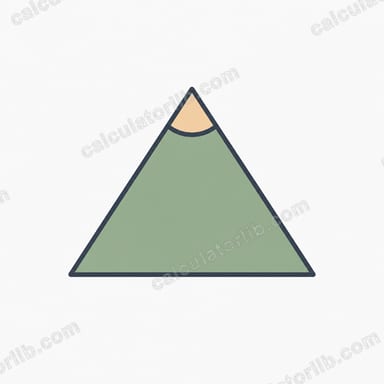
The Triangle Angle Calculator finds all three interior angles of a triangle when you know the lengths of its three sides — the classic SSS (side-side-side) case. Because the three sides completely determine the shape of a triangle, there is exactly one set of angles for any valid set of sides. The tool uses the law of cosines to recover those angles in degrees.
How to Use It
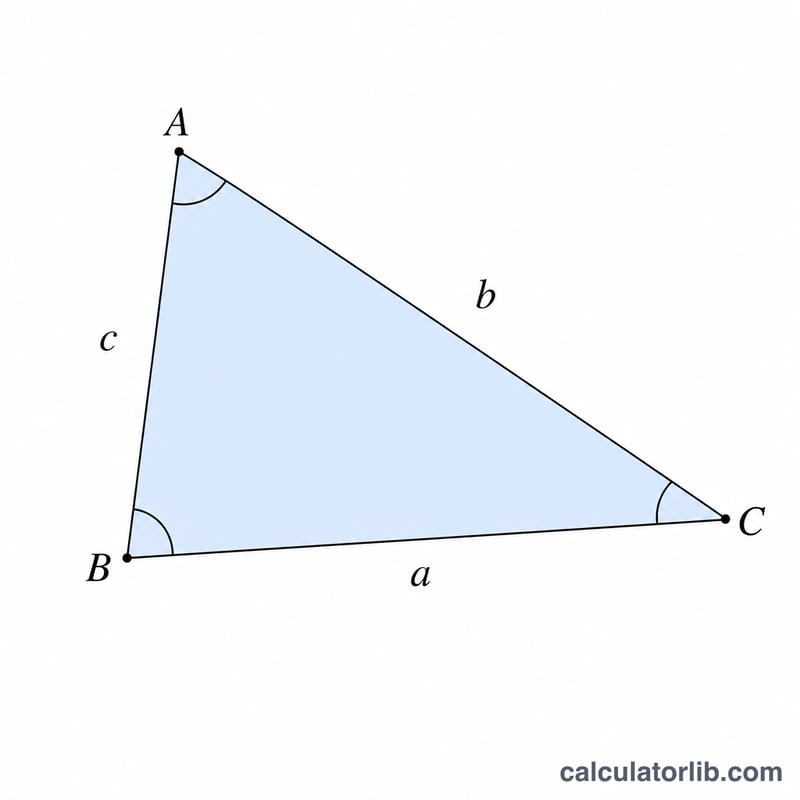
Enter the three side lengths in the boxes labeled a, b and c. Angle A is the angle opposite side a, angle B is opposite side b, and angle C is opposite side c. Press calculate and you'll see each angle, plus a reminder that they always add to 180°. The sides can be in any unit (cm, inches, meters) since angles depend only on their ratios — just keep them consistent.
The Formula Explained
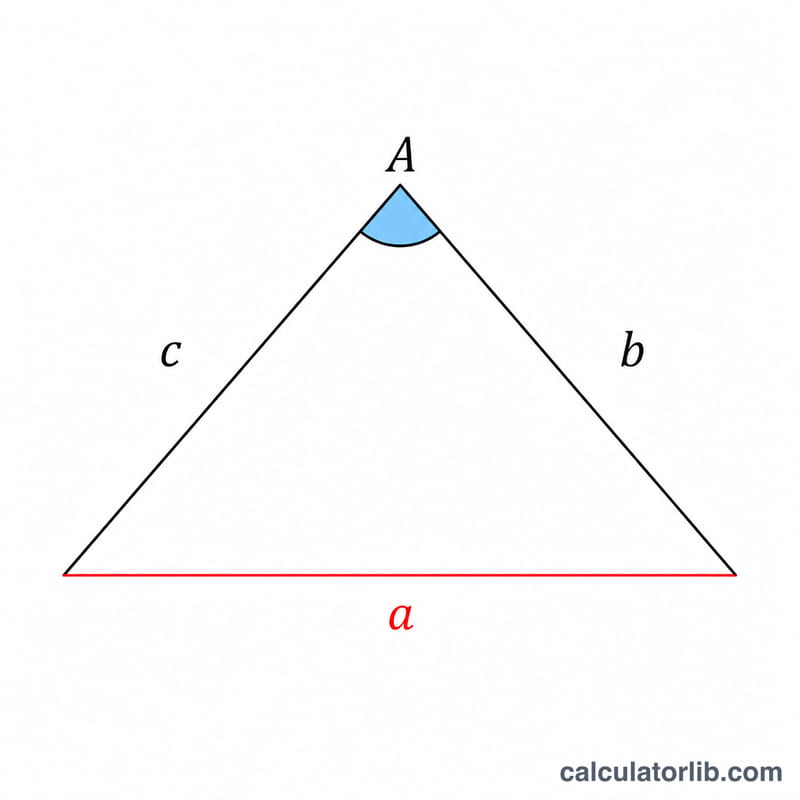
The law of cosines generalizes the Pythagorean theorem: for any triangle, $$a^2 = b^2 + c^2 - 2bc\cdot\cos A.$$ Rearranging gives $$\cos A = \frac{b^2 + c^2 - a^2}{2bc},$$ so \(A = \cos^{-1}(\ldots)\). The same approach gives angle B. The last angle follows instantly from the rule that all three interior angles sum to 180°: $$C = 180^\circ - A - B.$$
Worked Example
Take a 3-4-5 right triangle (a=3, b=4, c=5). For angle A: $$\cos A = \frac{16 + 25 - 9}{2\times4\times5} = \frac{32}{40} = 0.8,$$ so \(A = 36.87^\circ\). For angle B: $$\cos B = \frac{9 + 25 - 16}{2\times3\times5} = \frac{18}{30} = 0.6,$$ so \(B = 53.13^\circ\). Then \(C = 180 - 36.87 - 53.13 = 90^\circ\) — confirming it's a right triangle.
FAQ
What if my sides don't form a triangle? The longest side must be shorter than the sum of the other two (the triangle inequality). If not, no triangle exists and the calculator returns zeros.
Does the unit of length matter? No. Angles depend only on the ratios of the sides, so any consistent unit gives the same angles.
Can I use this for an equilateral triangle? Yes — enter three equal sides and you'll get 60°, 60°, 60°.