
What Is the Triangle Inequality Theorem?
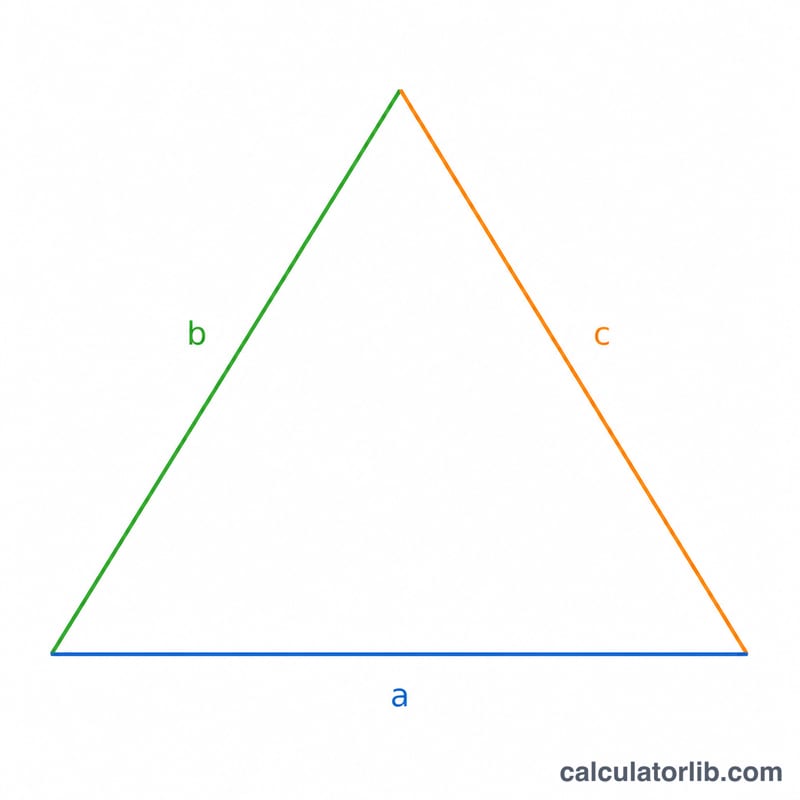
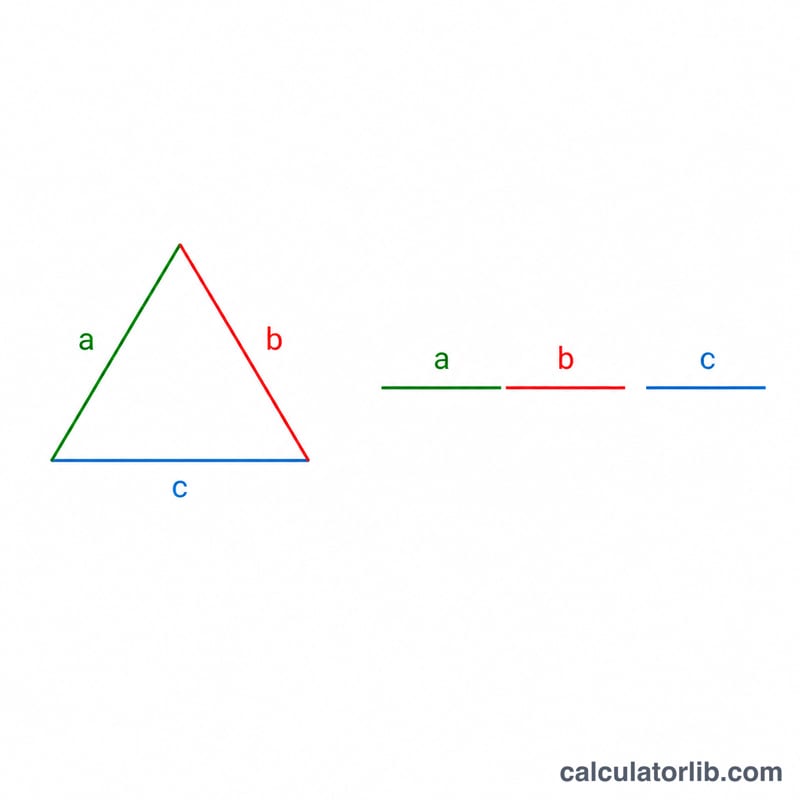
The triangle inequality theorem states that for any triangle, the sum of the lengths of any two sides must be strictly greater than the length of the remaining side. If even one of these three conditions fails, the three lengths cannot close up into a triangle. This calculator checks all three inequalities at once and tells you whether your sides form a valid triangle.
How to Use This Calculator
Enter the three side lengths a, b, and c in any units (they just need to be consistent). The calculator evaluates each of the three inequalities and shows a Pass or Fail for each, plus an overall verdict. All sides must be positive numbers.
The Formula Explained
A set of three positive lengths forms a triangle if and only if:
$$\begin{gathered} a + b > c \\[0.6em] a + c > b \\[0.6em] b + c > a \end{gathered}$$
The inequalities are strict. If a sum exactly equals the third side (for example \(2 + 3 = 5\)), the triangle is "degenerate" — the three points lie on a straight line and enclose zero area, so it is not counted as a valid triangle.
Worked Example
Take sides 3, 4, and 5. Check: \(3 + 4 = 7 > 5\) ✓, \(3 + 5 = 8 > 4\) ✓, \(4 + 5 = 9 > 3\) ✓. All three pass, so 3-4-5 is a valid triangle (in fact a right triangle).
FAQ
What if two sides add up to exactly the third? That is a degenerate triangle with zero area, so it is reported as not a valid triangle.
Do the units matter? No, as long as all three sides use the same unit. The test only compares relative magnitudes.
Why do I only need to check three conditions? Each pair of sides gives one inequality, and a triangle has exactly three pairs, so three checks fully determine validity.