What this calculator does
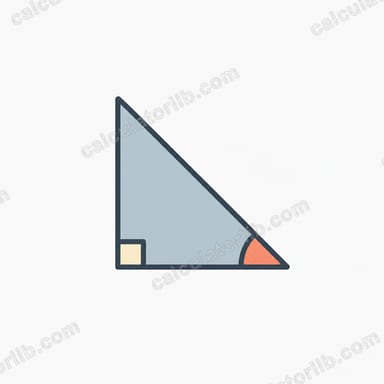
The Angle of Right Triangle Calculator finds an acute angle of a right triangle when you know any two of its three sides. A right triangle has one 90° angle, so the remaining two angles are acute and always add up to 90°. By supplying any two sides — the opposite leg, the adjacent leg, or the hypotenuse — this tool returns the angle in both degrees and radians, along with the complementary angle.
How to use it
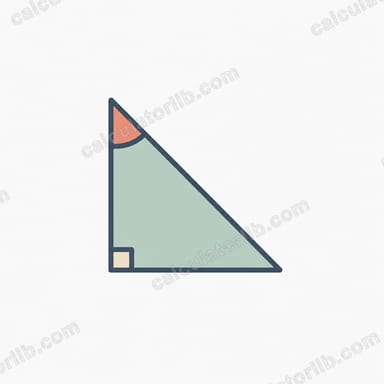
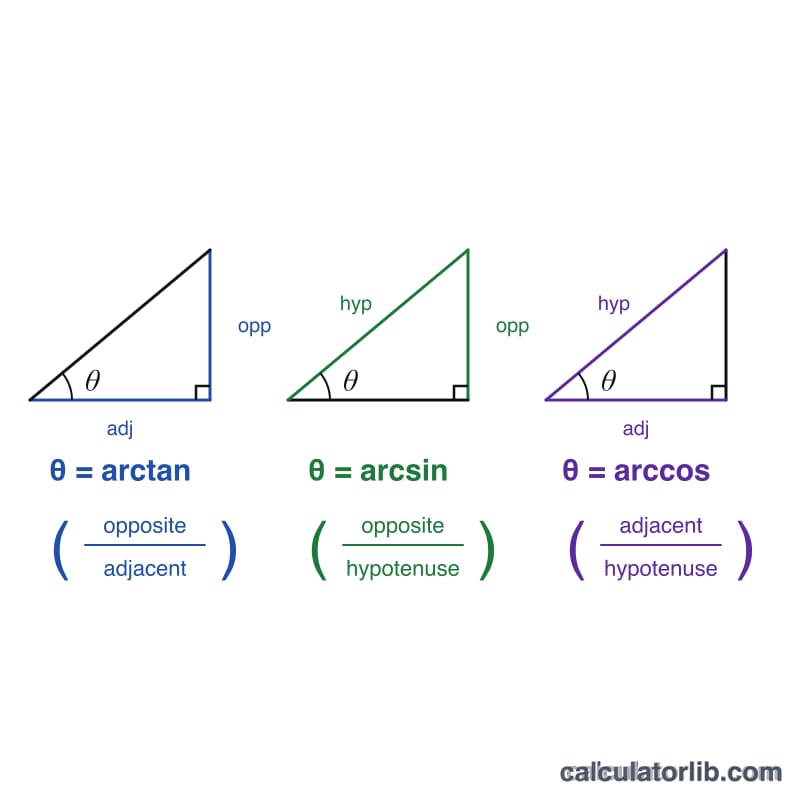
Label the sides relative to the angle θ you want to find: the opposite side faces θ, the adjacent side touches θ (and is not the hypotenuse), and the hypotenuse is the longest side opposite the right angle. Enter any two of these values and leave the third blank. The calculator automatically picks the correct inverse trigonometric function based on which sides you provided.
The formula explained
From SOHCAHTOA, three relationships let us solve for θ:
• If you know both legs: $$\theta = \arctan\!\left(\frac{\text{Opposite (a)}}{\text{Adjacent (b)}}\right)$$
• If you know the opposite leg and hypotenuse: $$\theta = \arcsin\!\left(\frac{\text{Opposite (a)}}{\text{Hypotenuse (c)}}\right)$$
• If you know the adjacent leg and hypotenuse: $$\theta = \arccos\!\left(\frac{\text{Adjacent (b)}}{\text{Hypotenuse (c)}}\right)$$
Each ratio is a number between 0 and 1 (or larger for tangent), and applying the inverse function returns the angle.

Worked example
Suppose the opposite side is 3 and the adjacent side is 4. Then $$\theta = \arctan(3 \div 4) = \arctan(0.75) \approx 36.8699°.$$ The complementary angle is \(90 - 36.8699 = 53.1301°\). In radians the angle is about \(0.6435\). This is the familiar 3-4-5 right triangle.
Common Right Triangle Angles and Side Ratios
These are the angles that come up most often, with their exact trigonometric values and decimal approximations. In each row the ratio is written opposite : adjacent : hypotenuse relative to the listed angle. The two acute angles of a right triangle always add up to 90°, so each row's complementary angle has sine and cosine swapped.
| Angle (degrees) | Angle (radians) | sin | cos | tan | Opposite : Adjacent : Hypotenuse |
|---|---|---|---|---|---|
| 30° | π/6 ≈ 0.5236 | 1/2 = 0.5 | √3/2 ≈ 0.8660 | √3/3 ≈ 0.5774 | 1 : √3 : 2 |
| 45° | π/4 ≈ 0.7854 | √2/2 ≈ 0.7071 | √2/2 ≈ 0.7071 | 1 | 1 : 1 : √2 |
| 60° | π/3 ≈ 1.0472 | √3/2 ≈ 0.8660 | 1/2 = 0.5 | √3 ≈ 1.7321 | √3 : 1 : 2 |
| 36.87° (3-4-5) | ≈ 0.6435 | 3/5 = 0.6 | 4/5 = 0.8 | 3/4 = 0.75 | 3 : 4 : 5 |
| 53.13° (3-4-5) | ≈ 0.9273 | 4/5 = 0.8 | 3/5 = 0.6 | 4/3 ≈ 1.3333 | 4 : 3 : 5 |
| 22.62° (5-12-13) | ≈ 0.3948 | 5/13 ≈ 0.3846 | 12/13 ≈ 0.9231 | 5/12 ≈ 0.4167 | 5 : 12 : 13 |
| 67.38° (5-12-13) | ≈ 1.1760 | 12/13 ≈ 0.9231 | 5/13 ≈ 0.3846 | 12/5 = 2.4 | 12 : 5 : 13 |
| 28.07° (8-15-17) | ≈ 0.4899 | 8/17 ≈ 0.4706 | 15/17 ≈ 0.8824 | 8/15 ≈ 0.5333 | 8 : 15 : 17 |
| 61.93° (8-15-17) | ≈ 1.0809 | 15/17 ≈ 0.8824 | 8/17 ≈ 0.4706 | 15/8 = 1.875 | 15 : 8 : 17 |
Angles for the Pythagorean triples are rounded to two decimal places.
FAQ
Which two sides should I enter? Any two — the tool detects whether to use arctan, arcsin, or arccos.
Why is my answer the same for legs 3,4 as for 6,8? Because angles depend on ratios, not absolute size; both give \(36.87°\).
Can the angle exceed 90°? No. In a right triangle the two non-right angles are always acute (less than 90°).