
What is a cyclic quadrilateral?
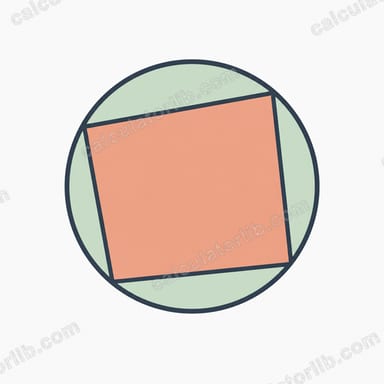
A cyclic quadrilateral is a four-sided polygon whose vertices all lie on a single circle. Among all quadrilaterals that share the same four side lengths, the cyclic one encloses the maximum possible area. This calculator uses Brahmagupta's formula to return that area together with the perimeter, given the four side lengths a, b, c and d.
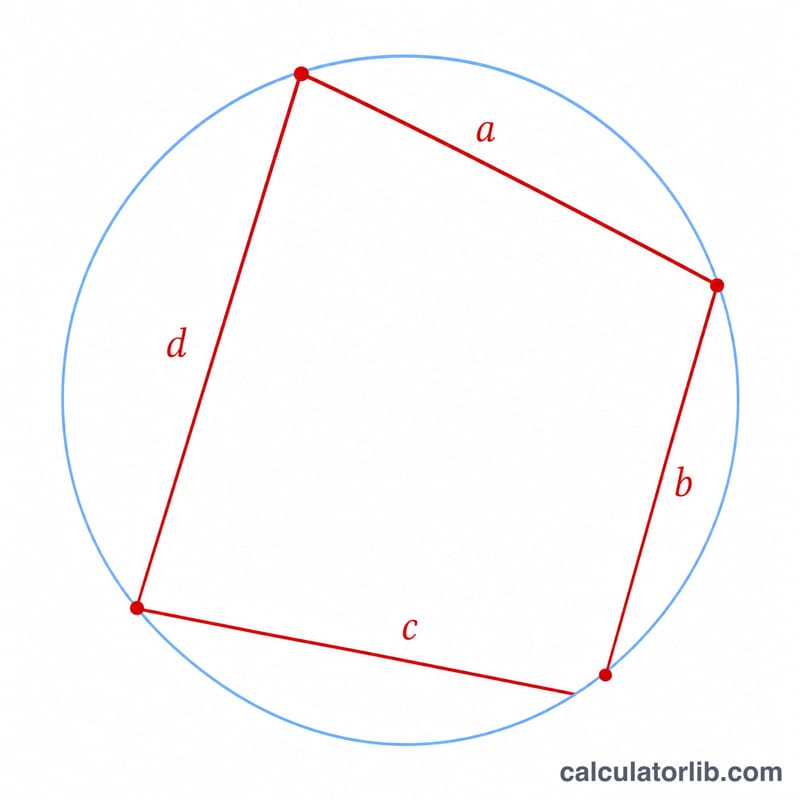
How to use it
Enter the four side lengths in any single, consistent length unit (all four must use the same unit). Press calculate. The area is returned in that unit squared and the perimeter in the original unit. If the lengths cannot form a real quadrilateral, the tool reports that no such shape exists.
The formula explained
First compute the semiperimeter \(s = (a + b + c + d) / 2\). Then the area is $$S = \sqrt{(s - a)(s - b)(s - c)(s - d)}.$$ The perimeter is simply $$L = a + b + c + d.$$ For the shape to exist, each side must be positive and shorter than the sum of the other three, which guarantees every factor under the square root is non-negative.
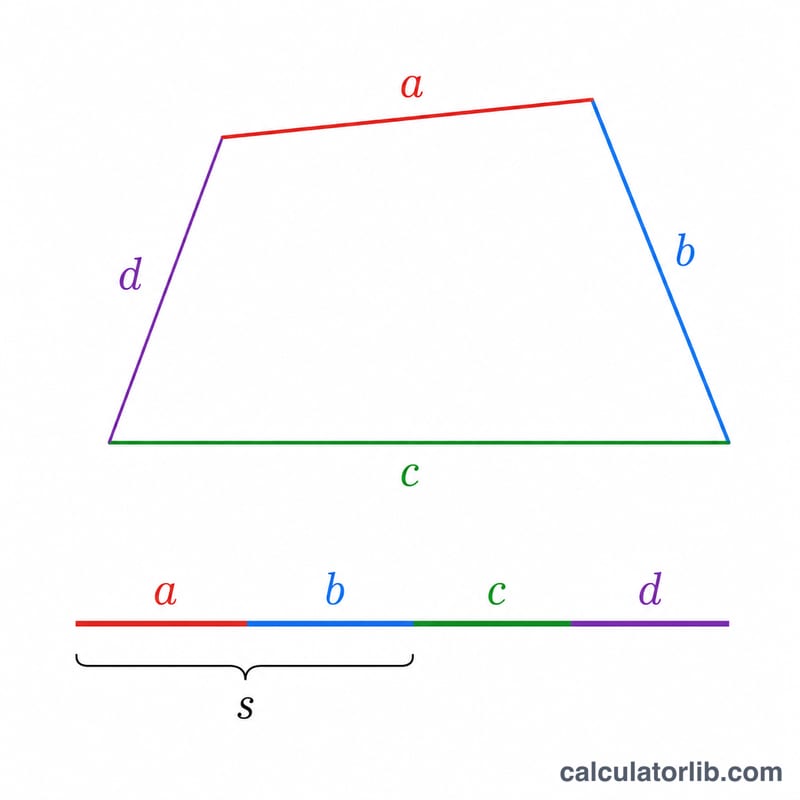
Worked example
For \(a = 13\), \(b = 14\), \(c = 3\), \(d = 13\): $$s = \frac{43}{2} = 21.5.$$ The factors are 8.5, 7.5, 18.5 and 8.5, whose product is 10024.6875. The area is $$\sqrt{10024.6875} \approx 100.12,$$ and the perimeter is 43.
FAQ
Does it work for any quadrilateral? Brahmagupta's formula is exact only for cyclic quadrilaterals; for other quadrilaterals it gives the maximum area attainable with those sides.
What if one side equals the sum of the others? The shape is degenerate (flat) and the area is zero.
What units does it use? Any consistent length unit you choose; area comes out in that unit squared.