
What this calculator does
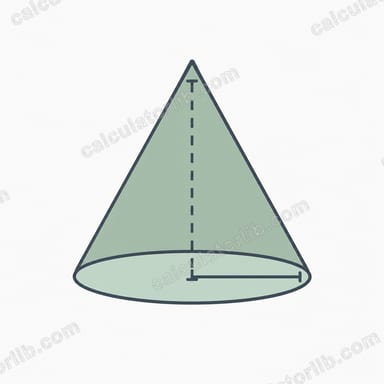
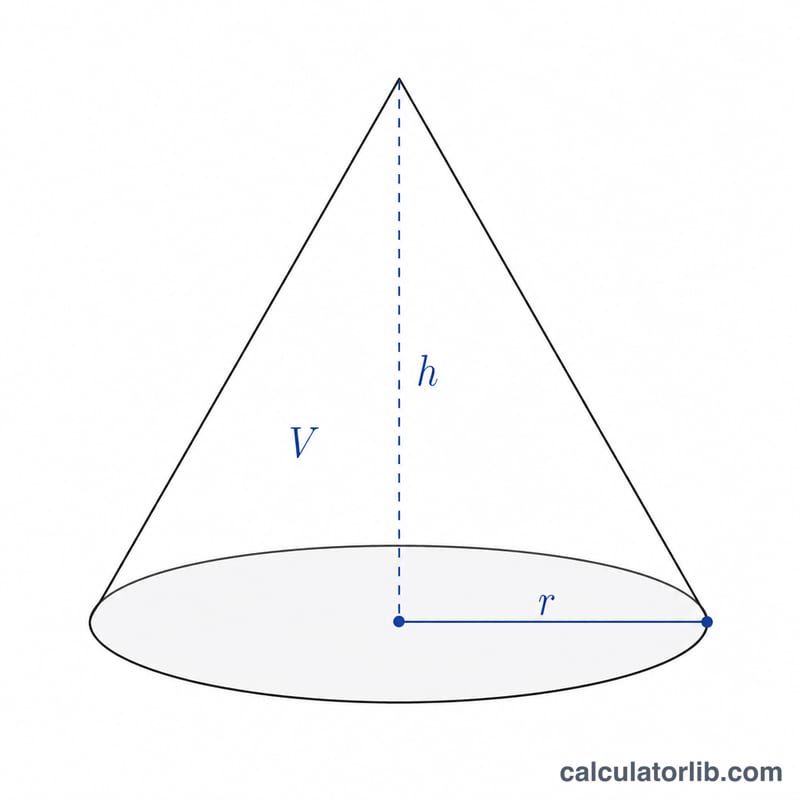
This tool finds the base radius of a cone when you already know its volume and height. It rearranges the standard cone volume formula to solve for the radius, so you don't have to do the algebra yourself. It works with any consistent units — if your volume is in cubic centimetres and your height in centimetres, the radius comes out in centimetres.
How to use it
Enter the cone's volume (V) and its height (h), then read off the radius. The calculator also shows the diameter, which is simply twice the radius. Make sure your volume and height share compatible units (e.g. cm³ with cm, or m³ with m) so the result is meaningful.
The formula explained
The volume of a cone is \(V = \tfrac{1}{3}\cdot\pi\cdot r^2\cdot h\). Solving for \(r\) gives:
$$r = \sqrt{\dfrac{3 \cdot \text{Volume }(V)}{\pi \cdot \text{Height }(h)}}$$
Multiply the volume by 3, divide by π times the height, then take the square root. Height must be greater than zero, otherwise the radius is undefined (you cannot divide by zero).
Worked example
Suppose a cone has a volume of 100 and a height of 10. Then \(3V = 300\), and \(\pi\cdot h \approx 31.4159\). So $$r = \sqrt{\dfrac{300}{31.4159}} = \sqrt{9.5493} \approx 3.0902.$$ The diameter is about 6.1804.
FAQ
What units does it use? Any units, as long as the volume and height are consistent (e.g. cm³ and cm give a radius in cm).
Why does height need to be positive? The formula divides by the height, so a height of zero or negative has no physical meaning for a cone.
Can I get the diameter too? Yes — the result table shows the diameter, which equals \(2 \times \text{radius}\).