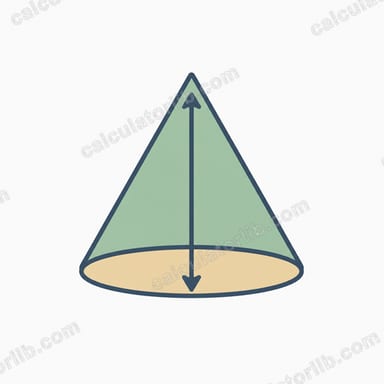
What is the Cone Calculator?
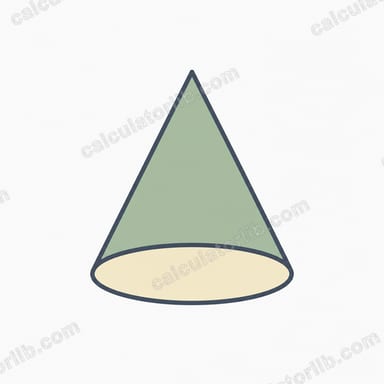
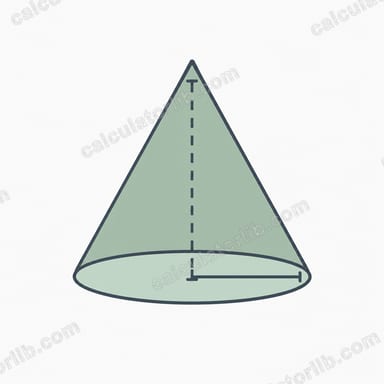
This calculator works out the key geometric properties of a right circular cone — its volume, slant height, base area, lateral (side) surface area, and total surface area — directly from the base radius and the perpendicular height. It is a universal math tool that applies anywhere; just keep your radius and height in the same unit and your results will be in matching square and cubic units.

How to use it
Enter the base radius (r) and the vertical height (h) of the cone, then read off the results. Volume is reported in cubic units; areas in square units. The slant height is computed automatically as the distance from the apex down the side to the edge of the base.
The formulas explained
The volume of a cone is exactly one-third of the cylinder that would enclose it: \( V = \tfrac{1}{3}\pi r^{2} h \). The slant height comes from the Pythagorean theorem, \( l = \sqrt{r^{2}+h^{2}} \), because the radius and height form a right angle at the centre of the base. The curved side, when unrolled, gives the lateral surface area \( \pi r l \), and adding the circular base area \( \pi r^{2} \) yields the total surface area \( \pi r\left(r + l\right) \).

Worked example
For a cone with \( r = 3 \) and \( h = 4 \): the slant height is $$\sqrt{9 + 16} = \sqrt{25} = 5.$$ Volume $$= \tfrac{1}{3}\cdot\pi\cdot 9\cdot 4 = 12\pi \approx 37.70.$$ Lateral area $$= \pi\cdot 3\cdot 5 = 15\pi \approx 47.12.$$ Total area $$= \pi\cdot 3\cdot(3 + 5) = 24\pi \approx 75.40.$$
FAQ
Is this for a right cone only? Yes — the surface-area formulas assume a right circular cone (apex directly above the centre of the base).
What units should I use? Any unit, as long as radius and height match. Areas come out squared and volume cubed in that unit.
What is slant height? It is the straight-line distance from the tip of the cone to the rim of the base, equal to \( \sqrt{r^{2}+h^{2}} \).