
What is De Moivre Theorem?
De Moivre theorem provides an elegant way to raise a complex number to any power. Instead of repeatedly multiplying out a binomial, you express the complex number in polar form — using its modulus \(r\) and argument \(\theta\) — and then simply raise \(r\) to the power \(n\) and multiply the angle by \(n\). This calculator handles the conversion and computation for you, returning the result in both polar and rectangular (\(a + bi\)) form.
How to use this calculator
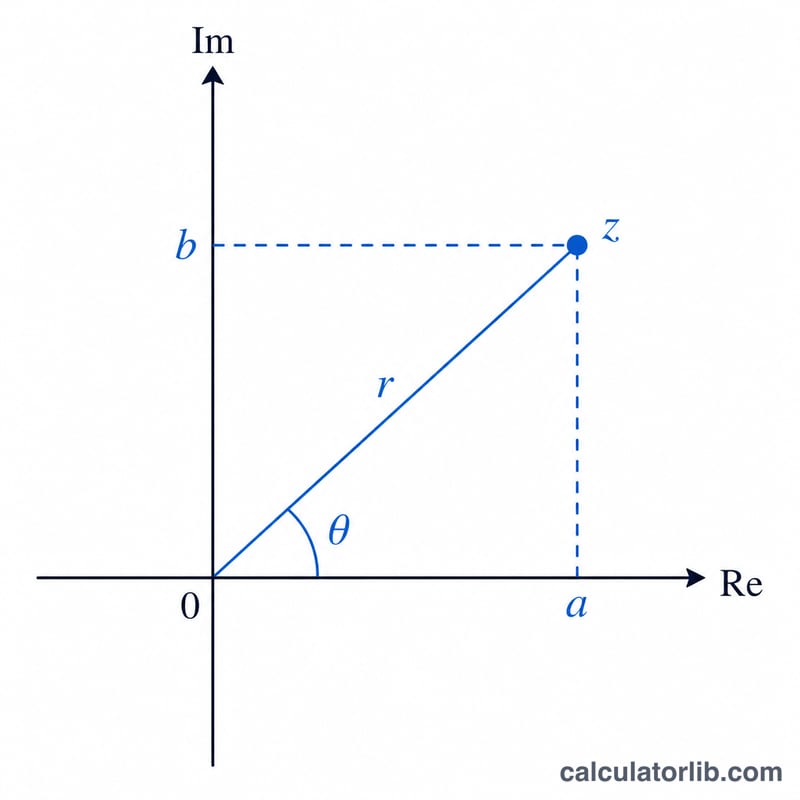
Enter the real part \(a\) and imaginary part \(b\) of your complex number \(z = a + bi\), then enter the exponent \(n\). The tool computes the polar form, applies De Moivre theorem, and reports the resulting real part, imaginary part, modulus, and argument. The exponent can be any real number, including fractions for roots and negatives for reciprocals.
The formula explained
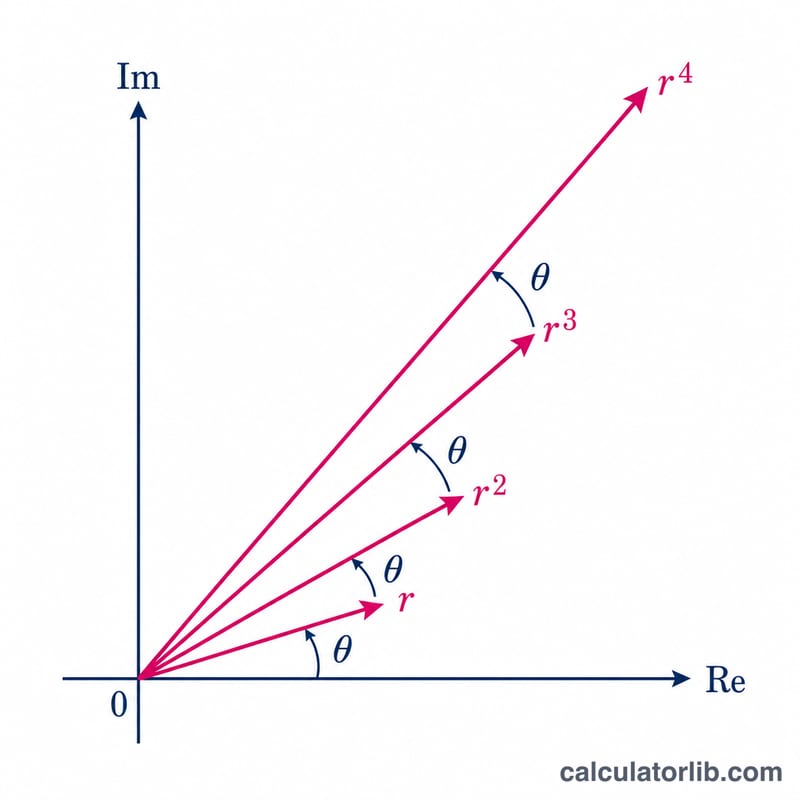
First convert to polar form: \(r = \sqrt{a^{2} + b^{2}}\) is the distance from the origin, and \(\theta = \operatorname{atan2}(b, a)\) is the angle. De Moivre theorem then states $$\left(r(\cos\theta + i\sin\theta)\right)^{n} = r^{n}(\cos n\theta + i\sin n\theta).$$ The new modulus is \(r^{n}\) and the new argument is \(n\theta\). Converting back gives the rectangular form $$r^{n}\cdot\cos(n\theta) + i\cdot r^{n}\cdot\sin(n\theta).$$
Worked example
Take \(z = 1 + i\) with \(n = 2\). Here \(r = \sqrt{1^{2} + 1^{2}} = \sqrt{2}\) and \(\theta = 45°\). By De Moivre, the modulus becomes \((\sqrt{2})^{2} = 2\) and the argument becomes \(2 \times 45° = 90°\). So $$z^{2} = 2(\cos 90° + i\sin 90°) = 0 + 2i.$$ You can verify directly: $$(1 + i)^{2} = 1 + 2i + i^{2} = 2i. \checkmark$$
FAQ
Can n be negative or fractional? Yes. A negative \(n\) gives the reciprocal power and a fractional \(n\) gives one of the roots (the principal root, corresponding to the principal argument).
Why use atan2 instead of arctan? \(\operatorname{atan2}(b, a)\) returns the correct quadrant for the angle, whereas plain \(\arctan(b/a)\) loses sign information and fails when \(a = 0\).
What if z = 0? The modulus is \(0\), so \(0^{n} = 0\) for positive \(n\); the argument is undefined but treated as \(0\) here.