
What It Does
This calculator simplifies the square root of a negative number into the form \(i\cdot\sqrt{n}\), where \(i\) is the imaginary unit (\(i^2 = -1\)). Since no real number squared gives a negative result, the square root of a negative number is a pure imaginary number.
How to Use It
Enter any number. If it is negative, the calculator factors out \(-1\) and returns the imaginary coefficient. If it is zero or positive, it simply returns the ordinary real square root.
The Formula
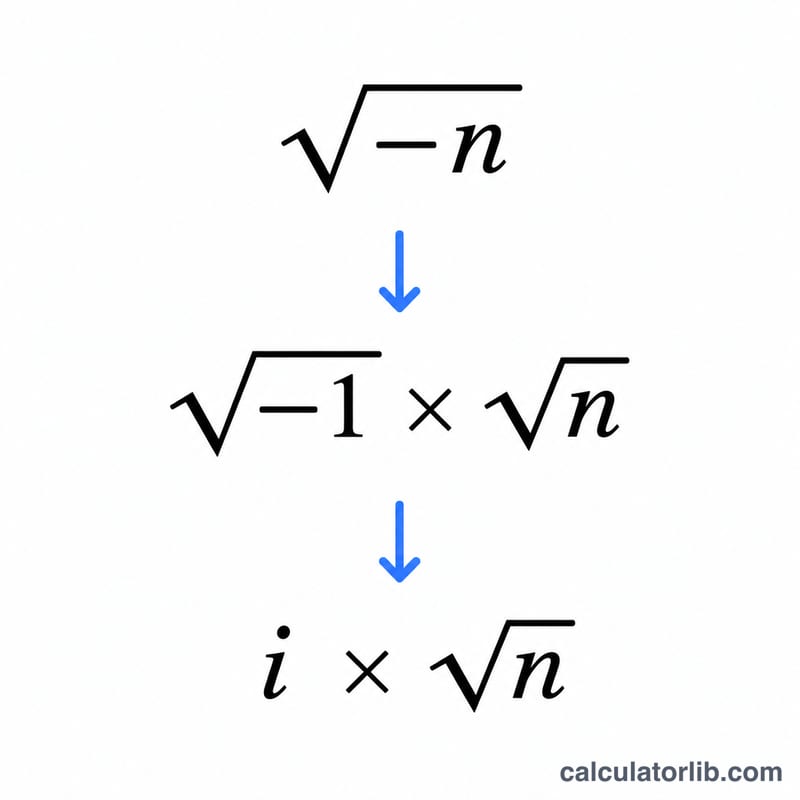
For any \(n > 0\):
$$\sqrt{-n} = \sqrt{-1}\cdot\sqrt{n} = i\cdot\sqrt{n}$$The displayed coefficient is \(\sqrt{n}\), the square root of the absolute value of your input.
Worked Example
Take \(\sqrt{-25}\). The absolute value is 25, and \(\sqrt{25} = 5\). Therefore
$$\sqrt{-25} = 5i$$For \(\sqrt{-18}\): \(\sqrt{18} \approx 4.242640\), so the answer is about \(4.242640i\).
FAQ
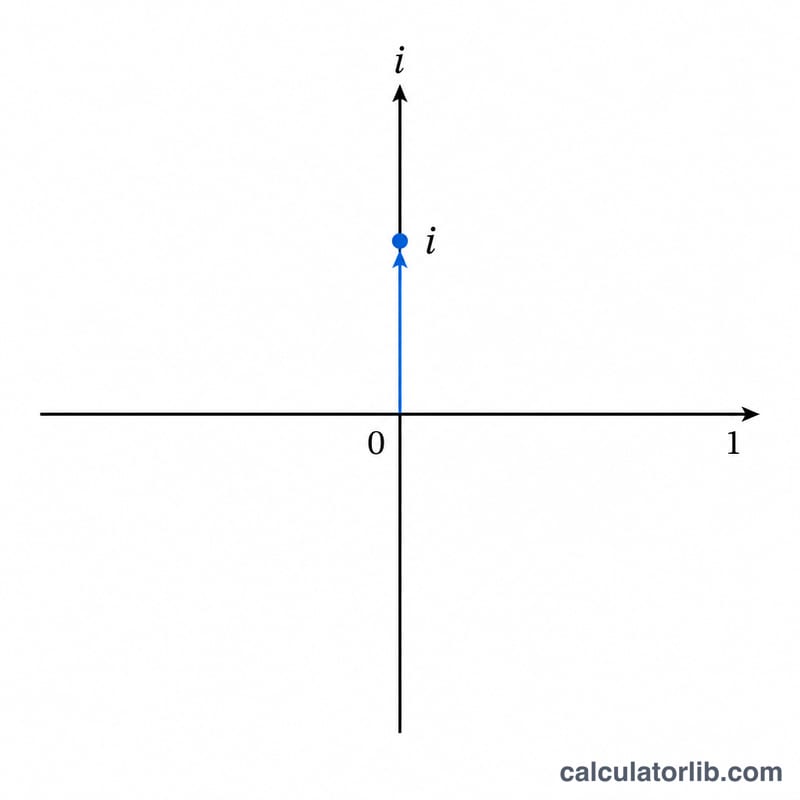
Why does a negative square root need i? Because squaring any real number yields a non-negative result, so the real number line cannot represent \(\sqrt{-1}\). Mathematicians define \(i = \sqrt{-1}\) to extend the numbers.
What if I enter a positive number? The result is just the ordinary real square root with no imaginary part.
Is the answer unique? Like all square roots there are two values (\(\pm 5i\) for \(-25\)); the principal value \(5i\) is shown.