
What Is a Square Root?
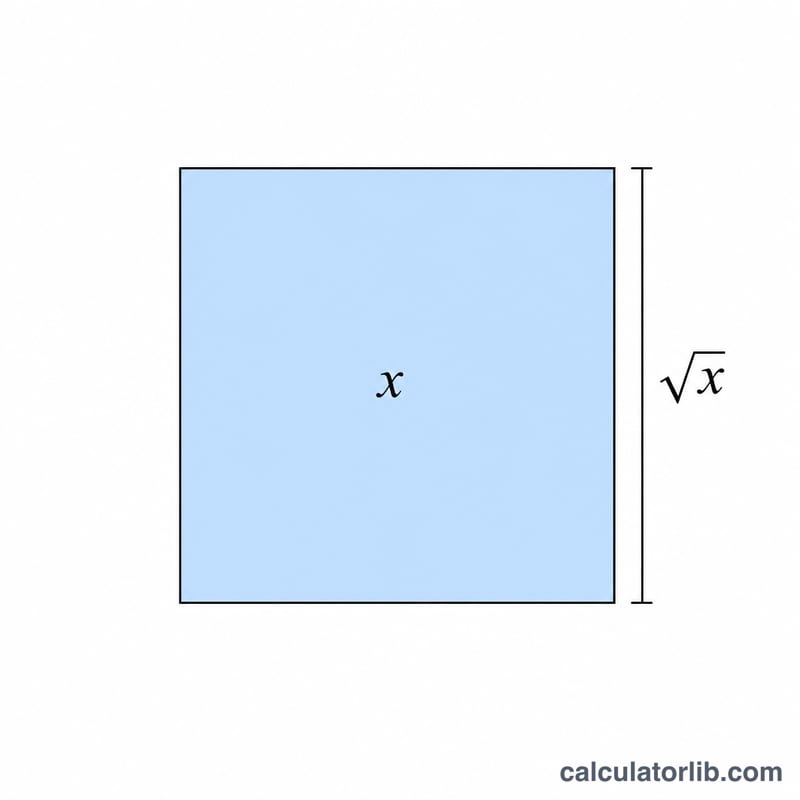
The square root of a number x is the value that, when multiplied by itself, produces x. It is written as \(\sqrt{x}\). For example, the square root of 25 is 5 because \(5 \times 5 = 25\). Every positive number has two square roots — one positive and one negative — but this calculator returns the principal (non-negative) root, which is the standard convention in mathematics.
How to Use This Calculator
Type any non-negative number into the input box and the calculator instantly returns its square root. You can enter whole numbers like 144, decimals like 2.25, or large values like 1,000,000. Negative numbers do not have a real square root, so the calculator treats them as zero. The result is shown to several decimal places for accuracy.
The Formula Explained
The relationship is simple:
$$\text{result} = \sqrt{x}$$which means \(\text{result}^2 = x\) with \(\text{result} \ge 0\). Squaring is the inverse operation of taking a square root, so you can always check your answer by multiplying the result by itself — it should return your original number.
Worked Example
Suppose you want the square root of 144. Ask: what number multiplied by itself equals 144? Since \(12 \times 12 = 144\), the square root of 144 is 12. For a non-perfect square such as 2, the answer is an irrational number approximately equal to 1.414214.
FAQ
Can I take the square root of a negative number? Not within the real numbers — the result would be imaginary. This tool returns 0 for negative inputs.
Why is the square root of 0 equal to 0? Because \(0 \times 0 = 0\).
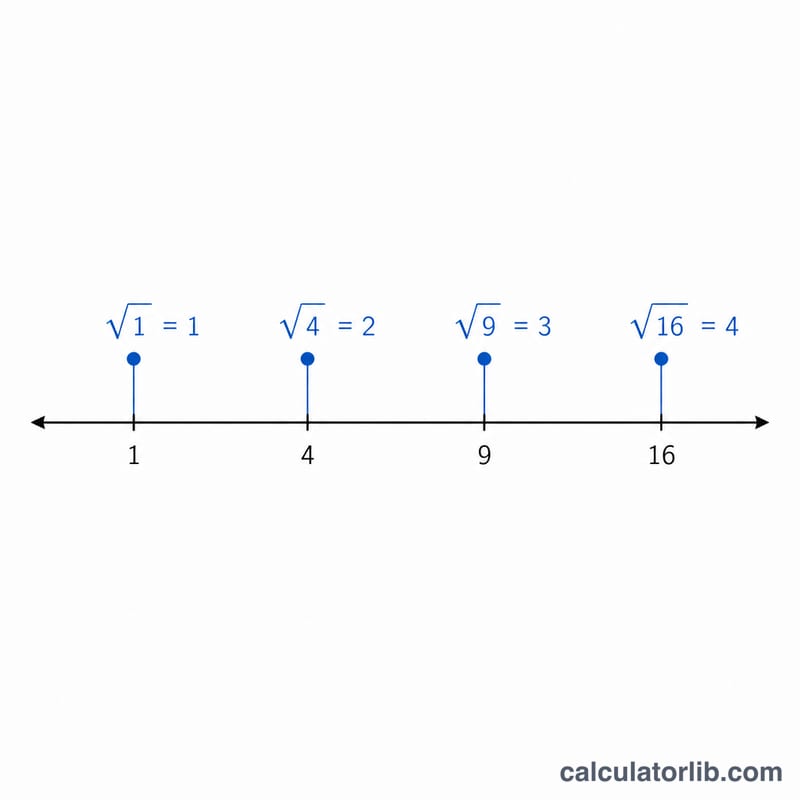
What is a perfect square? A perfect square is a number whose square root is a whole number, such as 1, 4, 9, 16, and 25.