
What is the Square Root of a Fraction?
The square root of a fraction is the number that, when multiplied by itself, gives that fraction. For a fraction a/b, its square root can be found by taking the square root of the numerator and dividing it by the square root of the denominator. This calculator computes \(\sqrt{a/b}\) for any positive numerator and denominator and shows each step.
How to Use This Calculator
Enter the numerator (a) and the denominator (b) of your fraction, then read the result. The tool returns the decimal value of \(\sqrt{a/b}\) along with the underlying fraction value, \(\sqrt{a}\), and \(\sqrt{b}\) so you can verify the math by hand. For example, 16/25 simplifies to a clean square root, while 2/3 produces an irrational decimal.
The Formula Explained
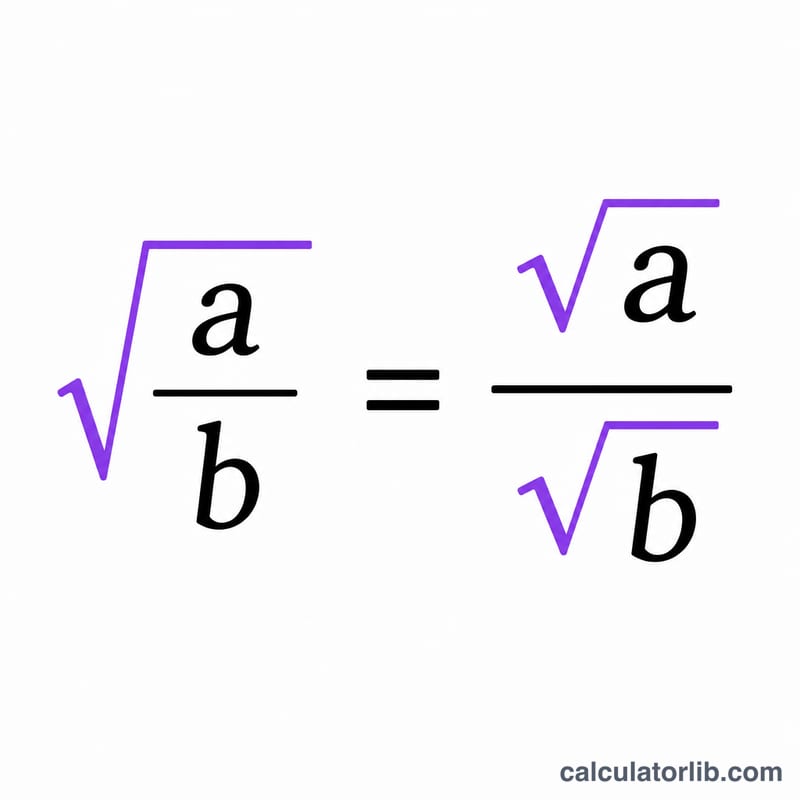
The key identity is $$\sqrt{\dfrac{a}{b}} = \dfrac{\sqrt{a}}{\sqrt{b}}$$ valid whenever \(a \ge 0\) and \(b > 0\). This works because the square root of a quotient equals the quotient of the square roots. So you can either divide first and then take one square root, or take both square roots and then divide — the answer is identical.
Worked Example
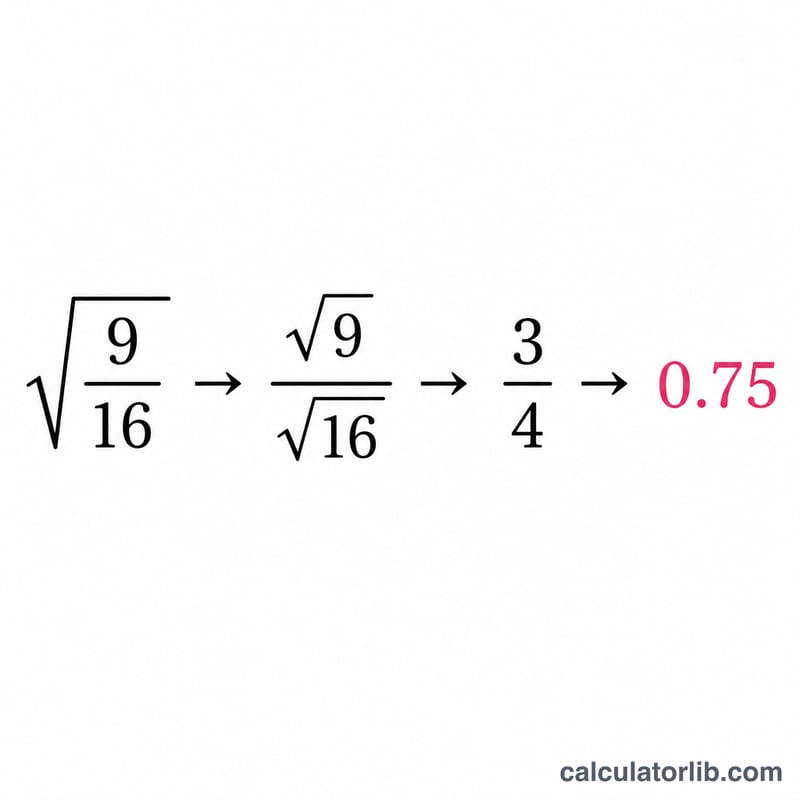
Take the fraction 16/25. First, \(\sqrt{16} = 4\) and \(\sqrt{25} = 5\). Therefore $$\sqrt{\dfrac{16}{25}} = \dfrac{4}{5} = 0.8$$ You can check this: \(0.8 \times 0.8 = 0.64\), and \(16 \div 25 = 0.64\). The two match, confirming the result.
FAQ
Can the denominator be zero? No. Division by zero is undefined, so b must be greater than zero.
What about negative numbers? The square root of a negative real number is not a real number, so this calculator expects \(a \ge 0\) and \(b > 0\).
Does it simplify the fraction first? It computes the decimal value directly, which is equivalent to simplifying — the numeric result is the same either way.