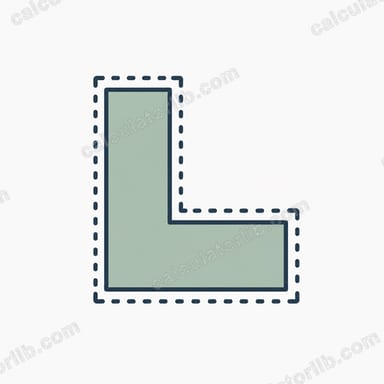

What Is the Perimeter of an L-Shape?
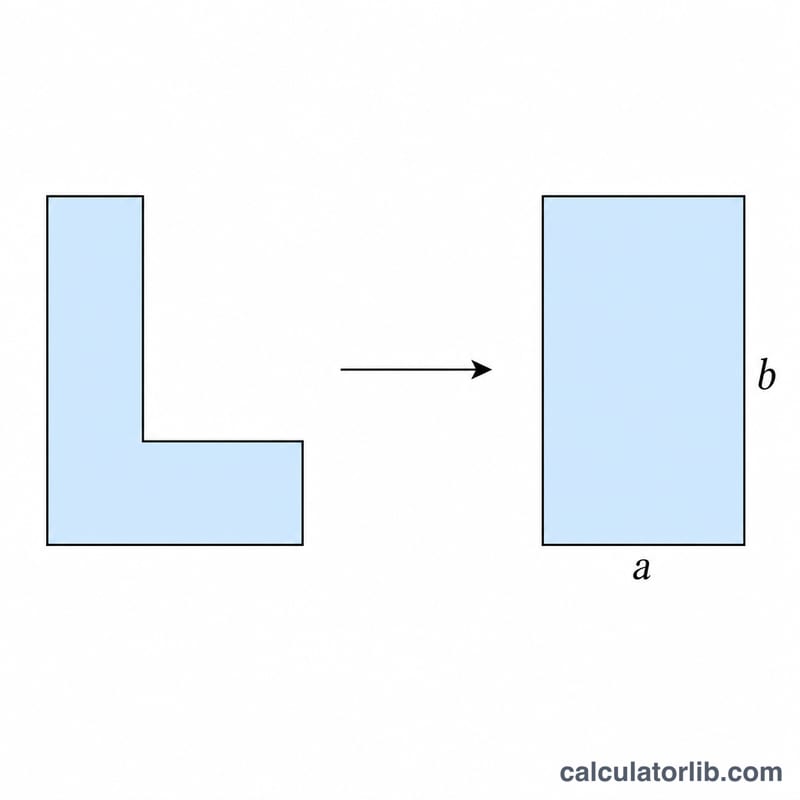
An L-shape is formed by removing a smaller rectangle from one corner of a larger rectangle. While the cut-out changes the area, an interesting geometric fact is that the perimeter stays the same as the bounding rectangle. The two extra edges created by the notch are exactly equal in length to the two edges they replace, so the total distance around the outline is unchanged. This means you only need the overall outer width (a) and overall outer height (b) of the figure to compute its perimeter.
How to Use This Calculator
Enter the overall outer width a — the full horizontal span of the L from its leftmost to rightmost point. Then enter the overall outer height b — the full vertical span from top to bottom. Make sure both values use the same unit (cm, m, inches, feet, etc.). Click calculate and the tool returns the perimeter in those same units.
The Formula Explained
The perimeter is given by $$P = 2 \times (a + b)$$ Picture tracing the outline: the horizontal edges (top plus the two lower steps) add up to the full width \(a\) twice over, and the vertical edges likewise add up to the full height \(b\) twice. Summing them gives \(2a + 2b\), identical to a rectangle of the same bounding box.
Worked Example
Suppose an L-shaped patio fits inside an overall outer width of 10 m and an overall outer height of 6 m. Then $$P = 2 \times (10 + 6) = 2 \times 16 = 32 \text{ m}$$ You would need 32 m of edging to border it, regardless of how large the notch is.
FAQ
Why doesn't the notch size matter? Because removing a rectangular corner replaces two outer edges with two inner edges of equal combined length — the perimeter is conserved.
Does this work for any L-shape? Yes, as long as all corners are right angles and the cut-out is rectangular, which is the standard L-shape.
What units does it use? Any unit you like — the result is in the same unit as your inputs.