What this calculator does
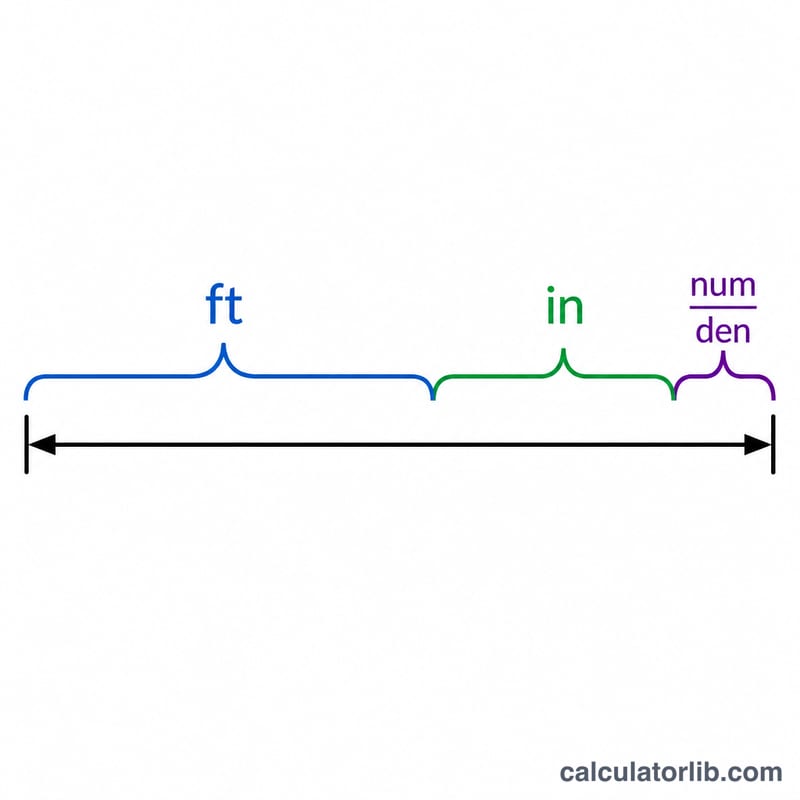
This tool combines a measurement given in feet, inches and a fraction of an inch into a single value, then rebuilds it as a tidy feet-inches-fraction reading. It is ideal for carpentry, construction, sewing and any task where a tape measure shows fractional inches.
How to use it
Enter the whole feet, whole inches, and the fraction as a numerator over a denominator (for example 3 over 4 for three-quarters). Pick the precision you want the answer rounded to, from 1/2 down to 1/32 of an inch. The calculator returns the total in decimal inches, the total in decimal feet, and a clean feet-inches-fraction reading.
The formula explained
First everything is converted to inches: $$\text{Total Inches} = 12 \times \text{Feet} + \text{Inches} + \frac{\text{Numerator}}{\text{Denominator}}$$ Total feet is simply that value divided by 12: $$\text{Total Feet} = \dfrac{12 \times \text{Feet} + \text{Inches} + \frac{\text{Numerator}}{\text{Denominator}}}{12}$$ To rebuild the reading, the whole feet are taken as the floor of total inches divided by 12, the leftover inches are the floor of the remainder, and the remaining decimal is rounded to the nearest 1/precision and reduced to lowest terms: $$\begin{gathered} \text{Fraction} = \frac{\operatorname{round}(F \cdot P)}{P} \\[1.5em] \text{where}\quad \left\{ \begin{aligned} F &= \text{fractional part of an inch} \\ P &= \text{Precision} \end{aligned} \right. \end{gathered}$$
Worked example
For 5 ft 8 3/4 in: \(5 \times 12 = 60\), plus 8 = 68, plus \(3/4 = 0.75\), giving 68.75 total inches and \(68.75 / 12 = 5.7292\) feet. Rebuilt at 1/16 precision this is 5 ft 8 12/16, which reduces to 5 ft 8 3/4 in.
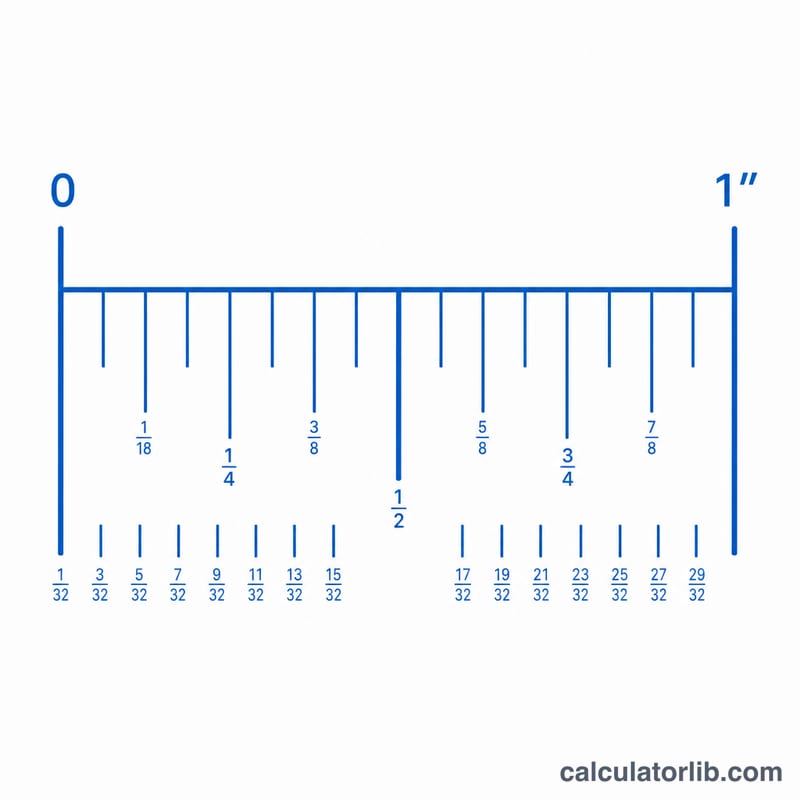
Fraction of an Inch to Decimal Conversion Chart
Every fraction below is a multiple of 1/32 inch, reduced to lowest terms. Decimal inches are exact. Millimetres use the exact definition 1 in = 25.4 mm and are rounded to 3 decimals.
| Fraction (in) | 32nds | Decimal (in) | Millimetres |
|---|---|---|---|
| 1/32 | 1/32 | 0.03125 | 0.794 |
| 1/16 | 2/32 | 0.0625 | 1.588 |
| 3/32 | 3/32 | 0.09375 | 2.381 |
| 1/8 | 4/32 | 0.125 | 3.175 |
| 5/32 | 5/32 | 0.15625 | 3.969 |
| 3/16 | 6/32 | 0.1875 | 4.763 |
| 7/32 | 7/32 | 0.21875 | 5.556 |
| 1/4 | 8/32 | 0.25 | 6.350 |
| 9/32 | 9/32 | 0.28125 | 7.144 |
| 5/16 | 10/32 | 0.3125 | 7.938 |
| 11/32 | 11/32 | 0.34375 | 8.731 |
| 3/8 | 12/32 | 0.375 | 9.525 |
| 13/32 | 13/32 | 0.40625 | 10.319 |
| 7/16 | 14/32 | 0.4375 | 11.113 |
| 15/32 | 15/32 | 0.46875 | 11.906 |
| 1/2 | 16/32 | 0.5 | 12.700 |
| 17/32 | 17/32 | 0.53125 | 13.494 |
| 9/16 | 18/32 | 0.5625 | 14.288 |
| 19/32 | 19/32 | 0.59375 | 15.081 |
| 5/8 | 20/32 | 0.625 | 15.875 |
| 21/32 | 21/32 | 0.65625 | 16.669 |
| 11/16 | 22/32 | 0.6875 | 17.463 |
| 23/32 | 23/32 | 0.71875 | 18.256 |
| 3/4 | 24/32 | 0.75 | 19.050 |
| 25/32 | 25/32 | 0.78125 | 19.844 |
| 13/16 | 26/32 | 0.8125 | 20.638 |
| 27/32 | 27/32 | 0.84375 | 21.431 |
| 7/8 | 28/32 | 0.875 | 22.225 |
| 29/32 | 29/32 | 0.90625 | 23.019 |
| 15/16 | 30/32 | 0.9375 | 23.813 |
| 31/32 | 31/32 | 0.96875 | 24.606 |
Feet to inches
| Feet | Inches |
|---|---|
| 1 ft | 12 in |
| 2 ft | 24 in |
| 3 ft | 36 in |
| 5 ft | 60 in |
| 10 ft | 120 in |
Quick example
For 5 ft 8 11/32 in: $$\text{Total Inches} = 12 \times 5 + 8 + \frac{11}{32} = 60 + 8 + 0.34375 = 68.34375$$ so the total is 68.34375 inches. Dividing by 12 gives 5.6953125 ft.
Rounding Precision Comparison
The calculator rebuilds the fractional part of an inch to the nearest step of the chosen precision. The largest possible rounding error is half a step. The table uses two inputs: 5 ft 8 1/3 in (total 68.3333 in, a fraction that is not an exact multiple of 1/32) and 0.34375 in (exactly 11/32 in). Errors are the rebuilt value minus the original, in inches.
| Precision | Max error (half a step) | 5 ft 8 1/3 in rebuilt | Error (in) | 0.34375 in rebuilt | Error (in) |
|---|---|---|---|---|---|
| 1/2 | 1/4 = 0.25 | 5 ft 8 1/2 in | +0.1667 | 1/2 in | +0.15625 |
| 1/4 | 1/8 = 0.125 | 5 ft 8 1/4 in | −0.0833 | 1/4 in | −0.09375 |
| 1/8 | 1/16 = 0.0625 | 5 ft 8 3/8 in | +0.0417 | 3/8 in | +0.03125 |
| 1/16 | 1/32 = 0.03125 | 5 ft 8 5/16 in | −0.0208 | 5/16 or 3/8 in (exact tie) | ±0.03125 |
| 1/32 | 1/64 = 0.015625 | 5 ft 8 11/32 in | +0.0104 | 11/32 in | 0 |
Check for the 1/32 row: 1/3 in = 0.33333 in, and 0.33333 × 32 = 10.667, which rounds to 11. So 11/32 = 0.34375 in, and the error is 0.34375 − 0.33333 = 0.01042 in, below the 1/64 in (0.015625 in) limit.
Finer precision gives a smaller worst-case error but a reading that is harder to measure on a tape. Note that 0.34375 in sits exactly halfway between 5/16 and 3/8 at 1/16 precision, so either neighbour is equally close.
Key Terms
- Feet (ft): a unit of length equal to 12 inches (1 ft = 12 in).
- Inches (in): the unit used for the whole-inch part of a reading. 1 in = 25.4 mm exactly.
- Numerator: the top number of a fraction. It counts how many equal parts are taken (the 11 in 11/32).
- Denominator: the bottom number of a fraction. It says how many equal parts make one whole inch (the 32 in 11/32). It cannot be zero.
- Improper fraction: a fraction whose numerator is equal to or larger than its denominator, such as 40/32, which equals 1 8/32 = 1 1/4 in.
- Precision (smallest fraction step): the finest fraction the answer is rounded to: 1/2, 1/4, 1/8, 1/16 or 1/32 in. The maximum rounding error is half of this step.
- Lowest terms: a fraction whose numerator and denominator share no common factor other than 1, for example 4/32 reduces to 1/8 and 6/32 reduces to 3/16.
- Total inches: the whole measurement expressed in inches only: 12 × feet + inches + numerator ÷ denominator.
- Total feet: total inches divided by 12, giving the same length as a decimal number of feet.
FAQ
Can I enter an improper fraction? Yes. Something like 9/4 inches is fully valid and will roll over into whole inches automatically.
What does the precision option do? It controls the smallest fraction the answer is rounded to, matching the markings on your tape measure.
Does it reduce fractions? Yes, the fraction is always reduced to lowest terms, so 12/16 becomes 3/4.