
What is the Inches to Fraction Calculator?
This tool converts a decimal inch measurement — like 2.375" — into the nearest fractional inch used on a standard tape measure or ruler. It's perfect for woodworking, metalworking, sewing, and any trade where measurements are expressed as halves, quarters, eighths, sixteenths, thirty-seconds, or sixty-fourths of an inch.
How to use it
Enter your decimal inch value, then choose the precision you want to round to (the denominator). The calculator returns the whole-inch part, the reduced fraction, and the equivalent improper fraction. For example, choosing "nearest 1/16" snaps the value to the closest sixteenth of an inch and then simplifies the result.
The formula explained
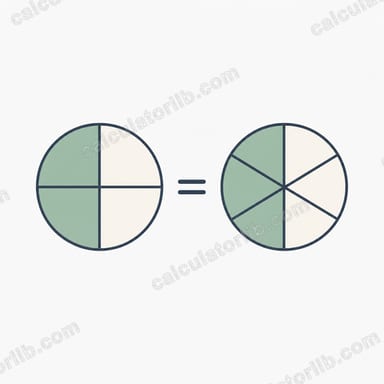
First the calculator multiplies the fractional part of your measurement by the chosen denominator D and rounds to the nearest whole number to get the numerator: \(n = \operatorname{round}(d \times D)\). It then reduces the fraction \(n/D\) by dividing both numbers by their greatest common divisor (GCD), giving the simplest equivalent fraction.
$$\text{Inches} = \lfloor x \rfloor + \dfrac{\operatorname{round}\!\left((x-\lfloor x \rfloor)\cdot d\right)}{d} \;\longrightarrow\; \text{reduce}$$$$\text{where}\quad \left\{ \begin{aligned} x &= \text{Decimal Inches} \\ d &= \text{Denominator} \end{aligned} \right.$$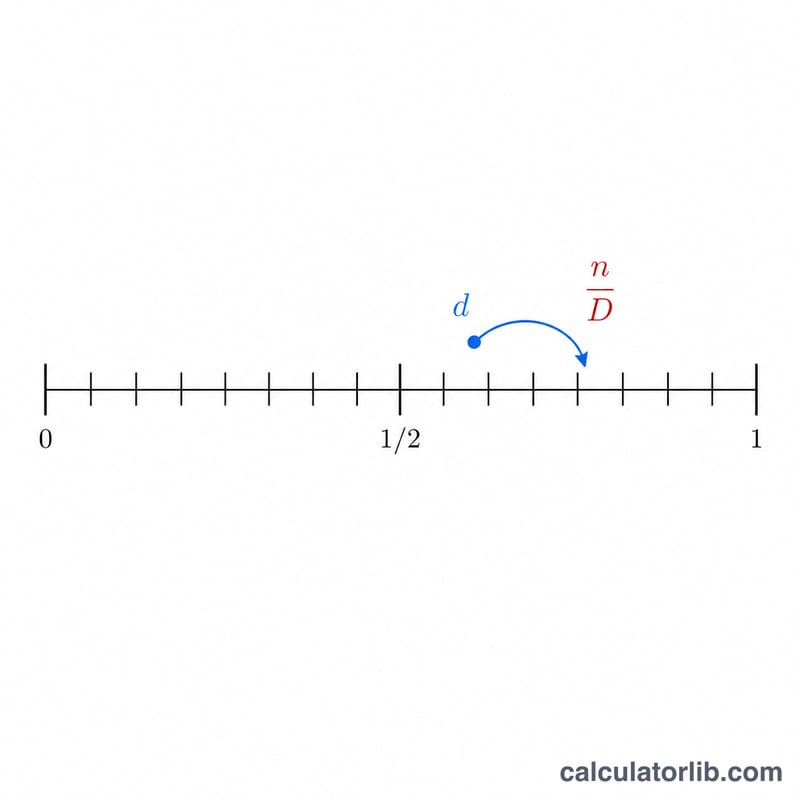
Worked example
Convert 2.375" to the nearest 1/16". The whole part is 2. The fractional part is 0.375, so \(n = \operatorname{round}(0.375 \times 16) = \operatorname{round}(6) = 6\). The fraction is \(6/16\), which reduces by GCD 2 to \(3/8\). So 2.375" = 2 3/8".
$$2.375" = 2 + \dfrac{6}{16} = 2 + \dfrac{3}{8} = 2\tfrac{3}{8}"$$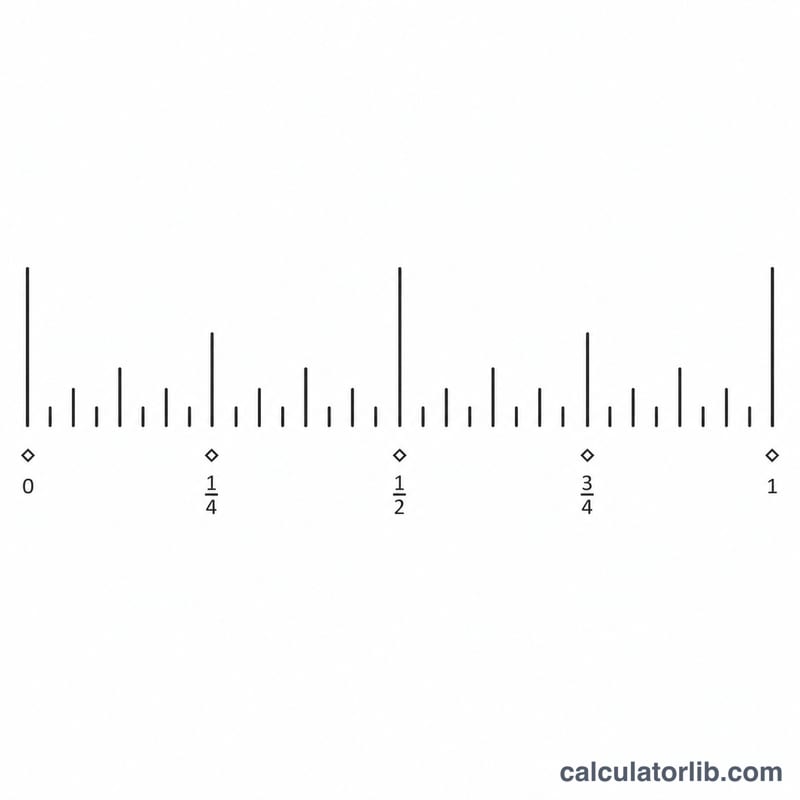
FAQ
Why does my answer round? Tape measures use fixed fractions, so any decimal must snap to the nearest available mark. Pick a larger denominator (like 1/64) for finer precision.
What if the fraction rounds up to a whole inch? If rounding produces a numerator equal to the denominator (e.g. \(16/16\)), the calculator carries it over and adds 1 to the whole-inch part.
Does it handle negative values? Yes — the sign is preserved and applied to the whole-inch portion of the result.