What Is a Weighted Blanket Calculator?
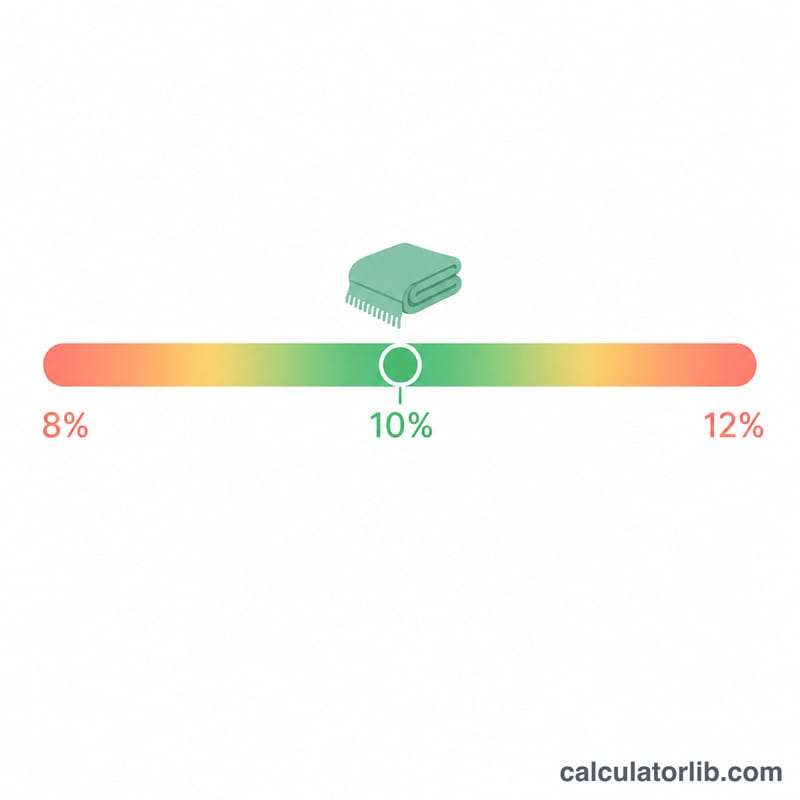
A weighted blanket calculator helps you choose a blanket that delivers comfortable deep-touch pressure without feeling oppressive. The most widely used guideline is roughly 10% of your body weight, often with one extra pound added for the blanket's structure. This tool applies that rule and also shows the broader 8–12% comfort range many manufacturers recommend.
How to Use It
Enter your body weight in pounds and the calculator returns the recommended blanket weight along with the acceptable lighter and heavier bounds. Use the central figure as your target, then pick the nearest commercially available size (blankets usually come in 5-pound increments such as 10, 15, 20, and 25 lbs).
The Formula Explained
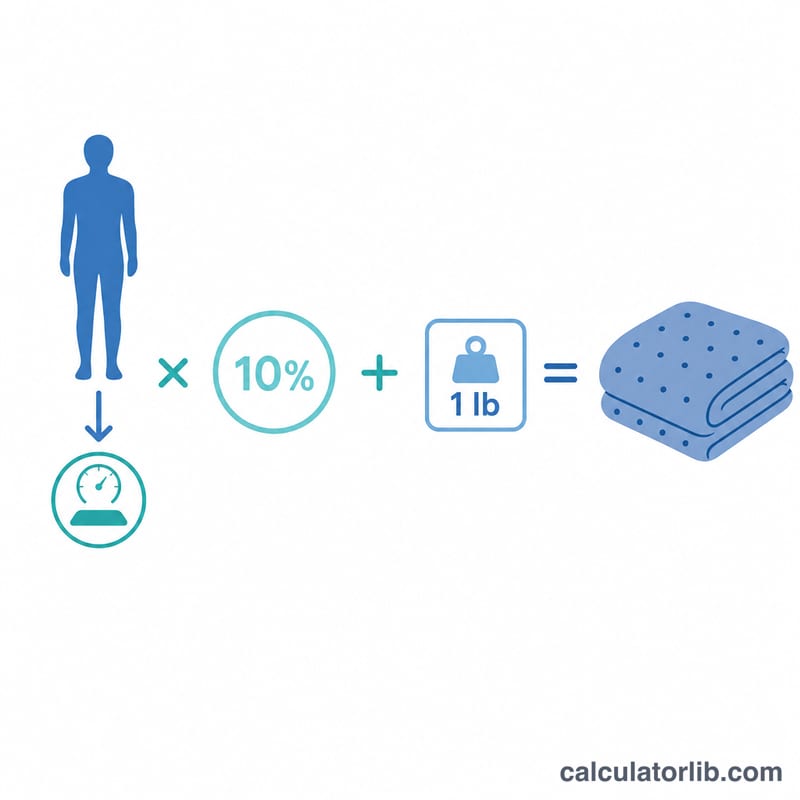
The core equation is $$\text{blanket\_weight} = \text{body\_weight} \times 0.10 + 1$$ The 10% factor sets the bulk of the pressure relative to your size, while the +1 lb compensates for filling distribution and fabric. The range bounds use 8% (lighter, cooler) and 12% (heavier, more grounding) of body weight.
Worked Example
For a 150 lb adult: $$150 \times 0.10 + 1 = 15 + 1 = \mathbf{16 \text{ lbs}}$$ The acceptable range is \(150 \times 0.08 = 12\) lbs up to \(150 \times 0.12 = 18\) lbs, so a standard 15 lb blanket fits comfortably.
Pounds to Kilograms Blanket Weight Conversion
Weighted blankets are most often sold in pounds (lbs), especially in the United States, but many shoppers outside the US think in kilograms. The conversion used here is 1 lb = 0.4536 kg, rounded to one decimal place.
| Blanket weight (lbs) | Blanket weight (kg) |
|---|---|
| 10 lb | 4.5 kg |
| 12 lb | 5.4 kg |
| 15 lb | 6.8 kg |
| 20 lb | 9.1 kg |
| 25 lb | 11.3 kg |
| 30 lb | 13.6 kg |
| 35 lb | 15.9 kg |
Working in metric: the calculator's rule is body weight × 0.10 + 1 lb. In kilograms, the +1 lb becomes about +0.45 kg, so the rule is: blanket weight (kg) ≈ body weight (kg) × 0.10 + 0.45. For example, \(68 \times 0.10 + 0.45 = 7.25\) kg, which is about 16 lb.
Practical Tips for Choosing a Blanket
- Round to an available size within the range. Blankets are sold in fixed weights, so your calculated figure rarely matches exactly. Use the 8–12% range as your window and pick the closest size inside it. For a 150 lb person, the 10% + 1 lb rule gives 16 lb, and the 8–12% range runs from 12 lb to 18 lb. A 15 lb blanket sits comfortably inside that window.
- Choose lighter or heavier within the range based on warmth and preference. Heavier blankets tend to feel warmer and more enveloping because more fill covers more of the body. If you sleep hot or are new to weighted blankets, the lower end of the range (near 8%) is a reasonable starting point. If you like a firmer, snugger feel and stay cool easily, the upper end (near 12%) may suit you better. Personal comfort matters more than hitting the exact number.
- Consider the fill type. Glass beads are fine and small, so they usually make a thinner, quieter, more evenly spread blanket. Plastic poly pellets are larger and cheaper, and the blanket may be bulkier and sound slightly rustly. Natural or breathable covers (such as cotton or bamboo blends) can also help reduce heat build-up.
- Check breathability and cover size. Look at the outer fabric, the quilting pattern that keeps the fill from shifting, and whether a removable, washable cover is available. Pick a blanket size that covers you without hanging far over the bed, because overhanging weight can pull the blanket off. Many people choose a blanket smaller than the mattress.
- Size for one user, not combined body weight. A blanket should be matched to the body weight of the single person using it. Adding two people's weights together will give a blanket that is too heavy for each of them. For a shared bed, two separate blankets are generally more practical.
This is general information about choosing a product, not medical advice. If you have a health condition or questions about whether a weighted blanket is appropriate for you or a child, ask a qualified professional and follow the manufacturer's guidance.
FAQ
Is this safe for children? Weighted blankets are generally not recommended for toddlers or infants. Always consult a pediatrician and never use one that restricts movement or breathing.
What if my ideal weight falls between sizes? Round to the nearest available size within the 8–12% range; rounding down feels lighter and cooler.
Should I size for two people? No. Pick a blanket based on a single person's weight, not the combined weight, so each user gets appropriate pressure.