
What this calculator does
The Bean Bag Filling Calculator estimates how much filler (expanded polystyrene beads, or "beans") you need to fill a bean bag chair. Buying beads is easiest in litres or cubic feet, but bean bag covers are sold by their physical dimensions. This tool bridges that gap by computing the bag's internal volume and then applying a sensible fill fraction so the finished bag is comfortable rather than rock-hard.
How to use it
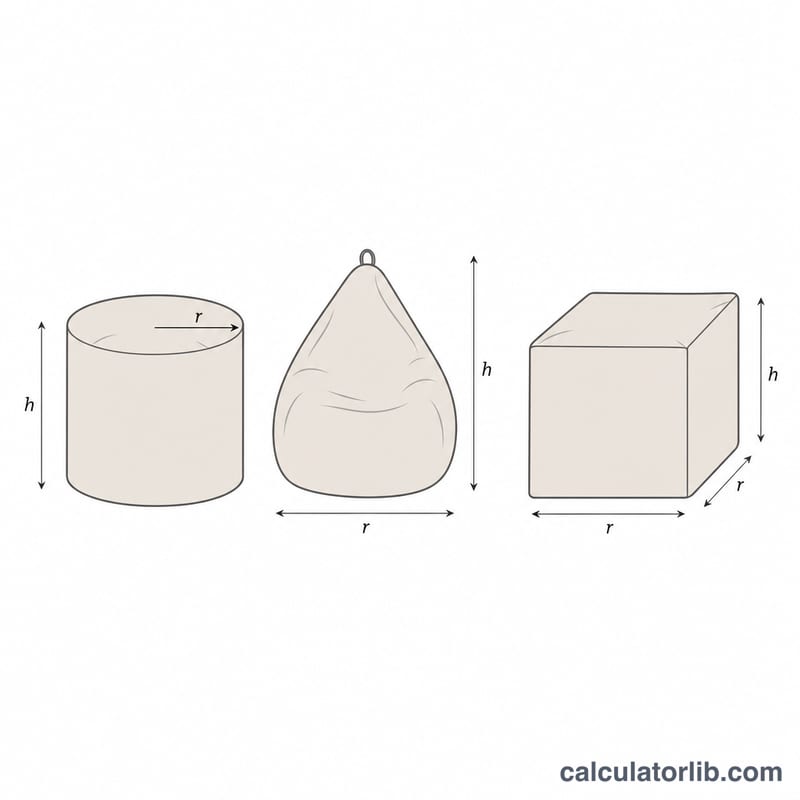
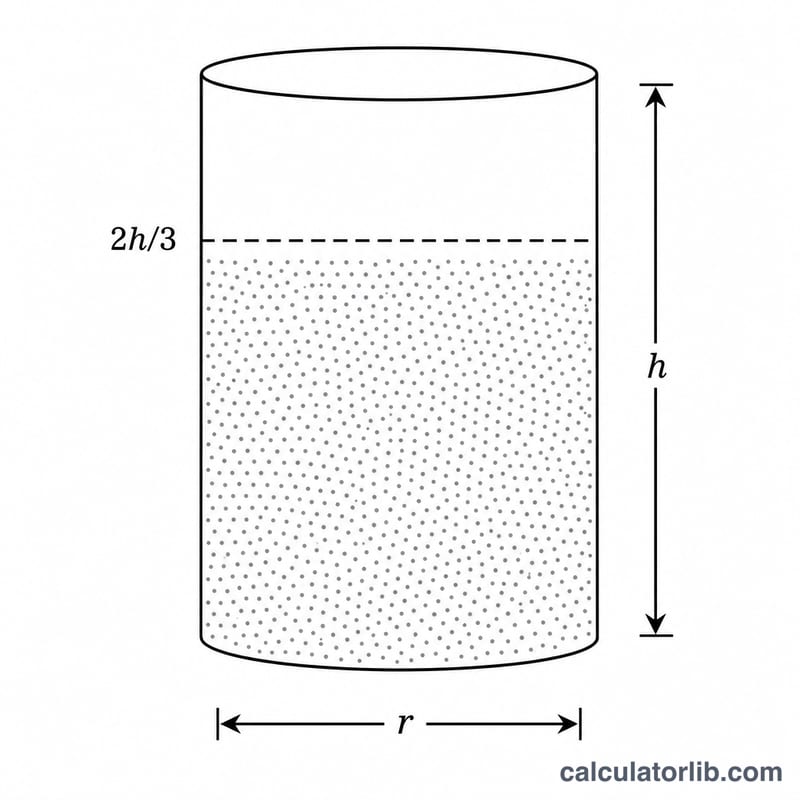
Pick your bag shape — round/cylinder or box/cube. Enter the dimensions in centimetres. Then set the fill fraction. We default to 0.66 because bean bags filled about two-thirds full mould to your body and stay comfy; overfilling makes them firm and stiff. The result shows the required filler in both litres and cubic feet.
The formula explained
For a cylinder the volume is \(\pi \times r^2 \times h\), where r is half the diameter and h is the height. For a box it is \(\text{length} \times \text{width} \times \text{height}\). We multiply the total volume by the fill fraction f to get the filler volume: \(\text{filler} = \text{volume} \times f\). Volumes in cubic centimetres are divided by 1000 to give litres, and litres are divided by 28.3168 to give cubic feet.
Worked example
A round bean bag 75 cm wide and 120 cm tall has r = 37.5 cm, so volume $$\text{volume} = \pi \times 37.5^2 \times 120 \approx 530{,}144 \text{ cm}^3 = 530.1 \text{ L}.$$ At a 0.66 fill fraction you need about $$530.1 \times 0.66 \approx 349.9 \text{ litres}$$ of beads, which is roughly 12.4 cubic feet.
How Much to Order
Once you have an estimated litre figure, use these practical rules to decide what to actually buy:
- Round up to the next standard bag. Filler beads are commonly sold in 100 L (about 3 ft³) sacks. If your estimate is 294 L, order three 100 L bags (300 L) rather than coming up short.
- Add 10–20% extra for top-ups. EPS beads compress over the first weeks of use as air works out and beads pack down, so a bag that felt perfect on day one will soften. Buying a little extra lets you firm it back up without a second shopping trip.
- Keep the leftovers sealed. Store remaining beads in a tied bag in a dry place. Bean bags typically need a refill every year or two, so leftover stock saves money and effort later.
- Fill in stages. Add about two-thirds of your beads, sit in the bag, then top up gradually until the firmness feels right rather than emptying every sack at once.
This is general guidance for estimating bulk filler; check the volume rating printed on your specific bean bag cover, as manufacturers sometimes state a recommended fill that differs from a purely geometric estimate.
FAQ
Why not fill it 100%? A completely full bean bag is hard and doesn't conform to your shape. Two-thirds full is the sweet spot for comfort.
My bag sagged — what now? Beads compress over time. Top up by 10–20% to restore loft.
Are litres and cubic feet interchangeable? They measure the same volume; suppliers in metric markets sell by litre, while US suppliers usually list cubic feet (\(1 \text{ ft}^3 \approx 28.32 \text{ L}\)).