
What Is the Appliance Wattage Calculator?
This calculator finds the electrical power an appliance draws, measured in watts (W), from two values usually printed on the device label: its operating voltage (volts, V) and its current draw (amperes, A). Knowing wattage helps you size circuits, compare energy use, choose generators or extension cords, and estimate running costs.
How to Use It
Enter the voltage your appliance runs on (commonly 120 V in North America or 230 V in much of Europe) and the current it draws in amps. The calculator instantly returns the power in watts and the equivalent in kilowatts. If your label lists watts already, you can divide by voltage to find the current instead.
The Formula Explained
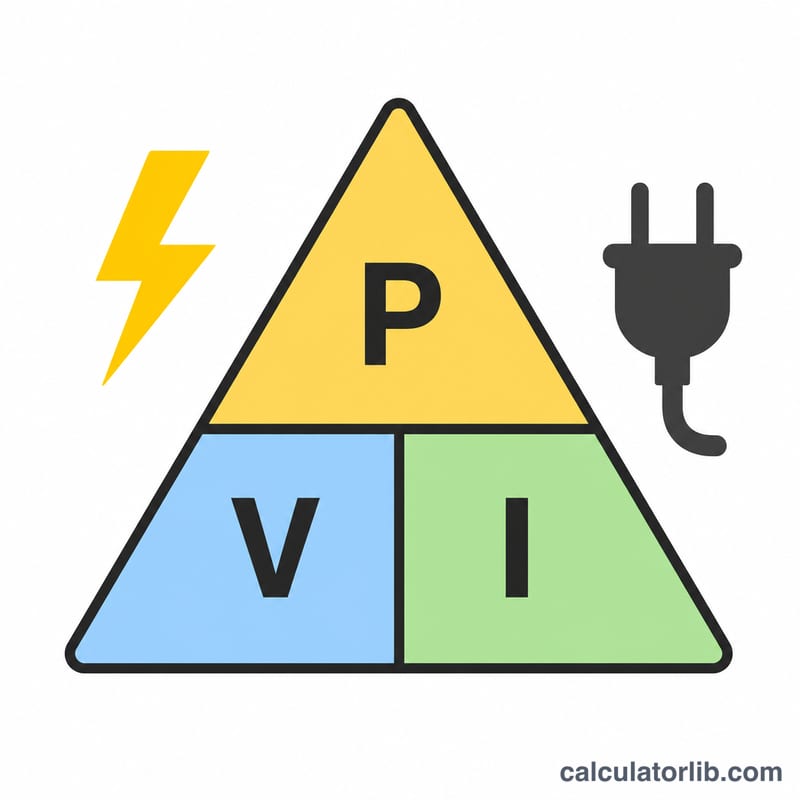
The relationship comes from the power equation for direct or resistive AC loads:
$$P = \text{Voltage (V)} \times \text{Current (A)}$$
For example, a device on a 120 V supply pulling 5 A consumes \(120 \times 5 = 600\) W, or 0.6 kW. To express it as kilowatts, divide the wattage by 1000.
Worked Example
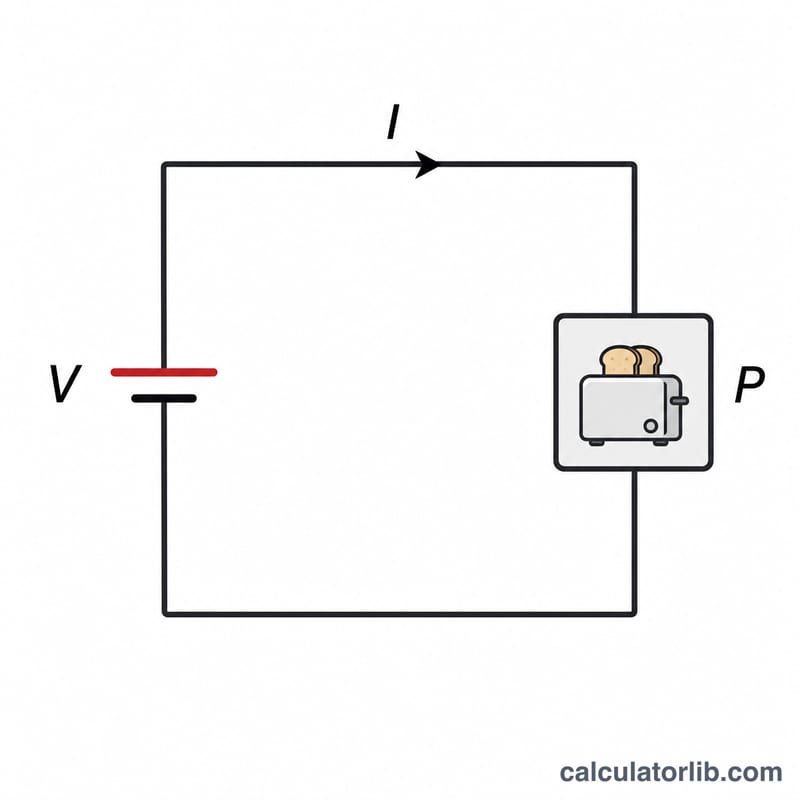
A space heater is rated for 230 V and draws 8 A. Its power is \(230 \times 8 = 1840\) W, which equals 1.84 kW. Running for one hour it uses 1.84 kWh of electricity.
Key Terms Explained
- Voltage (V)
- The electrical potential difference, or "pressure," that pushes current through a circuit, measured in volts. Common household supplies are 120 V (North America) and 230–240 V (most of the rest of the world).
- Current / Amperage (A)
- The rate of flow of electric charge through a conductor, measured in amperes (amps). For a given power level, higher voltage means lower current.
- Power (Watts, W)
- The rate at which electrical energy is used or produced. For a DC or purely resistive AC load, \(P = V \times I\). One watt equals one joule per second.
- Kilowatts (kW)
- A larger unit of power equal to 1000 watts. Energy use is billed in kilowatt-hours (kWh), the energy of a 1 kW load running for one hour.
- Power Factor (PF)
- A ratio between 0 and 1 describing how effectively current is converted to useful work in an AC circuit. Purely resistive loads (heaters, incandescent bulbs) have a PF near 1; motors and electronics may have a lower PF.
- Apparent Power (VA)
- The product of RMS voltage and RMS current, \(S = V \times I\), measured in volt-amperes. It represents the total power the supply must deliver, including the reactive component. The simple watts formula on this page gives apparent power; for PF < 1 the real power is lower.
- Real Power (W)
- The actual power doing useful work, equal to apparent power times power factor: \(P = V \times I \times \text{PF}\). For resistive appliances this equals the apparent power because PF ≈ 1.
FAQ
Does this work for any country? Yes. The \(\text{watts} = \text{volts} \times \text{amps}\) formula is universal; just enter the local voltage your appliance uses.
Is this accurate for AC motors? For purely resistive loads it is exact. Motors and electronics have a power factor below 1, so actual real power may be lower than \(\text{volts} \times \text{amps}\) (which gives apparent power, VA).
How do I get current if I only know watts? Rearrange the formula: \(\text{amps} = \text{watts} \div \text{volts}\).