
What is the Watts to Amps Calculator?
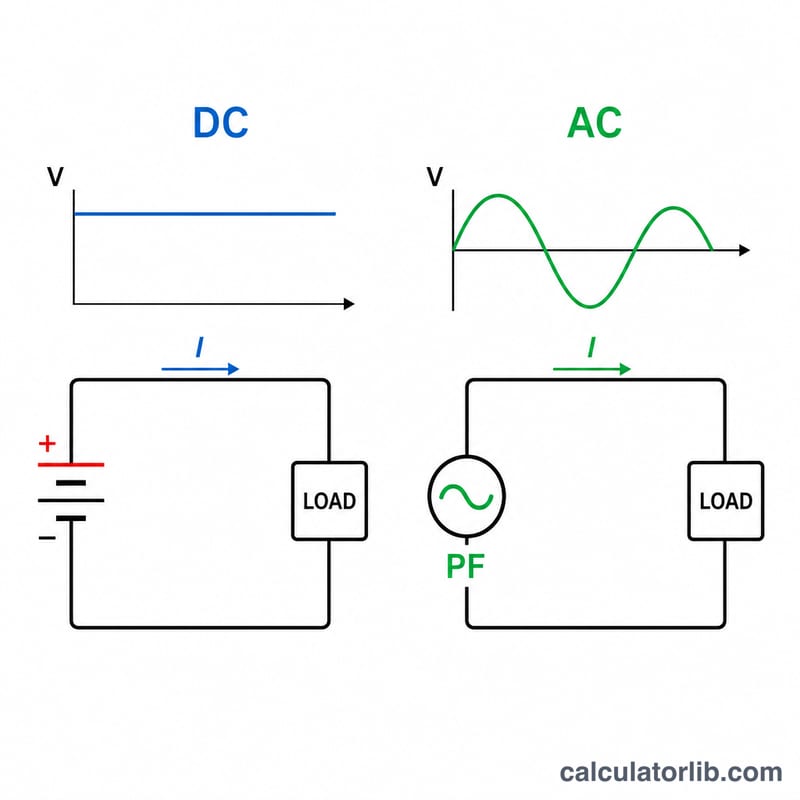
This tool converts electrical power, measured in watts (W), into electric current, measured in amps (A). It works for both direct current (DC) circuits and single-phase alternating current (AC) circuits, where a power factor must be included. It is useful for sizing wiring, breakers, fuses, and verifying that a device draws current within safe limits.
How to use it
Choose DC or AC. Enter the power in watts and the supply voltage in volts. For AC, also enter the power factor (PF) — a value between 0 and 1 that reflects how efficiently current is converted to useful work (resistive heaters are near 1.0; motors are often 0.7–0.9). Click calculate to see the current in amps.
The formula explained
For DC: \(I = P / V\). For single-phase AC the reactive component reduces real power transfer, so we divide by voltage times power factor: \(I = P / (V \times PF)\). Current is inversely proportional to voltage, which is why high-voltage systems carry the same power with less current.
$$I = \frac{\text{Power (W)}}{\text{Voltage (V)} \times \text{Power Factor}}$$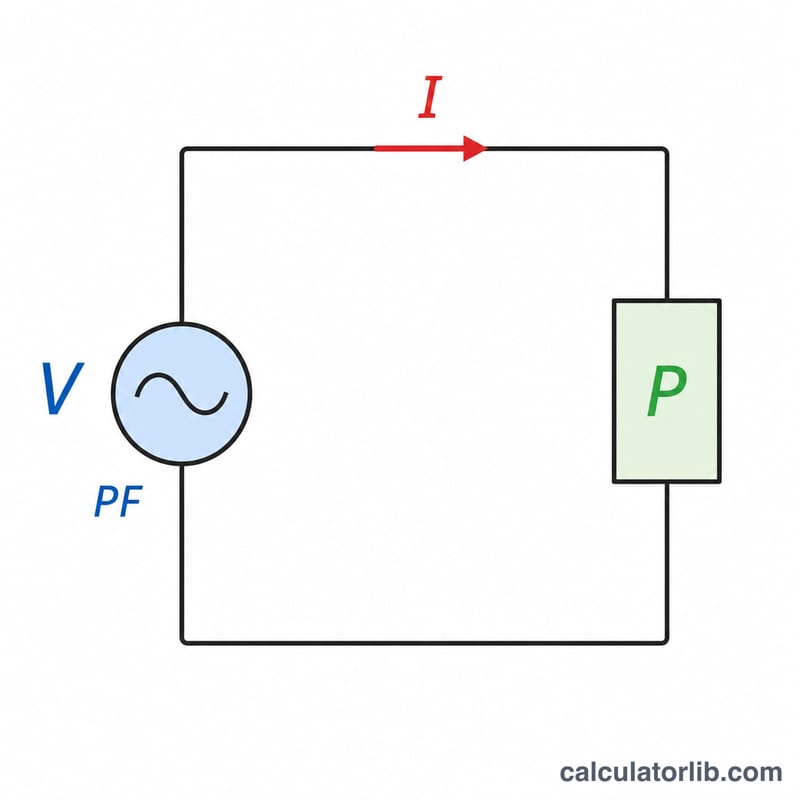
Worked example
A 1000 W appliance on a 120 V DC supply draws $$I = 1000 / 120 = 8.33 \text{ A}.$$ The same 1000 W on a 120 V AC circuit with a power factor of 0.8 draws $$I = 1000 / (120 \times 0.8) = 10.42 \text{ A}$$ — more current, because the power factor is below 1.
FAQ
What if I don't know the power factor? For purely resistive loads (heaters, incandescent bulbs) use 1.0. If you leave it blank or enter an invalid value, the calculator assumes 1.0.
Does this work for three-phase power? No — this tool covers DC and single-phase AC. Three-phase adds a \(\sqrt{3}\) factor to the denominator.
Why is AC current higher than DC for the same watts? Because power factor below 1 means the apparent power (volt-amps) exceeds the real power (watts), so more current flows.