
What Is the Watts to Volts Calculator?
This calculator converts electrical power (measured in watts) to voltage (measured in volts) when the current (in amps) is known. It applies to DC circuits and to AC circuits at unity power factor, using the fundamental relationship between power, voltage, and current. It is a universal physics tool and applies anywhere.
How to Use It
Enter the power in watts and the current in amps, then read the resulting voltage. For example, an appliance drawing 100 watts at 2 amps operates at 50 volts. The calculator simply rearranges Ohm's power law to solve for voltage.
The Formula Explained
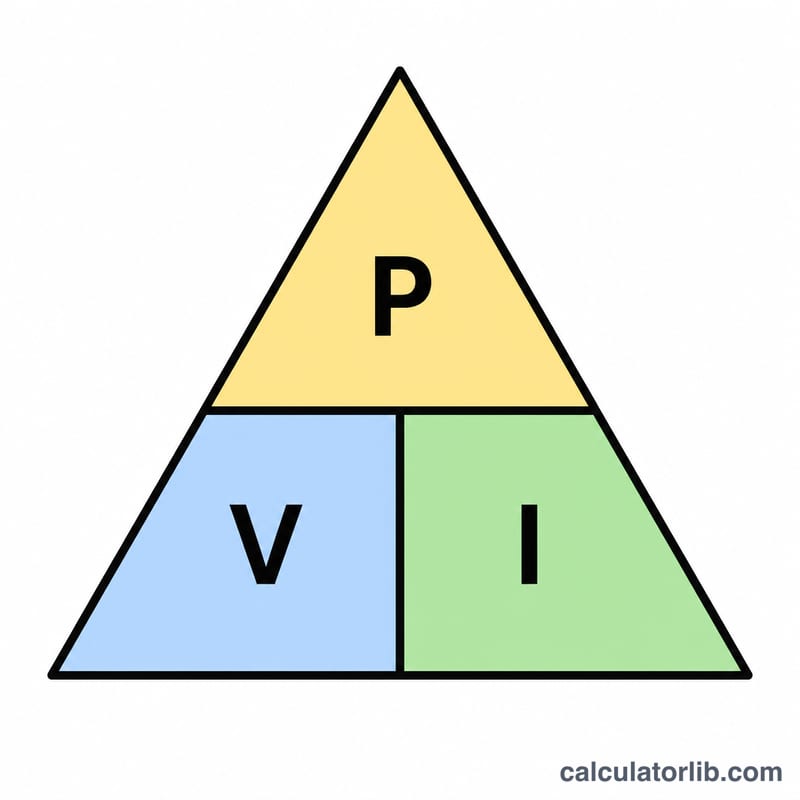
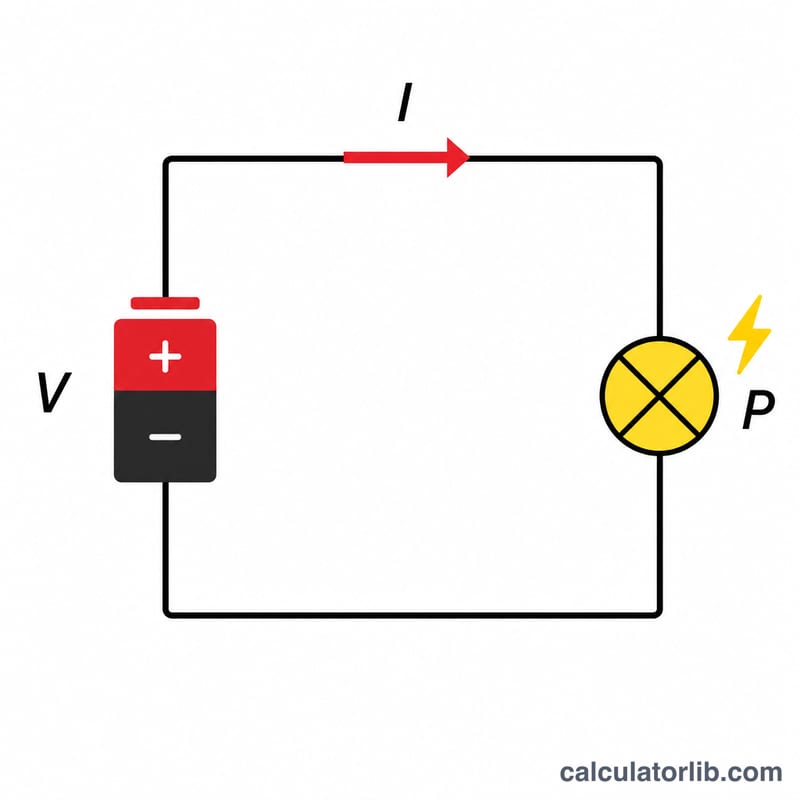
Electric power is the product of voltage and current: $$P = V \times I$$ Rearranging to solve for voltage gives $$V = \frac{P}{I}$$ where \(V\) is voltage in volts, \(P\) is power in watts, and \(I\) is current in amperes. Because dividing by zero is undefined, the current must be greater than zero.
Worked Example
Suppose a device consumes 1200 watts and draws 10 amps. Then $$V = 1200 \div 10 = 120 \text{ volts}$$ — a typical North American mains voltage. If the same 1200 W device drew only 5 amps, the voltage would be 240 volts.
FAQ
Does this work for AC power? Yes, at a power factor of 1. For AC with a power factor less than 1, divide by (current × power factor) instead.
What if I know power and voltage? Use \(I = \frac{P}{V}\) to find current instead.
Why can't current be zero? Dividing power by zero current is mathematically undefined, so a valid nonzero current is required.