
What the Watt Calculator Does
This Watt Calculator turns two simple electrical measurements — voltage and current — into two useful results: power in watts (W) and resistance in ohms (Ω). It is based on Ohm's law and the power equation, which apply universally to direct-current (DC) circuits and to the basic relationships taught in electronics worldwide (no country-specific rules are involved). Whether you are sizing a power supply, checking an appliance's load, or working on a hobby electronics project, this tool gives instant, accurate figures.
The Inputs You Enter
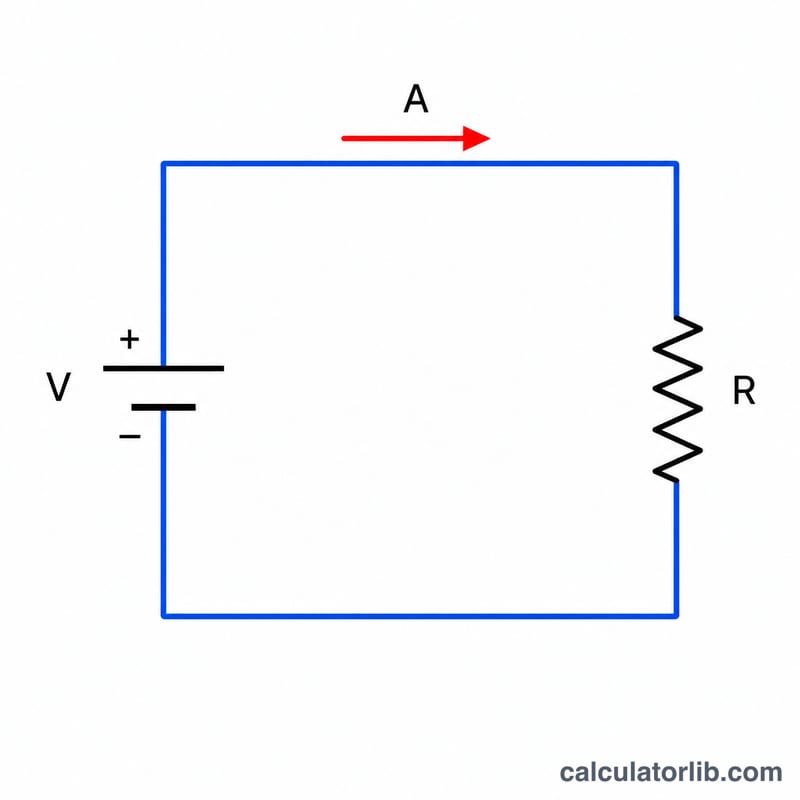
- Voltage (V): The potential difference across the component or circuit, measured in volts.
- Current (A): The flow of electric charge through the circuit, measured in amperes (amps).
Both values are read as numbers, so you can enter decimals such as 12 or 0.5. Make sure the two figures refer to the same point in the circuit for meaningful results.
The Formula Explained
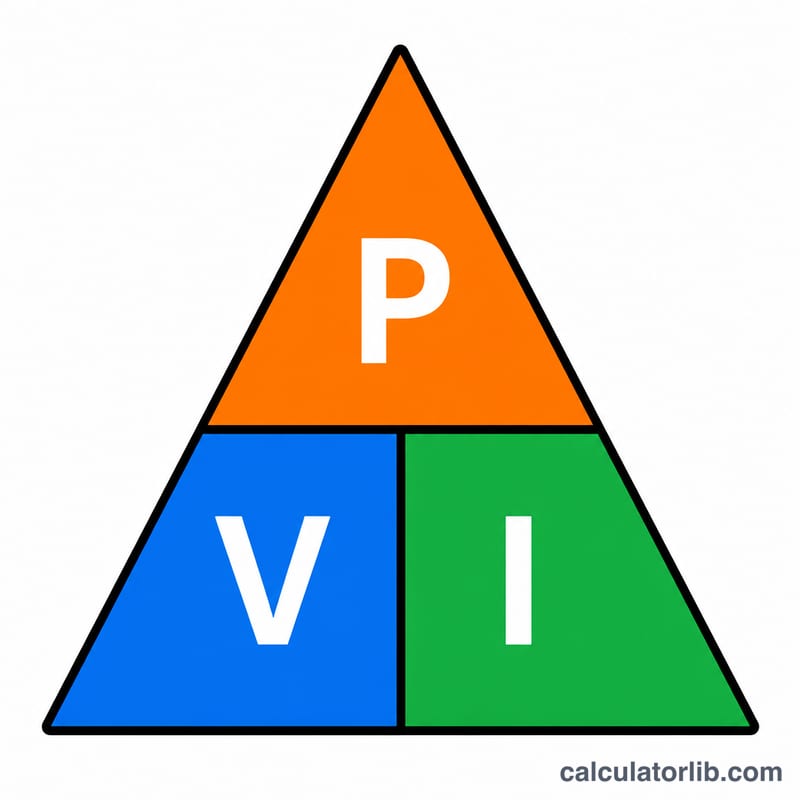
The calculator applies two formulas at once:
- Power: $$P = \text{Voltage (V)} \times \text{Current (A)}$$
- Resistance: $$R = \frac{\text{Voltage (V)}}{\text{Current (A)}}$$
Power tells you how much energy the circuit uses per second, while resistance — derived directly from Ohm's law (\(V = I \times R\)) — tells you how much the circuit opposes the current. The tool also expresses your result as a percentage of a 1000 W (1 kW) scale for quick visualisation, capping the bar at 100%.
Worked Example
Suppose you have a device running at 12 V drawing 2 A:
- $$\text{Power} = 12 \times 2 = 24 \text{ watts}$$
- $$\text{Resistance} = 12 \div 2 = 6 \text{ ohms}$$
- $$\text{Visualisation} = \frac{24}{1000} \times 100 = 2.4\% \text{ of the 1 kW scale}$$
So this device consumes 24 W and presents 6 Ω of resistance.
Frequently Asked Questions
What if I enter 0 amps? Power would correctly calculate as 0 W, but resistance (\(V \div A\)) cannot be computed because dividing by zero is undefined. Always enter a current greater than zero to get a valid resistance.
Does this work for AC circuits? The result is the apparent power for AC. True power in AC circuits with reactive loads also depends on the power factor, so for motors or transformers the actual wattage may be lower.
Why does the result cap at 100%? The percentage bar uses a fixed 1000 W reference for easy comparison. Any power above 1 kW simply shows as a full 100% bar, while the exact watt figure is still displayed.