
What Is the Amps to Watts Calculator?
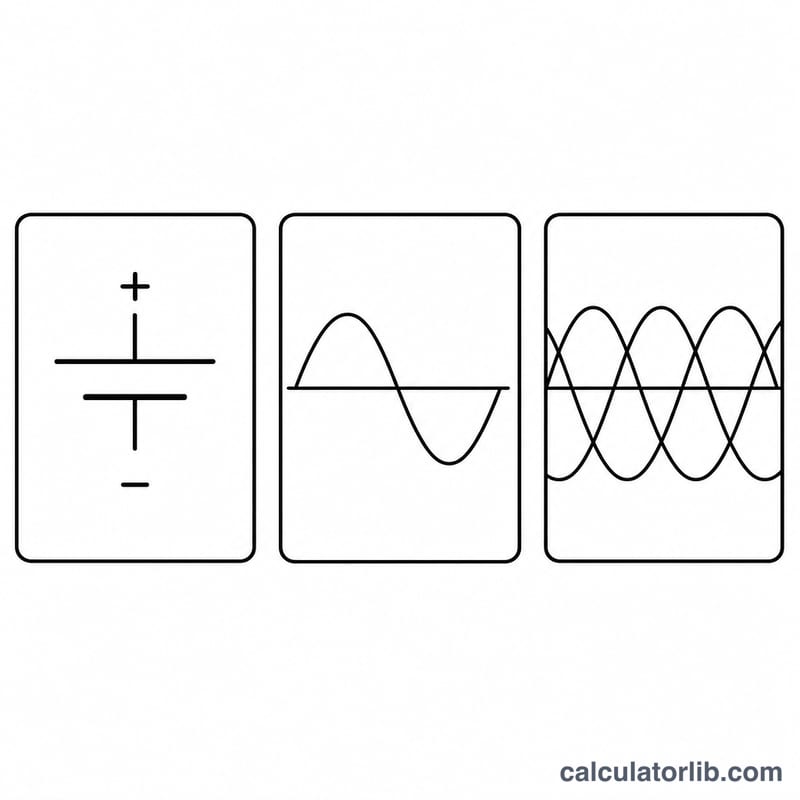
This calculator converts electric current measured in amperes (A) into electric power measured in watts (W). Watts tell you the rate at which energy is consumed, while amps describe how much current flows. To convert between them you also need the voltage, and for alternating-current (AC) systems the power factor. The tool supports direct current (DC) and resistive loads, AC single-phase, and AC three-phase circuits.
How to Use It
Choose your current type, then enter the current in amps and the voltage in volts. For AC systems, enter the power factor (a value between 0 and 1; use 1 for purely resistive loads such as heaters). The result shows power in watts and kilowatts. If you leave power factor blank or outside 0–1, the calculator assumes 1.
The Formula Explained
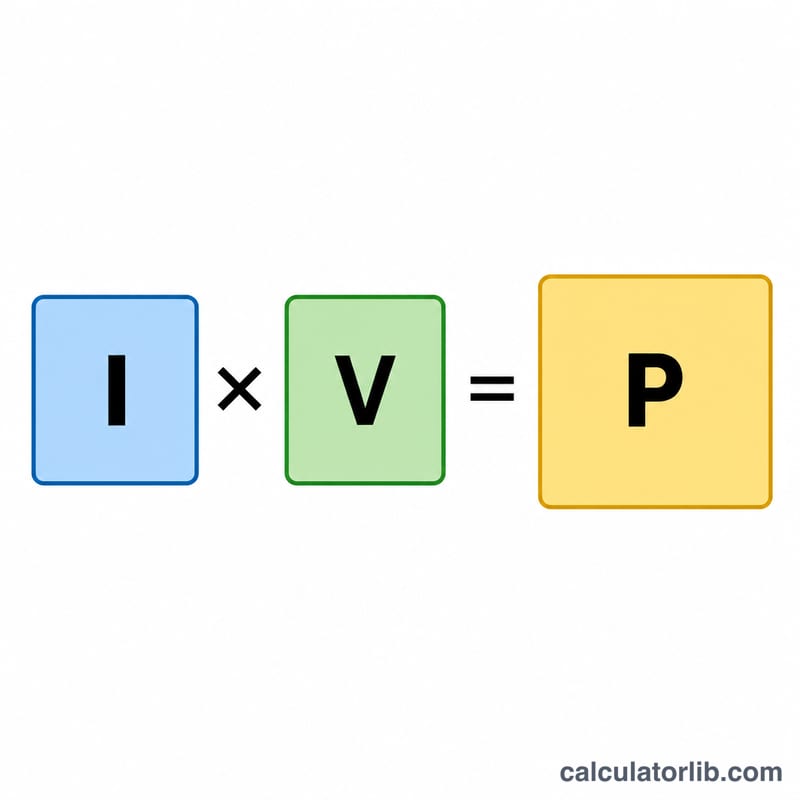
For DC or resistive loads, power is simply $$W = A \times V$$. For AC single-phase, the power factor scales this down: $$W = A \times V \times PF$$. For balanced three-phase systems, a factor of \(\sqrt{3}\) (≈1.732) is added because of how the line and phase quantities relate: $$W = \sqrt{3} \times A \times V \times PF$$. Power factor accounts for the phase difference between voltage and current caused by inductive or capacitive loads.
Worked Example
Suppose a single-phase motor draws 10 A at 230 V with a power factor of 0.85. Power $$= 10 \times 230 \times 0.85 = \textbf{1{,}955 W},$$ or about 1.955 kW. A DC device drawing 5 A at 12 V uses \(5 \times 12 = 60\) W.
Key Terms Explained
- Ampere (A)
- The SI unit of electric current, measuring the rate of charge flow through a conductor. One ampere equals one coulomb of charge per second.
- Volt (V)
- The SI unit of electric potential difference (voltage). It represents the energy per unit charge that drives current through a circuit.
- Watt (W)
- The SI unit of power — the rate of energy transfer. In a DC circuit, watts equal volts multiplied by amps; in AC circuits power factor is also applied.
- Kilowatt (kW)
- One thousand watts. Larger electrical loads and appliance ratings are commonly expressed in kilowatts (1 kW = 1000 W).
- Power factor (PF)
- A dimensionless number between 0 and 1 equal to the ratio of real power (W) to apparent power (VA). It reflects how effectively current is converted into useful work; a PF of 1.0 means voltage and current are perfectly in phase.
- Apparent vs real power
- Apparent power (volt-amps, VA) is the product of RMS voltage and RMS current. Real power (watts, W) is the portion that does useful work and equals apparent power times the power factor. The difference is reactive power (VAR), stored and returned by inductive or capacitive loads.
- Single-phase
- An AC supply delivered over one alternating voltage waveform, typical of homes and small loads. Power is calculated as \(P = V \times I \times PF\).
- Three-phase
- An AC supply using three voltage waveforms offset by 120°, common in industrial and commercial settings. With line-to-line voltage, power is \(P = \sqrt{3} \times V_{LL} \times I \times PF\).
- Line-to-line voltage
- The voltage measured between any two of the three phases in a three-phase system (e.g. 400 V). It is \(\sqrt{3}\) times the line-to-neutral voltage and is the value used in the three-phase power formula.
FAQ
Do I need power factor for DC? No. DC and resistive loads have a power factor of 1, so it is ignored.
What is a typical power factor? Resistive loads are 1.0; motors and many appliances range from 0.7 to 0.95.
Why the \(\sqrt{3}\) for three-phase? It converts between line-to-line voltage and the phase relationship in a balanced three-phase supply.