
What is the Horsepower to Amps Calculator?
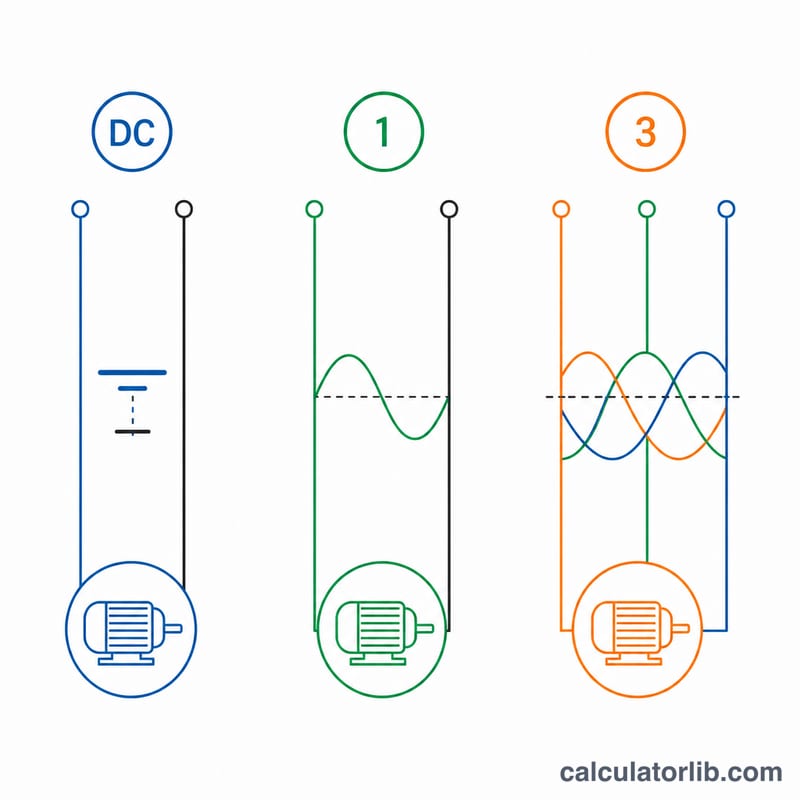
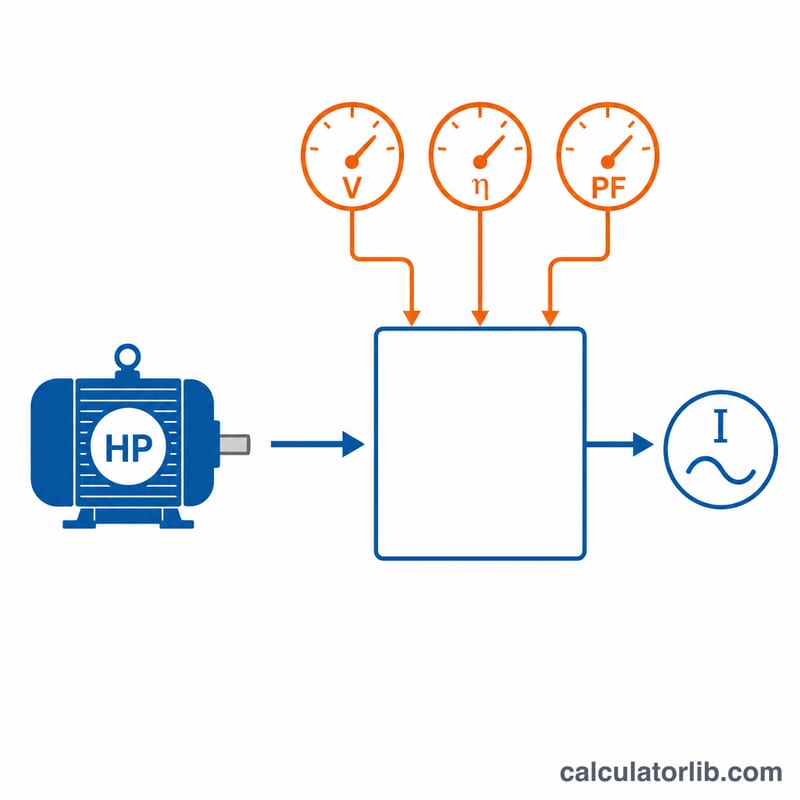
This tool converts mechanical horsepower (HP) into the electrical current, measured in amps (A), that a motor draws from its supply. Because one mechanical horsepower equals 746 watts, knowing the HP, supply voltage, motor efficiency, and power factor lets you size breakers, wiring, and overload protection correctly. It supports DC, AC single-phase, and AC three-phase systems.
How to use it
Enter the motor's rated horsepower and the supply voltage. Choose the current type (DC, single-phase, or three-phase). Then enter the motor efficiency as a percentage (typical motors run 80–95%) and the power factor (typically 0.8–0.95 for AC; power factor is ignored for DC). The calculator returns the full-load current in amps and the equivalent real power in watts.
The formula explained
The base relationship is current = power ÷ voltage. Real electrical power needed equals HP × 746 ÷ efficiency, because some input energy is lost as heat. For AC, the power factor (PF) accounts for the phase difference between voltage and current, so we divide by PF. Three-phase systems add a \(\sqrt{3}\) (≈1.732) factor because of the line-to-line voltage relationship:
Single-phase: $$I = \frac{746 \times \text{HP}}{\text{V} \times \dfrac{\text{Eff \%}}{100} \times \text{PF}}$$Three-phase: $$I = \frac{746 \times \text{HP}}{\sqrt{3} \times \text{V} \times \dfrac{\text{Eff \%}}{100} \times \text{PF}}$$DC: $$I = \frac{746 \times \text{HP}}{\text{V} \times \dfrac{\text{Eff \%}}{100}}$$
Worked example
A 5 HP single-phase motor on 230 V with 90% efficiency and 0.9 power factor: \(5 \times 746 = 3730\ \text{W}\). Then $$3730 \div (230 \times 0.90 \times 0.90) = 3730 \div 186.3 \approx 20.02\ \text{A}.$$
FAQ
Why is efficiency included? A motor draws more electrical power than it delivers mechanically. Dividing by efficiency converts output HP into the larger input power the supply must provide.
What if I don't know the power factor? Use 0.8–0.85 for typical induction motors, or 1 for purely resistive/DC loads. The PF field is ignored for DC.
Is this the running current or starting current? This gives full-load running current. Motor inrush at startup can be 5–8× higher, so size protection accordingly.