What Is a Rise Over Run to Degrees Calculator?
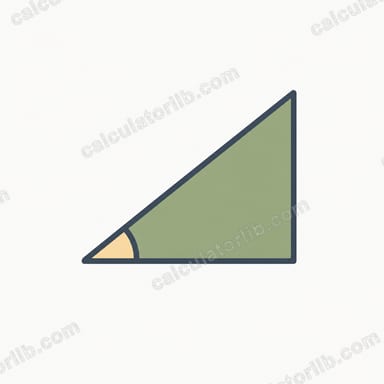
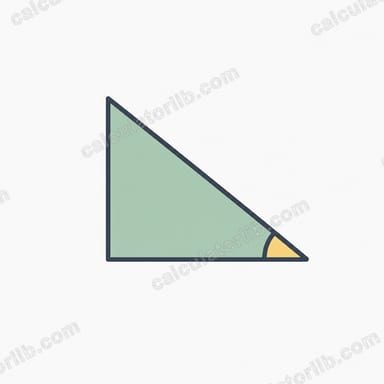
This calculator converts a slope expressed as rise over run into an angle measured in degrees. Rise is the vertical change and run is the horizontal change. The ratio of the two defines the steepness of a line, ramp, roof, road, or staircase — and that steepness can be expressed equally well as an angle. The tool is universal: it works for any units (feet, meters, inches) as long as rise and run use the same units.
How to Use It
Enter the rise (how far it goes up) and the run (how far it goes across). The calculator returns the slope angle in degrees, the equivalent percent grade, and the run-to-rise ratio. For example, a wheelchair ramp limit of 1:12 (one unit of rise per twelve of run) corresponds to about 4.76°.
The Formula Explained
The angle is found with the arctangent function: $$\theta = \arctan\left(\frac{\text{Rise}}{\text{Run}}\right) \times \frac{180}{\pi}$$ Because \(\arctan\) returns radians, we multiply by \(\frac{180}{\pi}\) to convert to degrees. The percent grade is simply \(\frac{\text{Rise}}{\text{Run}} \times 100\). When the run is zero, the slope is vertical, giving a 90° angle.

Worked Example
Suppose a roof rises 4 units for every 12 units of horizontal run. Then \(\frac{\text{rise}}{\text{run}} = \frac{4}{12} = 0.3333\), and \(\arctan(0.3333) = 0.32175 \text{ rad}\). Multiplying by \(\frac{180}{\pi}\) gives 18.43°. The percent grade is \(33.33\%\) and the ratio is \(3 : 1\).

Common Slopes: Ratio, Percent Grade and Angle
The table converts familiar slopes between rise:run, percent grade and angle. Angle is \(\theta = \arctan(\text{rise}/\text{run})\), and percent grade is \(\text{rise}/\text{run} \times 100\). A ratio written 1:n means 1 unit of rise for every n units of run.
| Rise:run | Percent grade | Angle (degrees) |
|---|---|---|
| 1:48 | 2.08% | 1.19° |
| 1:20 | 5% | 2.86° |
| 1:12 | 8.33% | 4.76° |
| 1:8 | 12.5% | 7.13° |
| 1:4 | 25% | 14.04° |
| 1:2 | 50% | 26.57° |
| 10% grade (1:10) | 10% | 5.71° |
| Roof pitch 4/12 | 33.33% | 18.43° |
| Roof pitch 6/12 | 50% | 26.57° |
| Roof pitch 9/12 | 75% | 36.87° |
| Roof pitch 12/12 | 100% | 45° |
Percent grade can exceed 100% for slopes steeper than 45°. A 45° slope has rise equal to run, which is exactly 100%. A slope of 200% rises 2 units per 1 unit of run, or about 63.4°. Angles approach 90° as the grade grows without limit.
Typical Slope Limits and Standards
The figures below come from specific standards, mostly from the United States. Local codes and other countries' rules may differ, so check the code that applies to your project.
- Accessible ramps (2010 ADA Standards for Accessible Design, US): the maximum running slope is 1:12 (8.33%, about 4.76°). The maximum cross slope is 1:48 (about 2.08%, 1.19°). The maximum rise for any single ramp run is 30 in (760 mm).
- Residential stairs (International Residential Code, US, section R311.7): the maximum riser height is 7¾ in and the minimum tread depth is 10 in. That gives \(\arctan(7.75/10) \approx 37.8^\circ\), the steepest stair the basic limits allow.
- Typical stair angles: most comfortable stairs fall roughly between 30° and 37°. Shallower stairs use more floor space, and steeper ones are harder to climb safely.
- Roof pitch: in North American practice, pitch is stated as rise per 12 units of run. A 6/12 roof rises 6 in for every 12 in of horizontal run (26.57°).
- Highways: grades are commonly kept below about 6-8%, depending on terrain and design speed (design guidance such as AASHTO's in the US). Steeper stretches exist and are normally signposted with the percent grade.
These are general reference values, not a substitute for the code adopted by your local authority or advice from a qualified professional.
FAQ
What angle is a 1:1 slope? A rise equal to the run gives \(\arctan(1) = 45°\).
Does the unit matter? No — only the ratio of rise to run matters, so any consistent unit works.
What if the run is 0? The slope is vertical and the angle is 90°.